

Add a heading (2)
Author

Dawn

Browsing

Let’s be real for a moment.

Cleaning your home often feels like a never-ending task. You clean today, and somehow it looks messy again tomorrow. If you’re busy, tired, or just not in the mood, even small chores can feel heavy.

Dishes sit in the sink. Clothes pile up. Dust shows up out of nowhere. And slowly, your home starts feeling stressful instead of relaxing.

That’s exactly why lazy cleaning tips are so useful.

You don’t need to spend hours cleaning every day. You just need simple habits and smart shortcuts that make cleaning easier and faster. These lazy cleaning tips are designed for real life — not perfect homes.

If you’ve been wondering how to clean without putting in too much effort, you’re in the right place.

Lazy Cleaning Tips That Actually Work

Lazy Cleaning Tips That Actually Work

Cleaning doesn’t have to feel hard or confusing. In fact, the smartest lazy cleaning tips are usually the simplest ones.

Instead of trying to clean your entire home in one go, focus on small, easy actions that give quick results. When you break cleaning into simple steps, it stops feeling overwhelming and becomes something you can actually keep up with.

These lazy cleaning tips are not about doing more work. They are about doing the right things in less time. A quick reset here, a small habit there — it all adds up.

If you stay consistent with these simple methods, your home will look cleaner every day without needing hours of effort. This is exactly how to clean your house with minimal effort while still getting real, visible results.

You can read : 7 Easy Steps to Clean the Bathroom Tiles Like a Pro

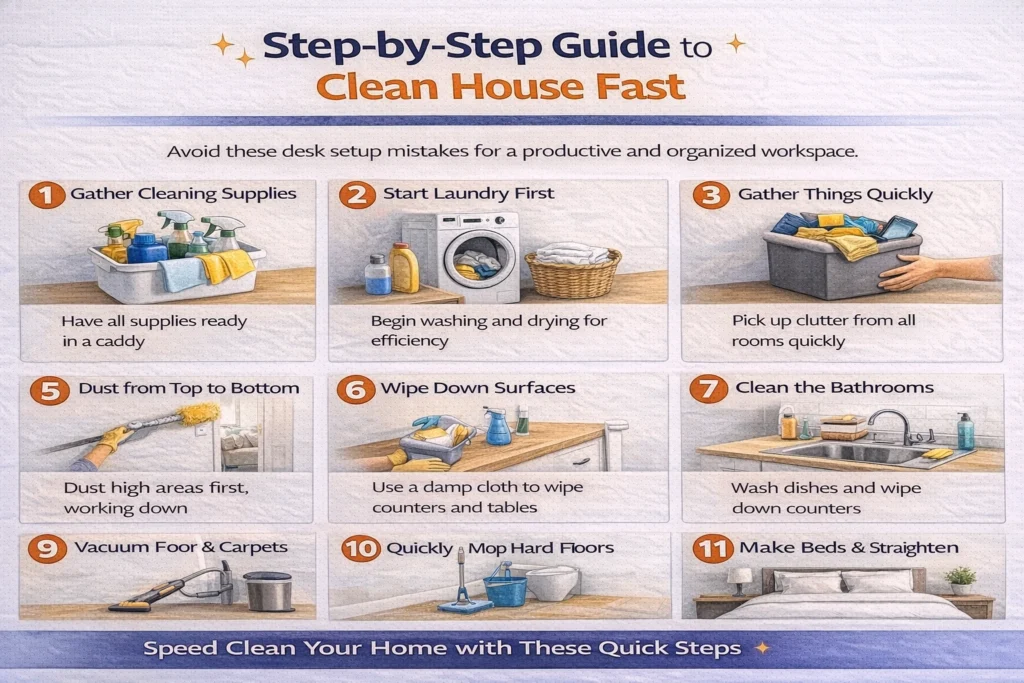
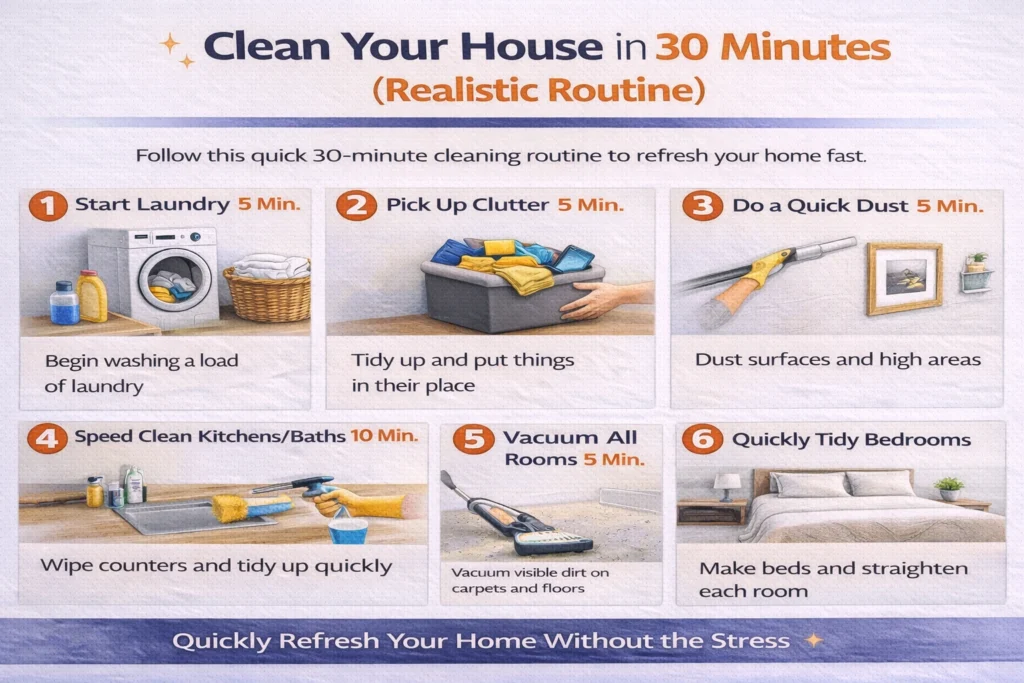
1. Start with a 10-Minute Lazy Cleaning Routine

If cleaning always feels like too much work, start small. A simple 10-Minute Lazy Cleaning Routine can help you stay in control without feeling tired or stressed.

Most people avoid cleaning because it feels like a big job. But when you say, “I’ll clean for just 10 minutes,” it suddenly feels easy to start.

Set a timer and clean only until the time is up. No pressure to do more.

In those 10 minutes, you can:

  • Pick up trash from around the room
  • Put dishes in the sink or dishwasher
  • Throw clothes into a laundry basket
  • Wipe one table or kitchen counter
  • Fix pillows and blankets

That’s enough.

You’re not trying to make everything perfect. You’re just making things a little better.

Why this works:

  • It feels quick and easy
  • You don’t feel overwhelmed
  • You see results right away

After a few days, this starts to feel normal. You won’t need to force yourself anymore.

That’s why this is one of the best lazy cleaning tips for busy people. It’s simple, fast, and actually works.

2. Keep Cleaning Supplies Where You Use Them

Here’s the simple truth.

Cleaning doesn’t feel hard because it’s difficult. It feels hard because it’s not easy to start.

If you have to walk to another room to grab a cleaner, you’ll likely say, “I’ll do it later.” And later usually never happens.

So make it easy.

One of the smartest lazy cleaning tips is to keep your cleaning supplies where you actually use them.

For example:

  • Bathroom: wipes, brush, cleaner under the sink
  • Kitchen: sponge, dish soap, spray near the counter
  • Bedroom: laundry basket and a small trash bin
  • Living room: cloth and a small basket for clutter

Now think about this.

You see a dirty sink. The cleaner is right there. You wipe it in seconds. Done.

No walking. No delay.

That’s the idea.

When your tools are close, cleaning becomes quick and easy. You don’t need to plan anything. You just do it.

You can also clean in small moments:

  • Spill something? Wipe it right away
  • See dust? Clean it in seconds
  • Trash nearby? Throw it instantly

These small actions stop mess from building up.

That’s why this works so well.

It’s one of those lazy cleaning tips that makes cleaning feel simple. You’re not doing more work. You’re just making it easier to start.

And honestly, starting is the hardest part.

3. Use the Basket Trick for Instant Clean Look

Here’s something most people don’t notice.

Your home often looks messy not because it’s dirty, but because of clutter. And clutter makes everything feel worse.

That’s where this trick helps.

Grab a basket or bag and walk around the room. Pick up anything that doesn’t belong there. Don’t think too much. Just move fast.

You can collect things like:

  • Clothes
  • Books
  • Toys
  • Chargers
  • Cups or random items

In just a few minutes, your space will look cleaner.

You’re not deep cleaning. You’re just removing what your eyes see first.

That alone makes a big difference.

Don’t worry about sorting the basket now. You can do that later when you have time.

This works because:

  • It’s quick
  • It’s easy
  • You see results fast

That’s why it’s one of the best lazy cleaning tips. It helps you clean without doing much.

If you feel tired or don’t want to clean, this is one of those lazy cleaning tips that gets the job done fast.

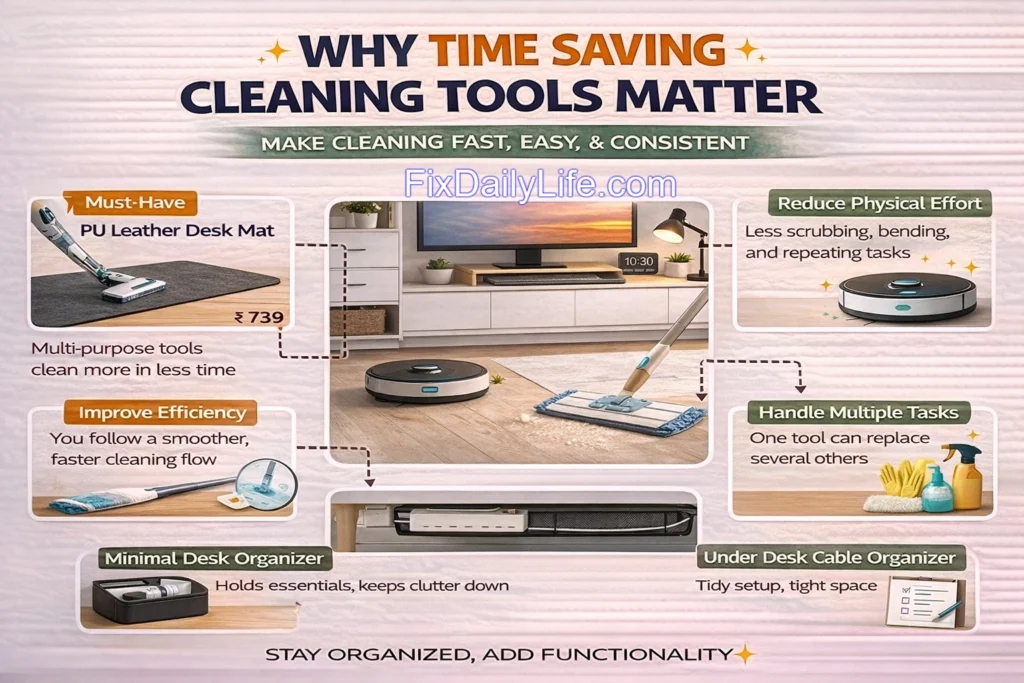
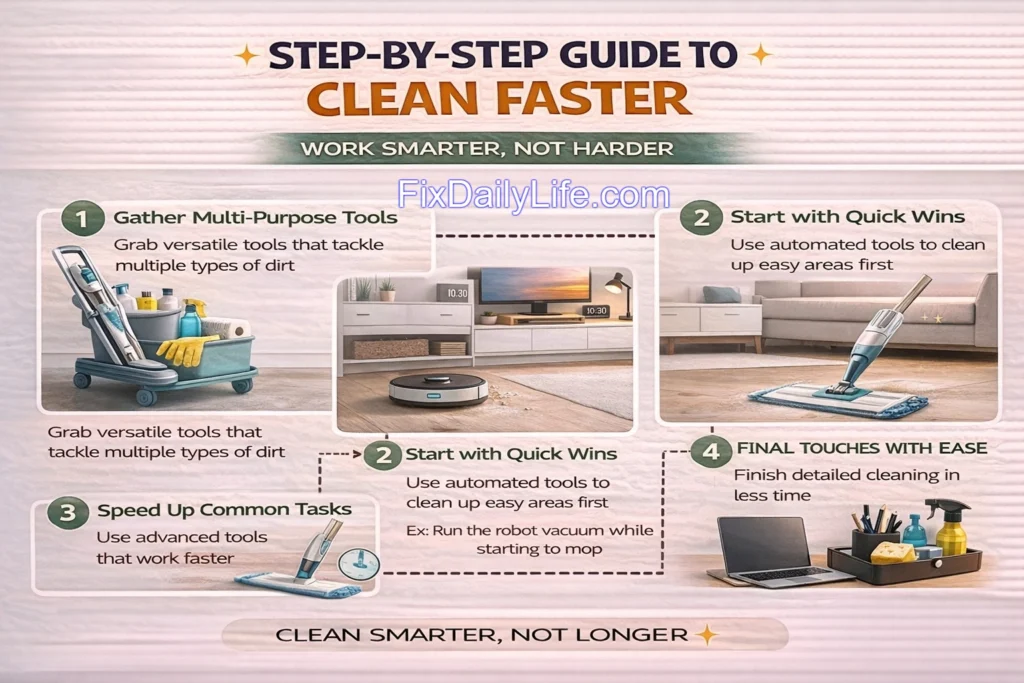
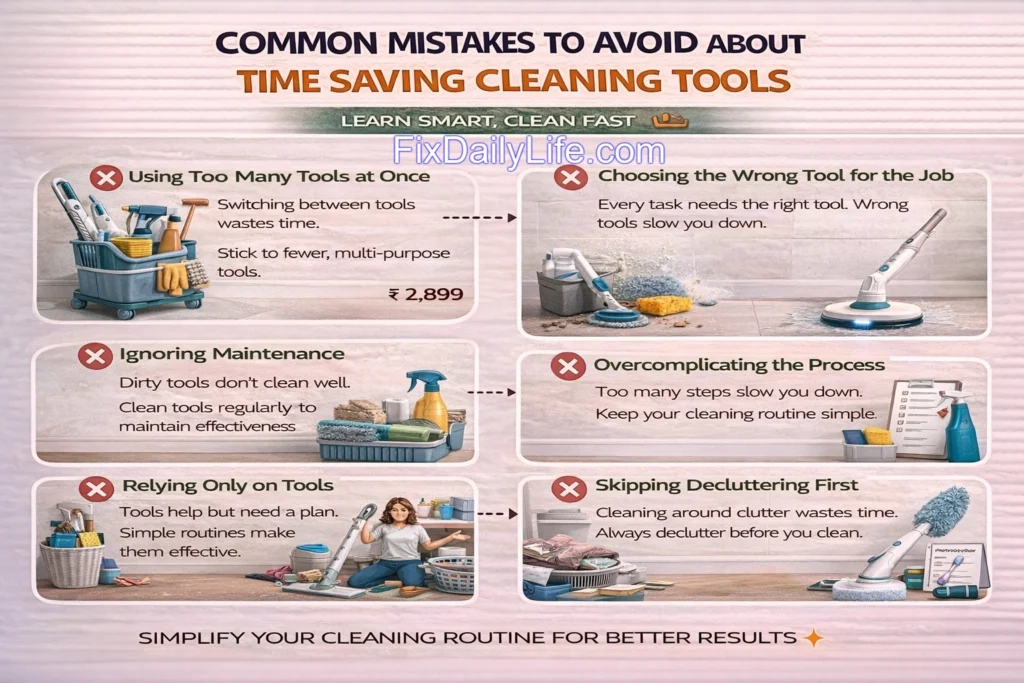
You can read also : 10 Best Time Saving Cleaning Tools That Actually Work

4. Clean What People See First

When you’re low on time, don’t try to clean everything. It feels too big, and you end up doing nothing.

Here’s a better way. Focus on what people can see.

These spots make your home look clean right away:

  • Kitchen counters
  • Dining table
  • Coffee table
  • Bathroom sink
  • Entryway
  • Couch area

You don’t need deep cleaning. Just do quick fixes:

  • Clear the surface
  • Wipe it down
  • Put things back

That’s enough to make a big difference.

This is one of the smartest lazy cleaning tips because you get fast results without much effort. You focus on what matters most, not everything.

It also helps when guests are coming or when you just want a quick reset.

That’s why this is one of the most useful lazy cleaning tips and also one of the best fast house cleaning tips that actually work.

5. Follow the One-Touch Rule

This is one of the easiest lazy cleaning tips you can follow every day.

The rule is simple. When you pick something up, don’t put it down somewhere else. Just finish the job right away.

Most mess happens because we keep moving things instead of putting them back.

For example:

  • Cup → take it to the kitchen
  • Jacket → hang it up
  • Mail → throw it away or keep it properly
  • Shoes → place them near the door

It only takes a few seconds, but it saves you from cleaning later.

If you don’t do this, things start piling up. One small item turns into a messy room before you even notice.

But when you follow this rule, your space stays clean without extra effort.

That’s why it’s one of the most useful lazy cleaning tips. You are not doing more work. You are just stopping the mess early.

After a few days, it becomes a habit. You don’t have to think about it. You just do it.

And that’s what makes it one of the easiest ways to keep your home clean every day.

6. Let Cleaning Products Do the Work

Most people make the same mistake. They spray and start scrubbing right away.

That just makes the job harder.

A better way is simple. Spray the cleaner and wait a few minutes. Let it sit.

This works really well on:

  • Bathroom surfaces
  • Toilets
  • Kitchen counters
  • Greasy stovetops
  • Shower walls

While you wait, the cleaner starts breaking down dirt and grease on its own. So when you come back, you don’t have to scrub hard. A quick wipe is usually enough.

You can even use this trick during your 10-Minute Lazy Cleaning Routine. Spray first, do something else, then come back and wipe.

That way, you save both time and effort.

Here’s why this works so well:

  • You scrub less
  • You finish faster
  • You get better results

It’s one of the smartest lazy cleaning tips because you’re letting the product do part of the work for you.

And honestly, anything that saves effort is always a win.

This is also one of the best Pro Tips to Clean Faster with Less Effort, especially if you don’t like scrubbing.

7. Clean While You Wait

You don’t need extra time to clean. You just need to use the time you already have.

Think about your day. You spend a lot of time just waiting.

Like when:

  • Coffee is brewing
  • Food is heating
  • Water is boiling
  • Laundry is running

Instead of standing or scrolling your phone, do one small thing.

You can:

  • Wipe a counter
  • Put dishes in the sink
  • Throw away trash
  • Pick up a few items

That’s it. Nothing big.

This is one of the easiest lazy cleaning tips because it doesn’t feel like work. You’re not doing a full cleaning. You’re just using free time.

And those small things add up.

After a few days, your home starts looking cleaner without you trying too hard.

That’s how you build a simple low effort cleaning routine without stress.


8. Make Your Bed (The Lazy Way)

This is one of the simplest lazy cleaning tips you can do every day.

Making your bed doesn’t need to be perfect. You don’t have to fix every corner or make it look like a hotel bed. Just doing the basics is enough to make your room look clean.

Keep it easy:

  • Pull the blanket up
  • Adjust the pillows
  • Remove any clothes or items
  • Smooth the top a little

That’s all.

It takes less than two minutes, but it changes how your whole room looks. Even if the rest of the room is not perfect, a made bed makes things feel better.

This works because your bed takes up a big space. When it looks neat, everything else looks cleaner too.

That’s why it’s one of the most useful lazy cleaning tips. You get quick results without doing much work.

If you do this every morning, your room will never feel too messy. And you don’t have to spend extra time cleaning later.

You can read : 15 Powerful Desk Setup Ideas for Minimal Setup

9. Add More Trash Bins

If you keep seeing trash on tables or around the room, it’s not really your fault.

The real problem is simple. There’s no bin nearby.

One of the easiest lazy cleaning tips is to add more small trash bins in your home. When a bin is close, you don’t think. You just use it.

Try putting bins in places like:

  • Bedroom
  • Bathroom
  • Home office
  • Living room

You don’t need big bins. Small ones are enough.

Think about it. If you have a wrapper in your hand and the bin is right there, you’ll throw it away. But if it’s far, you’ll leave it on the table and say, “I’ll do it later.”

And later usually doesn’t happen.

That’s how mess builds up.

This is one of those lazy cleaning tips that makes life easier. You’re not doing extra work. You’re just making it simple to stay clean.

It also helps a lot if you want lazy ways to keep your house clean daily without thinking too much.

Small change. Big difference.


10. Do Smaller Laundry Loads

LLaundry feels hard when it turns into a big pile. When it gets too big, you don’t feel like starting at all.

So keep it small.

Instead of waiting, do laundry in smaller loads. This is one of those lazy cleaning tips that makes life easier without extra effort.

Try this:

  • Keep a basket where you usually drop clothes
  • Wash when it’s half full, not overflowing
  • Fold only clothes that wrinkle
  • Use bins for socks or home clothes

Now laundry feels quick, not heavy.

You don’t need a full day to do it. You just do a little, and it’s done.

That’s why this works so well.

It’s one of the best lazy cleaning tips for busy people because you don’t need to plan anything big. You just keep things under control.

And honestly, that’s the goal.

This is one of those lazy cleaning tips that helps you stay on track without feeling tired or stressed.

You can read also : How to Clean Bathroom Sink Drain Naturally in 5 Simple Steps


11. Rinse Dishes Immediately

Dirty dishes get harder to clean when food dries on them. Then you have to scrub more, and that takes time.

A quick rinse can fix that.

This is one of the simplest lazy cleaning tips you can follow in the kitchen. It takes just a few seconds, but it saves you a lot of effort later.

Even if you don’t wash dishes right away, do this:

  • Rinse plates after using them
  • Fill them with a little water
  • Stack them neatly in the sink

Now when you come back later, cleaning feels much easier.

You don’t have to scrub hard. Most of the dirt comes off quickly.

You can also make things easier by using fewer dishes during the day. One plate, one cup, and one spoon are easier to manage than a full sink.

This small habit is part of a smart low effort cleaning routine. You’re not doing extra work. You’re just making things easier for your future self.

That’s why it’s one of the most useful lazy cleaning tips for keeping your kitchen under control without stress.


12. Keep Floors Clear

Floors can make your whole home look messy, even if everything else is clean.

If things are lying around—shoes, bags, toys—the room feels untidy right away. But when the floor is clear, the space looks better in seconds.

This is one of those simple lazy cleaning tips that gives quick results without much effort.

You don’t need to deep clean. Just stop things from piling up on the floor.

Try this:

  • Keep shoes near the door
  • Use hooks for bags
  • Put toys in bins after use
  • Place baskets where clutter usually collects

When everything has a place, things don’t end up on the floor.

And here’s the bonus—cleaning becomes much faster. Sweeping or vacuuming takes less time because nothing is in the way.

This is also a smart way to follow how to clean your house with minimal effort. You’re not doing more work. You’re just making cleaning easier.

Small habit, big difference.


13. Use Multi-Purpose Cleaners

Too many cleaning products can make things confusing. You stand there thinking, “Which one do I use?” And that slows you down.

Keep it simple. Use one good cleaner for most things.

This is one of those lazy cleaning tips that saves both time and effort.

You can use a multi-purpose cleaner for:

  • Counters
  • Tables
  • Sinks
  • Door handles

Instead of switching between bottles, you just grab one and get the job done.

That makes cleaning faster and easier. No thinking, no guessing.

It also saves space and keeps things less messy.

This is why it works so well. Fewer choices mean you act faster.

That’s also why it’s one of the best cleaning hacks that save time and energy.

And when cleaning feels easy, you’re more likely to actually do it.y.


14. Do a 5-Minute Night Reset

Do a 5-Minute Night Reset

A quick reset before bed can change how your home feels the next day.

You don’t need to clean everything. Just spend five minutes doing a few small things.

This is one of those lazy cleaning tips that feels easy but works really well.

Before you sleep, do this:

  • Clear cups and plates
  • Toss any trash
  • Fix the couch or pillows
  • Wipe one surface like the kitchen counter
  • Put a few things back in place

That’s it. Nothing more.

These small steps stop mess from building up overnight. So when you wake up, your home already feels better.

You don’t start your day with clutter, and that makes a big difference.

This is why it’s one of the most useful lazy cleaning tips for daily life. You’re not doing a deep clean. You’re just keeping things under control.

It’s a simple habit, but it helps you maintain a clean home without extra effort.


15. Clean One Surface at a Time

When your home looks messy, it’s easy to feel stuck. You look around and don’t even know where to start.

So don’t start with everything. Just pick one spot.

This is one of the simplest lazy cleaning tips you can follow when you feel overwhelmed.

Start small:

  • One table
  • One counter
  • One desk

Clean that one surface fully. Wipe it, clear it, and make it look neat.

Then stop if you want. No pressure to keep going.

The best part? You’ll see results right away. One clean surface can make the whole room feel better.

And once you start, you might even feel like doing one more.

That’s how this works.

It’s one of those lazy cleaning tips that helps you get started without feeling stressed. You don’t need energy for the whole house. Just one small step.

And most days, that’s more than enough..


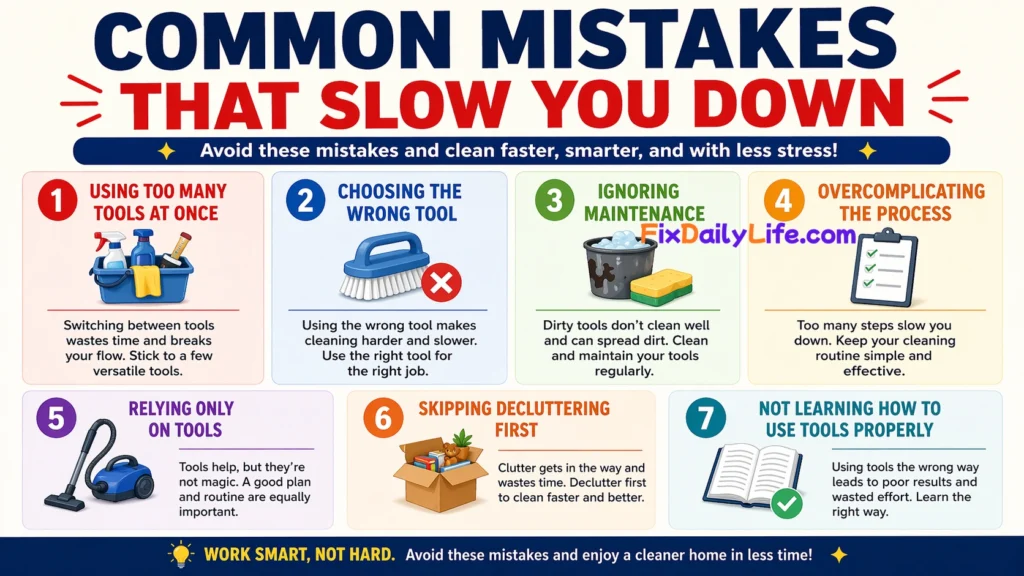
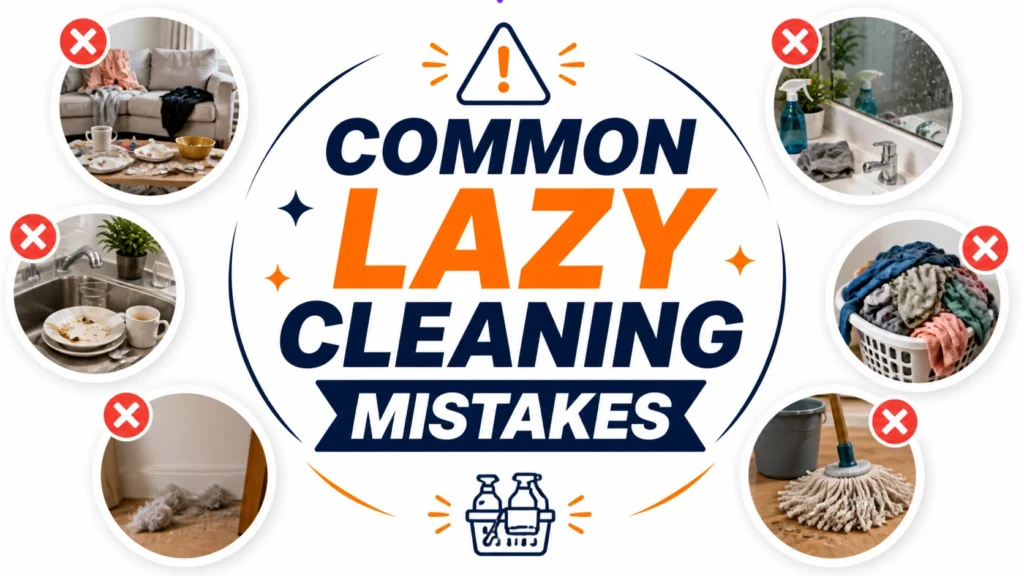
16. Common Lazy Cleaning Mistakes
Common Lazy Cleaning Mistakes

Even when you’re trying to keep things simple, a few small habits can slow you down.

That’s why it’s important to notice these Common Lazy Cleaning Mistakes and avoid them early. It will save you time and effort later.

Here are some common mistakes people make:

  • Waiting too long to clean
  • Moving clutter instead of putting it away
  • Trying to make everything perfect
  • Ignoring small messes
  • Using too many cleaning products

These might seem small, but they add up fast.

For example, when you wait too long, the mess gets bigger and harder to deal with. When you keep moving clutter around, it never really goes away.

And trying to be perfect? That just makes cleaning feel harder than it needs to be.

The truth is, lazy cleaning tips work best when you keep things simple. You don’t need to do everything. You just need to do enough.

Stick to easy habits. Fix small messes early. Don’t overthink it.

That’s how lazy cleaning tips actually save your time and energy.sistent.


17. Build a Low Effort Cleaning Routine

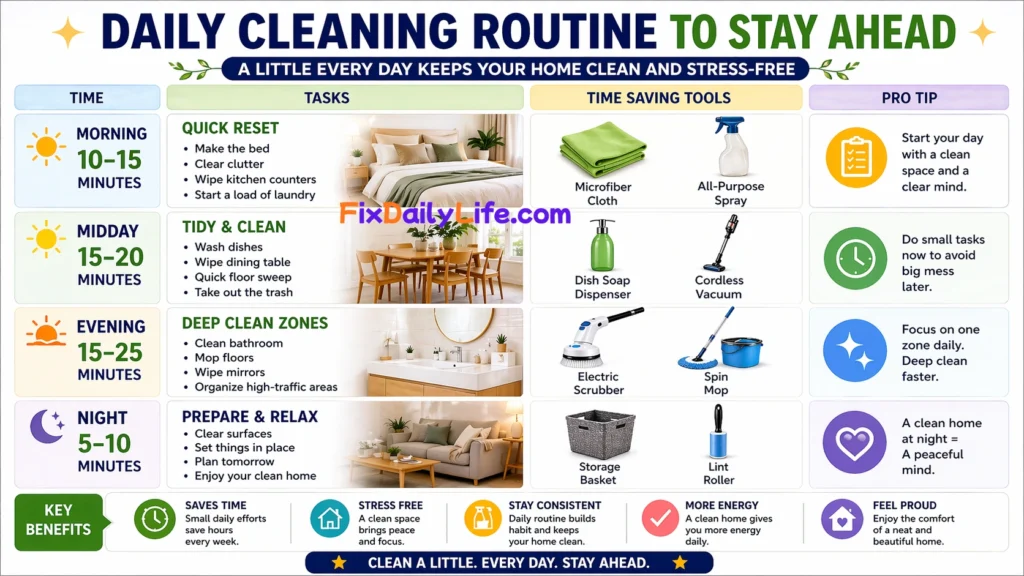
A good routine should feel easy, not stressful. If it feels too hard, you won’t stick with it.

That’s why simple routines work best.

This is one of those lazy cleaning tips that helps you stay on track without doing too much at once. You’re not cleaning all day. You’re just doing small things at the right time.

Here’s a simple plan you can follow:

Daily:

  • Make your bed
  • Do a quick 5-minute reset
  • Rinse dishes after use
  • Throw away trash

Few times a week:

  • Vacuum busy areas
  • Do one load of laundry
  • Clean the bathroom sink

Weekly:

  • Mop floors
  • Clean the toilet
  • Change bed sheets

You don’t have to follow this perfectly. Just do what you can.

The goal is to keep things under control, not make everything perfect.

This kind of routine works well because it breaks cleaning into small steps. Nothing feels too big or tiring.

That’s why it’s one of the most practical lazy cleaning tips for everyday life. It fits into your day without taking too much time or energy.


Conclusion

At the end of the day, you don’t need a perfect home.

You just need a space that feels clean, calm, and easy to live in.

That’s what these lazy cleaning tips are all about. They help you stay on track without feeling tired or stressed.

Start small. Don’t try to do everything at once.

Pick one or two habits:

  • Do a quick 10-minute clean
  • Rinse dishes
  • Clear one surface

That’s enough to begin.

The more you repeat these small actions, the easier they get. And over time, your home stays clean without extra effort.

That’s the real goal.

These lazy cleaning tips work because they fit into real life. You don’t need a strict routine or hours of cleaning. You just need simple habits you can follow every day.

And honestly, that’s what makes them work so well.
Water is draining slowly. A bad smell is coming from the sink. Sometimes, the water just sits there and doesn’t go down. This happens to almost everyone.

Most people ignore it at first. Then one day, it gets worse. The water drains slower. The smell gets stronger. Suddenly, your simple morning routine turns into a headache.

The good news? You don’t need a plumber for most cases.

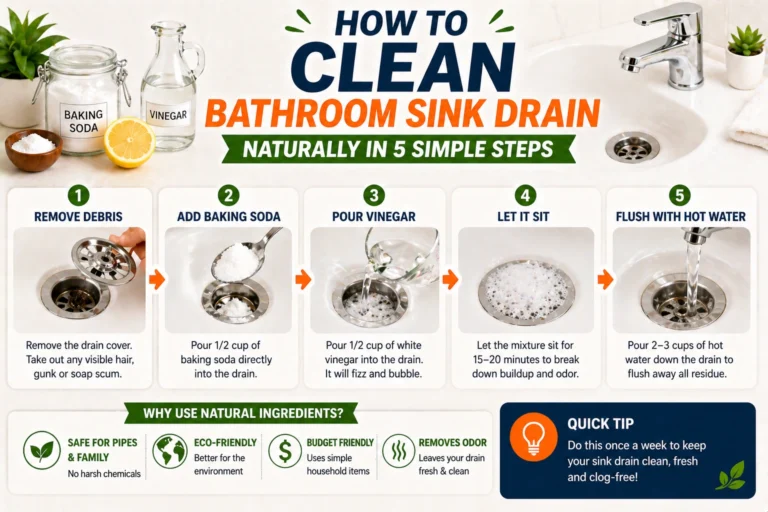
In this guide, you’ll learn how to clean bathroom sink drain step by step using simple methods. We’ll also show you how to fix slow draining bathroom sink, remove hair, and clean sink drain naturally without harsh chemicals.

Let’s get your sink back to normal.

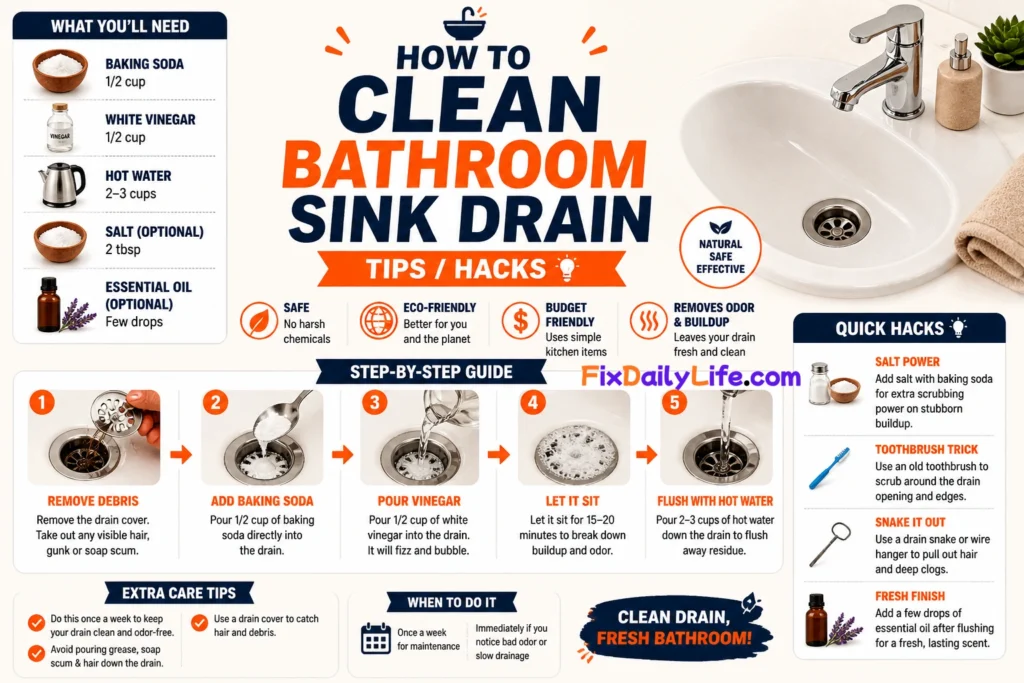
How to Clean Bathroom Sink Drain (Step-by-Step Guide)

Cleaning your sink drain is easier than it sounds. You just need a clear process. Once you understand the steps, learning how to clean bathroom sink drain becomes simple and stress-free. You don’t need special skills or expensive tools—just a few common items and a little time.

First, it helps to know why your sink gets clogged. Hair, soap residue, and toothpaste slowly build up inside the pipe. Over time, this buildup can block water flow and create bad smells. That’s when you need to clean sink drain naturally and take action before the problem gets worse.

The good part? You can fix most issues at home. Whether your sink is draining slowly or starting to smell, these steps will help you fix slow draining bathroom sink problems quickly. Even beginners can follow this guide without confusion.

Next, we’ll walk through each step in detail so you can safely and effectively clean your drain and keep it working like new.

You can also read : 15 Time Saving Cool Kitchen Gadgets for Busy People

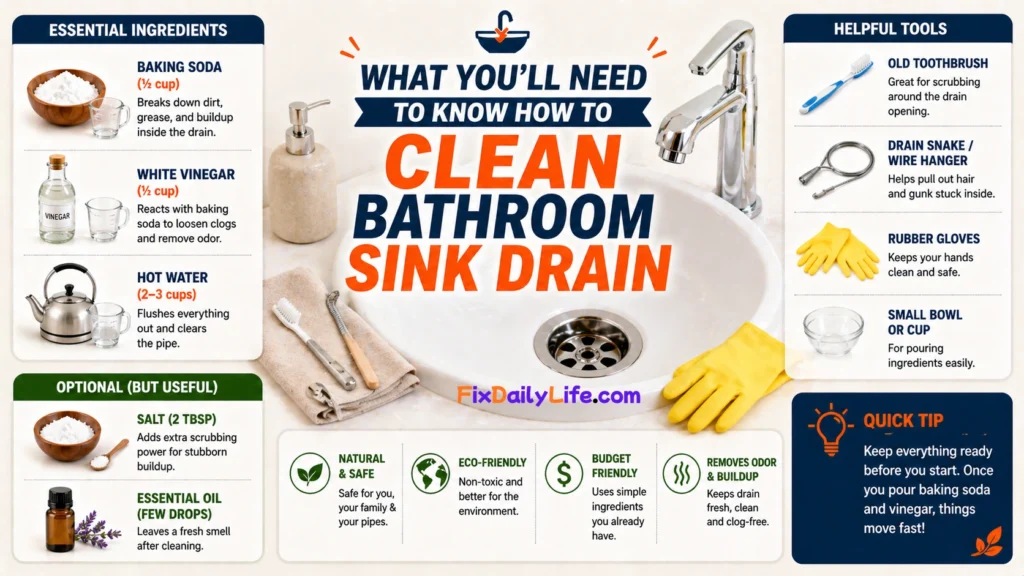
What You’ll Need to know How to Clean Bathroom Sink Drain

What You’ll Need to know How to Clean Bathroom Sink Drain

Before you start, gather a few simple items. These everyday tools make it much easier to how to clean bathroom sink drain without stress. You don’t need anything fancy—just basic supplies that help you clean sink drain naturally and safely.

Here’s what you’ll need:

  • Baking soda – Helps break down buildup and is great to clean sink drain naturally without harsh chemicals
  • White vinegar – Reacts with baking soda to loosen dirt and clear the drain
  • Boiling water – Flushes out grease, soap, and small clogs
  • Gloves – Keeps your hands clean while removing hair and debris
  • Drain snake or wire tool – Very useful to remove hair and fix slow draining bathroom sink issues
  • Old toothbrush – Helps scrub the stopper and small parts easily

Essential Ingredients

  • Baking Soda (½ cup)
    Breaks down dirt, grease, and buildup inside the drain.
  • White Vinegar (½ cup)
    Reacts with baking soda to loosen clogs and remove odor.
  • Hot Water (2–3 cups)
    Flushes everything out and clears the pipe.

Helpful Tools

  • Old Toothbrush
    Great for scrubbing around the drain opening.
  • Drain Snake / Wire Hanger
    Helps pull out hair and gunk stuck inside.
  • Rubber Gloves
    Keeps your hands clean and safe.
  • Small Bowl or Cup
    For pouring ingredients easily.

Optional (But Useful)

  • Salt (2 tbsp)
    Adds extra scrubbing power for stubborn buildup.
  • Essential Oil (few drops)
    Leaves a fresh smell after cleaning.

First, make sure everything is within reach before you begin. This saves time and keeps the process smooth. Next, once your tools are ready, you can move on to the actual steps to how to clean bathroom sink drain and handle even stubborn clogs with ease.

You can Read : 7 Easy Steps to Clean the Bathroom Tiles Like a Pro

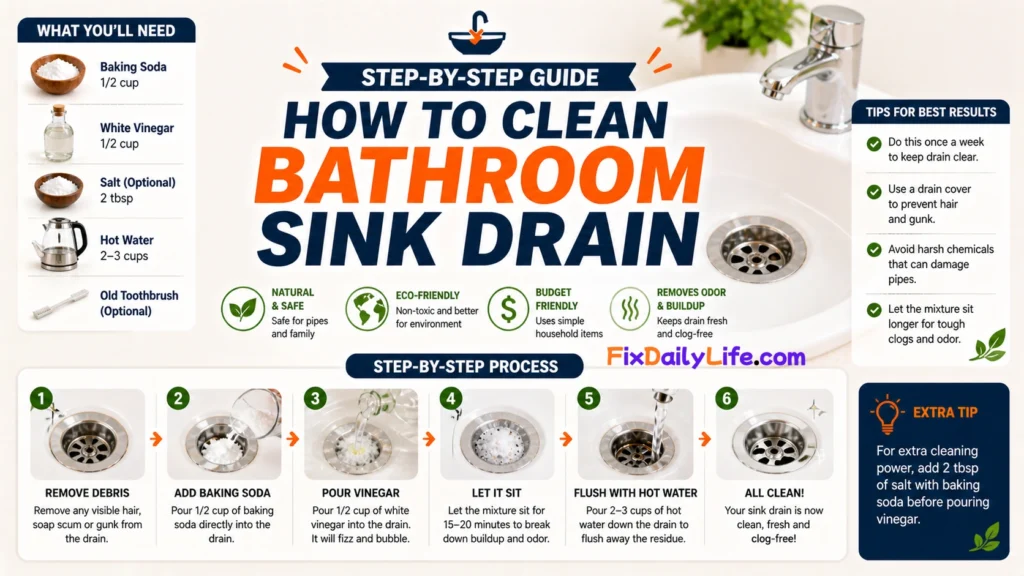
Step-by-Step Guide How to Clean Bathroom Sink Drain

Step-by-Step Guide How to Clean Bathroom Sink Drain

Step 1: Remove the Sink Stopper and Check for Blockage

First things first—take out the stopper.

Most clogs happen right here. Hair, soap, and sticky buildup slowly collect and block the water flow. If you really want to how to clean bathroom sink drain the right way, you have to start from the top. This is also the first step to fix slow draining bathroom sink problems before they get worse.

First, pull the stopper out slowly and carefully. You might notice hair wrapped around it or stuck inside the drain opening. Don’t worry—this is very common in almost every home. This buildup is one of the main reasons you need to clean sink drain naturally and regularly.

Next, use your hands (with gloves) or a tissue to remove the hair and debris. Try to pull out as much as you can. Even a small amount can block water flow and cause slow drainage. This simple step alone can sometimes fix slow draining bathroom sink issues instantly.

Finally, rinse the stopper under warm water and scrub it with an old toothbrush if needed. Keeping this part clean makes a big difference when you’re learning how to clean bathroom sink drain properly and keep it working smoothly.

This step alone can sometimes fix slow draining bathroom sink issues instantly.

Also, check inside the drain opening. If you see visible buildup, remove it gently. This helps clean sink drain naturally before using any solution.

Step 2: Flush with Hot Water

Next, boil water.

Next, boil a pot of water. This is one of the simplest steps, but it plays a big role when learning how to clean bathroom sink drain the right way. Hot water works by softening and breaking down soap scum, grease, and light buildup inside the pipe. It’s also one of the safest ways to clean sink drain naturally without using any chemicals.

Now, carefully pour the hot water down the drain—but don’t dump it all at once. Go slowly and in stages so it works better.

  • Pour a small amount
  • Wait a few seconds
  • Pour again

This step-by-step pouring helps loosen the buildup and push it further down the pipe. As a result, it improves water flow and supports your effort to fix slow draining bathroom sink problems early.

If your sink was draining slowly before, you might already notice a difference after this step. Sometimes, this alone can clear minor clogs and make your sink work smoothly again. That’s why it’s an important part of how to clean bathroom sink drain effectively.

Tip: Don’t skip this step. It prepares the drain for deeper cleaning in the next steps and makes other methods like baking soda and vinegar work even better.

Step 3: Use Baking Soda and Vinegar

Now comes the powerful combo. This is one of the most effective ways to how to clean bathroom sink drain without using harsh chemicals. If you’re thinking about how to clean sink drain with baking soda and vinegar, this is exactly the step you need.

First, make sure the drain is clear of visible debris. Then follow these simple steps:

  • Pour ½ cup baking soda into the drain
  • Next, add 1 cup white vinegar
  • Let it fizz and sit for 10–15 minutes

You’ll hear a bubbling sound—that’s normal. This reaction helps break down soap scum, grease, and hidden dirt inside the pipe. It’s one of the safest ways to clean sink drain naturally while also helping to fix slow draining bathroom sink issues.

After waiting, flush the drain with hot water again. This helps wash away everything that was loosened.

This step helps to:

  • Remove buildup inside the drain
  • Reduce bad smells
  • Improve water flow

It’s simple, low-cost, and works really well for regular maintenance. If you follow this method often, you’ll find it much easier to how to clean bathroom sink drain and keep it clog-free for longer.

Step 4: Remove Hair from Sink Drain Easily

Hair is the biggest enemy of your drain. Over time, it mixes with soap and forms a sticky clog that blocks water flow. If you really want to how to clean bathroom sink drain properly, you have to deal with the hair buildup. This is also one of the main steps to fix slow draining bathroom sink issues for good.

To how to remove hair from sink drain easily, you don’t need anything complicated. Just use a simple tool that can reach inside the drain.

Use one of these:

  • Drain snake
  • Plastic hair remover tool
  • Bent wire hanger

First, insert the tool slowly into the drain. Then pull it out gently. You’ll likely see clumps of hair and gunk attached to it. It may not look nice, but it works really well when you want to clean sink drain naturally and clear blockages.

Repeat this process a few times until you stop pulling out debris. This ensures the drain is clear and helps water flow smoothly again. It’s a simple but powerful way to support your effort to how to clean bathroom sink drain without using chemicals.

Finally, rinse the drain with hot water. This helps wash away any leftover dirt and improves the result even more.

Step 5: How to Clean Bathroom Sink Drain Pipe ?

If nothing worked fully, go deeper. Sometimes the clog sits inside the pipe, not near the top. That’s when you need to learn how to clean bathroom sink drain pipe under sink. This step is very effective if you still can’t fix slow draining bathroom sink after basic cleaning.

First, look under your sink and find the curved pipe (called the P-trap). This part often holds trapped debris like hair, soap, and dirt. Place a bucket under it to catch any dirty water before you start. This keeps things clean and avoids a mess while you clean sink drain naturally.

Now follow these steps carefully:

  • Unscrew the pipe slowly (by hand or with a wrench if needed)
  • Let the water drain into the bucket
  • Remove any trapped debris inside the pipe
  • Wash the pipe with clean water
  • Reattach it tightly

Take your time while doing this. Make sure everything is fitted back properly to avoid leaks. This step helps remove deep clogs that other methods can’t reach when learning how to clean bathroom sink drain.

Finally, run hot water through the sink to test it. In most cases, this will fully restore smooth flow and completely fix slow draining bathroom sink problems.

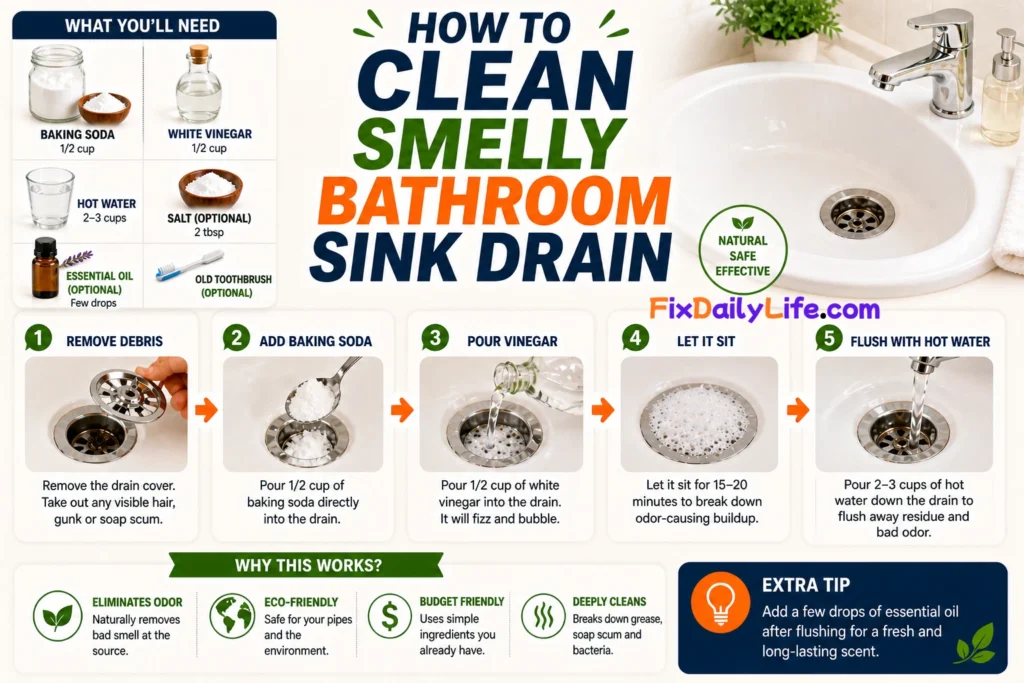
How to Clean Smelly Bathroom Sink Drain

How to Clean Smelly Bathroom Sink Drain

Bad smell coming from your sink? That usually means bacteria, soap buildup, and trapped dirt are sitting inside the pipe. If you ignore it, the smell can get worse over time. So, if you want to how to clean bathroom sink drain properly, you also need to deal with the odor.

To how to clean smelly bathroom sink drain, you can use simple and safe methods at home. These options help you clean sink drain naturally while also improving hygiene.

Try these:

  • Baking soda + vinegar
  • Lemon juice + hot water
  • Enzyme cleaner (for deeper cleaning)

First, pour your chosen solution into the drain. Then let it sit for 15–20 minutes. This gives it enough time to break down odor-causing bacteria and buildup. After that, flush with hot water to clear everything out.

This method helps to:

  • Remove bad odor from the drain
  • Kill bacteria causing the smell
  • Freshen your sink naturally

If your sink still smells after cleaning, repeat the process once or twice. Regular use of these methods makes it easier to fix slow draining bathroom sink issues and keep your drain clean and fresh for longer.

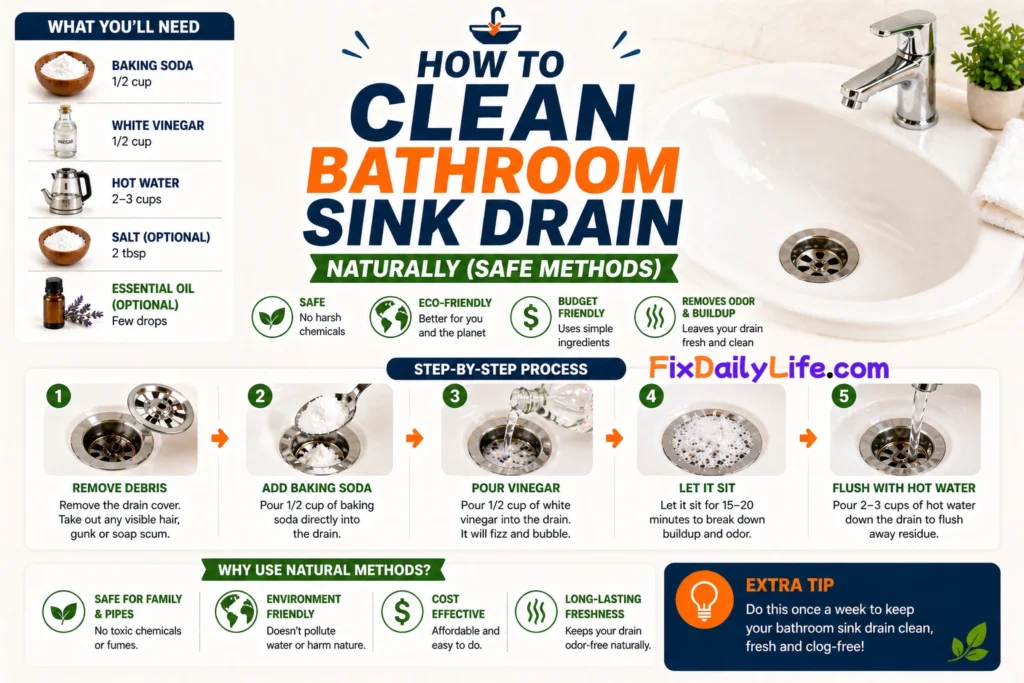
How to Clean Bathroom Sink Drain Naturally (Safe Methods)

How to Clean Bathroom Sink Drain Naturally Safe Method

If you prefer chemical-free options, you’re not alone. Many people now choose safer ways to clean sink drain naturally without using harsh cleaners. These methods are simple, affordable, and still very effective when learning how to clean bathroom sink drain at home.

To clean sink drain naturally, you can use everyday ingredients that break down buildup and keep your drain fresh:

  • Baking soda + vinegar – Loosens dirt and clears light clogs
  • Salt + hot water – Helps scrub and flush out grease inside the pipe
  • Lemon juice – Removes odor and leaves a fresh smell

First, pick one method and apply it slowly into the drain. Then, let it sit for a few minutes so it can work properly. After that, flush with hot water to wash everything away. These simple steps not only help you clean sink drain naturally, but also support efforts to fix slow draining bathroom sink issues early.

These methods are:

  • Safe for regular use
  • Eco-friendly and non-toxic
  • Easy to repeat weekly

If you follow this routine, you’ll find it much easier to how to clean bathroom sink drain and prevent clogs before they become a bigger problem.gs.

How to Clean Bathroom Sink Drain Tips / Hacks

How to Clean Bathroom Sink Drain Tips Hacks

Keeping your sink clean doesn’t take much effort. A few small habits can make a big difference over time. If you follow these tips, it becomes much easier to how to clean bathroom sink drain and avoid major clogs. It also helps you clean sink drain naturally without needing strong chemicals again and again.

Here are some simple habits you should follow:

  • Run hot water weekly – This helps break down soap and keeps the flow smooth
  • Use a drain cover – Stops hair from going inside and blocking the pipe
  • Clean the stopper regularly – Removes buildup before it becomes a problem
  • Avoid dumping hair into the sink – Even small strands can cause clogs over time
  • Do monthly deep cleaning – Use baking soda and vinegar to keep things clear

First, try to make these steps part of your routine. Next, stay consistent—this is the key to preventing issues. These habits not only help you clean sink drain naturally, but also reduce the chances of needing to fix slow draining bathroom sink later.

In the end, small habits prevent big problems.

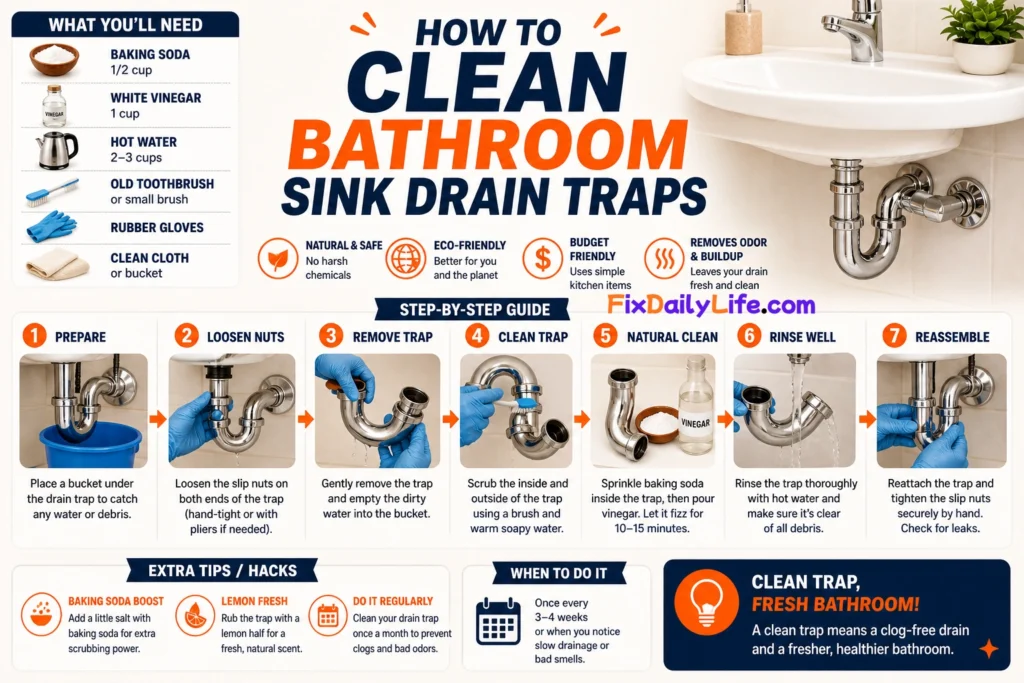
How to Clean Bathroom Sink Drain Traps

How to Clean Bathroom Sink Drain Traps

Cleaning the drain trap is an important step if basic methods don’t fully solve the problem. The drain trap (also called the P-trap) is where hair, soap, and debris often get stuck. If you want to properly how to clean bathroom sink drain, you need to check this part, especially when you’re trying to fix slow draining bathroom sink issues that keep coming back.

First, place a bucket under the pipe to catch dirty water. Then slowly unscrew the trap and remove any buildup inside. You may find hair, sludge, or small debris blocking the flow. Clean it thoroughly with water and a brush, then reattach it tightly. This process not only helps you clean sink drain naturally, but also improves water flow and removes hidden clogs when learning how to clean bathroom sink drain the right way.

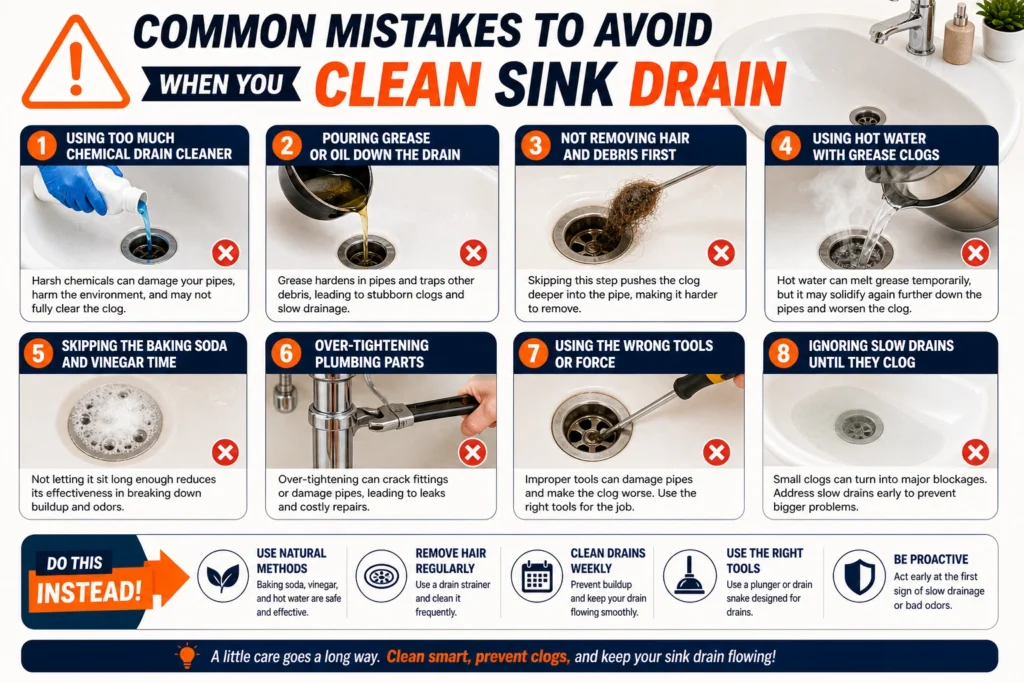
Common Mistakes to Avoid When You Clean Sink Drain

Common Mistakes to Avoid When You Clean Sink Drain

When you’re trying to how to clean bathroom sink drain, small mistakes can make the problem worse instead of better. Many people try quick fixes, but end up damaging the drain or missing the real issue. If you want to clean sink drain naturally and get long-term results, it’s important to avoid these common errors.

Here are the mistakes you should watch out for:

  • Using too many chemicals – Strong cleaners can damage pipes and don’t always fix the clog
  • Ignoring slow drainage – A slow sink is an early warning sign. If you delay, it becomes harder to fix slow draining bathroom sink later
  • Not removing the stopper – Most clogs sit right under it, so skipping this step leaves the blockage untouched
  • Pouring grease in the sink – Grease hardens inside the pipe and causes stubborn clogs
  • Skipping regular cleaning – Without routine care, buildup keeps growing over time

First, try to notice problems early. Next, use simple and safe methods before the clog becomes serious. This approach helps you clean sink drain naturally and avoid bigger repairs.

In short, avoiding these mistakes makes it much easier to how to clean bathroom sink drain properly and keep your sink working smoothly for a long time.


Pro Tips for Clean Sink Drain

Pro Tips for Clean Sink Drain

If you want better results, a few smart tricks can make a big difference. These simple tips help you how to clean bathroom sink drain more effectively and keep it working smoothly for longer. They also make it easier to clean sink drain naturally without repeating the same problem again.

Here are some practical tips you can follow:

  • Use boiling water, not just warm – Hotter water breaks down grease and soap much faster
  • Let cleaning solutions sit longer – Give baking soda and vinegar time to work deeply inside the pipe
  • Clean weekly, not monthly – Regular care prevents buildup and helps avoid the need to fix slow draining bathroom sink
  • Use tools, not just liquids – A drain snake or wire can remove hair that liquids can’t dissolve
  • Check the pipe if the problem continues – Sometimes the clog is deeper, so you may need to clean the pipe under the sink

First, apply these tips during your regular cleaning routine. Next, stay consistent—this is what really keeps your drain clear. When you follow these steps, it becomes much easier to clean sink drain naturally and avoid major blockages.

In the end, consistency is key.


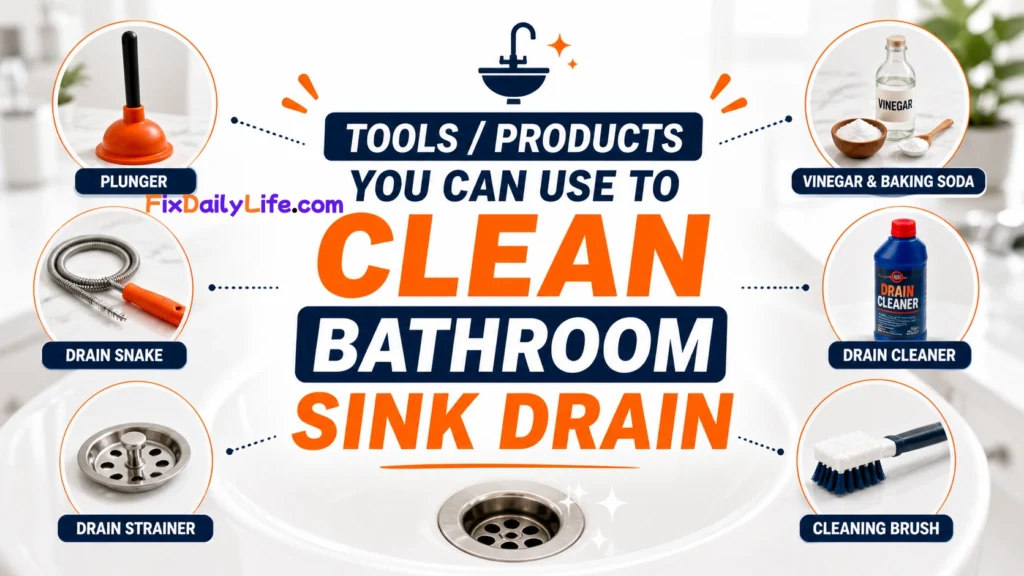
Tools / Products You Can Use to Clean Bathroom Sink Drain

Tools Products You Can Use to Clean Bathroom Sink Drain

Using the right tools makes a big difference when learning how to clean bathroom sink drain properly. These simple items help you clean sink drain naturally and also make it easier to fix slow draining bathroom sink problems without much effort.

Drain Snake – This tool is perfect for reaching deep inside the pipe where clogs usually hide. It can easily pull out hair, soap buildup, and other debris that block water flow. If you’re trying to fix slow draining bathroom sink, this is one of the most effective tools you can use. It works much better than just pouring liquid cleaners.

Baking Soda – Baking soda is a safe and natural cleaner that helps break down dirt inside the drain. It’s great if you want to clean sink drain naturally without using strong chemicals. When used regularly, it also helps prevent bad smells and buildup. This makes it a key part of how to clean bathroom sink drain at home.

Vinegar – Vinegar works best when combined with baking soda. It creates a fizzing reaction that helps loosen grease and stuck particles inside the pipe. This method is simple, low-cost, and very effective to clean sink drain naturally. It also helps in reducing odor and improving water flow.

Drain Cover – A drain cover is a simple tool, but it prevents a lot of problems. It stops hair and debris from going into the drain, which is the main cause of clogs. Using it regularly can reduce the need to fix slow draining bathroom sink later. It’s one of the easiest ways to keep your drain clean.

Plunger – A plunger is useful for quick fixes when water is not draining properly. It creates pressure that helps push clogs down and restore flow. While it may not remove all buildup, it’s a fast way to fix slow draining bathroom sink issues. It’s especially helpful for minor blockages.

Pipe Brush – This tool is great for deep cleaning inside the pipe. It helps scrub away dirt and buildup that stick to the pipe walls. If you want a more thorough clean, this is very useful for how to clean bathroom sink drain properly. It works well along with natural cleaning methods.

First, choose the right tool based on your problem. For example, use a drain snake for hair and baking soda for regular cleaning. Next, combine tools and natural methods to get better results. This approach helps you clean sink drain naturally while also making it easier to how to clean bathroom sink drain step by step.

In the end, these tools save time and make the whole process much easier.


Conclusion

Cleaning your sink doesn’t have to be hard. Once you understand the basics, the whole process becomes simple and manageable. You don’t need special skills—just the right steps and a little consistency.

Now you know exactly how to clean bathroom sink drain using simple, practical methods. You can clean sink drain naturally, remove hair buildup, and fix slow draining bathroom sink problems without stress. These small actions can save you from bigger issues later.

First, start with basic cleaning like hot water and baking soda. Next, if the problem continues, go deeper by removing hair or cleaning the pipe. Step by step, you’ll see real improvement.

Don’t wait until the drain gets fully blocked. Take action today, follow these methods regularly, and keep your sink running smoothly. Your future self will definitely thank you.


FAQs

1. How to clean bathroom sink drain at home?

Use baking soda, vinegar, and hot water. Remove hair and debris first.

2. How to clean sink drain naturally?

Use baking soda + vinegar or lemon + hot water.

3. How to fix slow draining bathroom sink?

Remove hair, flush hot water, and clean pipe if needed.

4. How to remove hair from sink drain easily?

Use a drain snake or wire tool to pull it out.

5. How to clean bathroom sink drain pipe under sink?

Open the P-trap, clean debris, and reattach.

6. Why does my bathroom sink smell bad?

Bacteria and trapped debris cause odor.

7. How often should I clean my sink drain?

Once a week for best results.

8. How to clean a slow draining bathroom sink without chemicals?

You can clean sink drain naturally using baking soda and vinegar followed by hot water. This method helps fix slow draining bathroom sink issues without using harsh chemicals.

9. What is the best way to clean smelly bathroom sink drain fast?

You can clean sink drain naturally using baking soda and vinegar followed by hot water. This method helps fix slow draining bathroom sink issues without using harsh chemicals.

Cooking sounds fun… until you’re stuck chopping vegetables forever or dealing with a messy kitchen.

We’ve all been there. You start with energy, but halfway through, it feels like a chore. Too much effort. Too much time. And honestly, too much cleanup.

That’s exactly where cool kitchen gadgets come in.

The right tools can completely change how you cook. They help you save time, reduce effort, and make everyday cooking feel smooth again. Whether you’re a beginner or someone who cooks daily, using cool kitchen gadgets can make things faster, easier, and way more enjoyable.

In this guide, you’ll discover gadgets that actually work—no gimmicks. Just practical tools that make a real difference.


Why Cool Kitchen Gadgets Are Worth It

Why Cool Kitchen Gadgets Are Worth It

Let’s keep it simple—good tools make life easier. And in the kitchen, the right tools can change everything.

Using cool kitchen gadgets isn’t about showing off or filling your drawers with random stuff. Instead, it’s about working smarter, not harder. When you bring in the right cool kitchen gadgets, even simple tasks like chopping, mixing, or measuring become faster and smoother. As a result, cooking feels less stressful and a lot more enjoyable.

First of all, many time saving kitchen gadgets for busy people are designed to cut your prep time in half. Think about it—what used to take 20 minutes can often be done in 5. That’s a big win, especially on busy weekdays.

Next, these cool kitchen gadgets help reduce effort. No more struggling with tight jar lids or spending extra time chopping vegetables by hand. With the right tools, even repetitive tasks feel easy and quick. This is why many home cooks rely on useful kitchen gadgets for everyday cooking to make their routine smoother.

Another big benefit is organization. If you have a small kitchen, you know how important space is. Many cool kitchen gadgets are compact and smartly designed, making them perfect for tight spaces. In fact, several time saving kitchen gadgets for busy people also double as storage-friendly tools.

Also, if you’re just starting out, these tools are a huge help. You don’t need advanced skills when you have the right support. Many useful kitchen gadgets for everyday cooking are beginner-friendly, so you can cook with confidence without feeling overwhelmed.

Finally, consistency becomes much easier. When cooking feels simple and fast, you’re more likely to do it regularly. That’s the real power of cool kitchen gadgets—they turn cooking from a chore into something you actually enjoy doing.

In the end, investing in the right cool kitchen gadgets is not about spending more money. It’s about saving time, reducing effort, and making your everyday cooking experience better Cooking help you stay consistent. You’ll cook more often because it feels easier.

10 Best Time Saving Cleaning Tools That Actually Work


15 Cool Kitchen Gadgets That Actually Work

15 Cool Kitchen Gadgets That Actually Work

If you’re tired of slow prep work and messy cooking, these cool kitchen gadgets can make a real difference. Each one is designed to save time, reduce effort, and make everyday cooking easier. Let’s go through them one by one.


1. Vegetable Chopper

A must-have cool kitchen gadget if you hate chopping vegetables. With this tool, you can dice onions, tomatoes, and other veggies in seconds. It saves time and keeps your cuts even, which also helps food cook properly. Many time saving kitchen gadgets for busy people like this one are perfect for daily cooking.


2. Electric Jar Opener

Struggling with tight lids can be frustrating. This cool kitchen gadget solves that instantly. Just place it on the jar, press a button, and it opens automatically. It’s especially helpful for seniors or anyone with weak grip strength. Truly an innovative kitchen gadget for home cooks.


3. Oil Sprayer Bottle

If you want to cook healthier meals, this cool kitchen gadget is a great choice. It lets you control how much oil you use. You get an even spray, which is perfect for frying, grilling, or baking. It’s one of those useful kitchen gadgets for everyday cooking that you’ll use almost daily.


4. Digital Kitchen Scale

Accuracy matters, especially in baking. This cool kitchen gadget helps you measure ingredients perfectly every time. It’s also useful for portion control if you’re tracking your diet. Many time saving kitchen gadgets for busy people include digital scales because they reduce guesswork.


5. Clip-On Strainer

This simple yet smart cool kitchen gadget clips directly onto your pot. You can drain pasta or vegetables without using a separate colander. It saves space and reduces cleanup. That’s why it’s one of the best space saving kitchen gadgets for apartments.


6. Garlic Press Rocker

Peeling and chopping garlic can be messy and time-consuming. This cool kitchen gadget lets you crush garlic quickly with minimal effort. It’s easy to clean and perfect for daily use. A top pick among useful kitchen gadgets for everyday cooking.


7. Automatic Pan Stirrer

Imagine cooking without constantly stirring your food. This cool kitchen gadget does the job for you. It’s great for sauces, soups, and gravies. Just set it and let it work. It’s one of those time saving kitchen gadgets for busy people that truly feels like a helper in the kitchen.


8. Avocado Slicer

Cutting avocados can be tricky. This cool kitchen gadget makes it simple. It slices, removes the pit, and scoops the flesh—all in one tool. It’s safe, easy, and perfect for quick meals. A great example of innovative kitchen gadgets for home cooks.


9. Herb Scissors Cutter

Chopping herbs with a knife takes time. This cool kitchen gadget speeds things up with multiple blades. You get fine, even cuts in seconds. It’s one of the most useful kitchen gadgets for everyday cooking, especially if you use fresh herbs often.


10. Adjustable Measuring Spoon

Instead of using multiple spoons, this cool kitchen gadget lets you adjust measurements with one tool. It saves space and reduces clutter. It’s a smart choice for small kitchens and one of the best space saving kitchen gadgets for apartments.


11. Mini Waffle Maker

This compact cool kitchen gadget is perfect for quick breakfasts or snacks. It heats up fast and doesn’t take much space. You can even use it for creative recipes. It’s a fun and practical option among cool kitchen gadgets under $50.


12. Sink Organizer Caddy

Keeping your sink area clean can be tough. This cool kitchen gadget helps you organize sponges, brushes, and soap in one place. It keeps everything neat and easy to reach. A simple but effective addition to your useful kitchen gadgets for everyday cooking.


13. Egg Cooker Machine

Boiling eggs sounds easy, but getting them perfect every time is tricky. This cool kitchen gadget takes care of that. Whether you want soft, medium, or hard-boiled eggs, it does it all. It’s a reliable time saving kitchen gadget for busy people.


14. Bag Sealer

Open snack bags can quickly go stale. This cool kitchen gadget seals them instantly, keeping food fresh longer. It’s small, easy to use, and very handy. One of the most cheap cool kitchen gadgets that actually work.


15. Smart Meat Thermometer

Cooking meat perfectly can be challenging. This cool kitchen gadget gives you accurate temperature readings, so you never overcook or undercook your food. It’s a must-have innovative kitchen gadget for home cooks who want better results.


These cool kitchen gadgets are not just trendy—they actually make cooking faster, easier, and more enjoyable. When you combine a few of these with other time saving kitchen gadgets for busy people, your entire kitchen routine becomes smoother and more efficient.

15 Powerful Desk Setup Ideas for Minimal Setup


Best Cool Kitchen Gadgets for Small Kitchens

Best Cool Kitchen Gadgets for Small Kitchens

If you have limited space, choosing the right cool kitchen gadgets becomes even more important. A small kitchen can feel crowded very quickly, especially if you use the wrong tools. That’s why picking smart and compact cool kitchen gadgets can make a huge difference in how your kitchen looks and works.

First of all, you want gadgets that do more than one job. Multi-purpose tools are a game changer in small spaces. Instead of filling your drawers with different items, you can use one tool for multiple tasks. Many space saving kitchen gadgets for apartments are designed exactly for this—less clutter, more function.

Next, always look for foldable or compact designs. Bulky tools take up too much space and make your kitchen feel messy. On the other hand, compact cool kitchen gadgets are easy to store and quick to use. This is why many time saving kitchen gadgets for busy people also focus on size and convenience.

Wall-mounted or stackable items are another smart choice. These help you use vertical space instead of just relying on your counter. When your counters are clear, cooking becomes much easier. Plus, your kitchen looks clean and organized, which makes a big difference in daily use.

Some great examples of cool kitchen gadgets for small kitchens include clip-on strainers, adjustable measuring tools, and compact appliances. These are simple, but they work really well. In fact, many of these are also useful kitchen gadgets for everyday cooking, so you’ll use them often without feeling like they’re taking up space.
Finally, the goal is to keep things neat without losing functionality. The best space saving kitchen gadgets for apartments help you cook efficiently while keeping your kitchen organized. When everything has its place, cooking feels less stressful and more enjoyable.


15 Budget Friendly Cool Kitchen Gadgets Under $25

15 Budget Friendly Cool Kitchen Gadgets Under $25

You don’t need to spend a lot to upgrade your kitchen. In fact, many cool kitchen gadgets under $50 work just as well as expensive ones. Even better, there are plenty of cool kitchen gadgets on amazon under $25 that are simple, useful, and built for everyday use.

First of all, budget-friendly doesn’t mean low quality. If you choose wisely, these cool kitchen gadgets can save time, reduce effort, and make cooking much easier. The key is to focus on tools that you’ll actually use daily. Many time saving kitchen gadgets for busy people fall into this affordable range.

Here are some of the best options you can consider:


1. Waterproof Food Thermometer

A reliable cool kitchen gadget for checking food temperature quickly. It helps you cook meat perfectly without guessing. One of the most useful time saving kitchen gadgets for busy people.


2. Kitchen Multi Unique Gadgets

These are all-in-one tools designed to handle small kitchen tasks. They’re compact and practical, making them great space saving kitchen gadgets for apartments.


3. Onion Slicer

Say goodbye to uneven cuts. This cool kitchen gadget helps you slice onions safely and quickly. A great pick among useful kitchen gadgets for everyday cooking.


4. Jar Opener

Simple but effective. This cool kitchen gadget gives you a better grip and makes opening lids easy. One of the most cheap cool kitchen gadgets that actually work.


5. Herb Scissors

Cut herbs in seconds with this smart tool. It’s one of the most useful kitchen gadgets for everyday cooking, especially if you cook fresh meals often.


6. Microwave Oven Steam Cleaner

Cleaning your microwave becomes effortless. This cool kitchen gadget uses steam to loosen dirt, saving time and effort. A true time saving kitchen gadget for busy people.


7. Egg Separator

Separate egg yolks from whites quickly and cleanly. A simple yet effective cool kitchen gadget for baking and cooking.


8. Egg Shell Opener

Crack eggs neatly without mess. This small cool kitchen gadget is surprisingly helpful for daily use.


9. 5-in-1 Hand Blender

A powerful and compact tool for mixing, blending, and whisking. It’s one of the best cool kitchen gadgets under $50 that offers multiple functions.


10. Onion Holder

Keep onions steady while slicing. This cool kitchen gadget improves safety and precision, making it ideal for beginners.


11. Vacuum Sealer Machine

Keep food fresh longer. This cool kitchen gadget helps reduce waste and store food properly. A great addition to time saving kitchen gadgets for busy people.


12. Magnetic Knife Holder

Save counter space by storing knives on the wall. One of the most practical space saving kitchen gadgets for apartments.


13. Meat Shredder Claws

Shred meat quickly without forks. This cool kitchen gadget is perfect for BBQ lovers and home cooks.


14. Mueller Pro-Series Vegetable Chopper

A powerful multi-blade chopper that speeds up prep work. It’s one of the most popular cheap cool kitchen gadgets that actually work.


15. Compact Kitchen Tool Sets

These sets include multiple tools in one package. They’re affordable and perfect as useful kitchen gadgets for everyday cooking.


Finally, when buying cool kitchen gadgets on amazon under $25, always check reviews and ratings. This helps you avoid low-quality products and choose tools that actually last.

In the end, you don’t need a big budget to build a smart kitchen. With the right cool kitchen gadgets, even small and affordable tools can make a big difference in your daily cooking routine.


Step-by-Step Guide: How to Choose the Right Cool Kitchen Gadgets

How to Choose the Right Cool Kitchen Gadgets

Step 1: Understand Your Cooking Style

First, think about how often you cook. If you cook daily, invest in useful kitchen gadgets for everyday cooking like choppers or scales. If you cook occasionally, go for basic cool kitchen gadgets that simplify prep work.

Step 2: Focus on Time-Saving Tools

Next, prioritize time saving kitchen gadgets for busy people. These tools reduce effort and speed up cooking. For example, automatic stirrers or vegetable choppers can save minutes every day.

Step 3: Check Your Kitchen Space

If you have a small setup, choose space saving kitchen gadgets for apartments. Avoid bulky tools. Compact gadgets keep your kitchen clean and organized.

Step 4: Set a Budget

Don’t overspend. Many cheap cool kitchen gadgets that actually work are available under $50. Focus on value instead of price.

Step 5: Read Reviews Before Buying

Finally, always check reviews. This helps you avoid low-quality products and pick innovative kitchen gadgets for home cooks that truly deliver.


Tips / Hacks to Use Kitchen Gadgets Better

Tips Hacks to Use Kitchen Gadgets Better

Buying tools is one thing, but using them properly is what really matters. When used the right way, cool kitchen gadgets can save time and make cooking much easier. Even simple habits can improve how your cool kitchen gadgets perform every day.

First, clean your gadgets right after use. This keeps them in good condition and saves effort later. Many useful kitchen gadgets for everyday cooking last longer when they’re cleaned immediately.

Next, store similar tools together. This helps you find things quickly and keeps your kitchen organized. It’s especially helpful when using time saving kitchen gadgets for busy people during cooking.

Also, choose multi-purpose tools whenever possible. These cool kitchen gadgets reduce clutter and save space. Many space saving kitchen gadgets for apartments are designed to handle multiple tasks.

Avoid overloading your kitchen with unnecessary tools. Stick to cool kitchen gadgets that you actually use. This keeps your space clean and efficient.

Finally, keep frequently used tools within reach. Easy access to your useful kitchen gadgets for everyday cooking helps you cook faster and stay organized.

In the end, these simple habits make your cool kitchen gadgets more useful and easier to manage.


Common Mistakes to Avoid When Buying Kitchen Gadgets

Common Mistakes to Avoid When Buying Kitchen Gadgets

Buying the right tools can make cooking easier, but choosing the wrong ones can do the opposite. Many people end up wasting money on cool kitchen gadgets they never use. To get the best results, it’s important to avoid a few common mistakes when picking cool kitchen gadgets.

1. Buying Unnecessary Tools

Not every gadget is useful in real life. Some cool kitchen gadgets look interesting but rarely get used. Before buying, ask yourself if you really need it. Focus on useful kitchen gadgets for everyday cooking that solve real problems.

2. Ignoring Quality

Going for the cheapest option can backfire. While there are many cheap cool kitchen gadgets that actually work, some low-quality tools break quickly. Always check reviews and choose durable cool kitchen gadgets that last longer.

3. Overcrowding Your Kitchen

Too many gadgets can make your kitchen feel messy and hard to manage. Even the best cool kitchen gadgets lose value if they create clutter. Instead, pick a few space saving kitchen gadgets for apartments that keep things organized.

4. Choosing Trend Over Function

Some gadgets look cool online but don’t perform well in real use. Don’t fall for trends alone. Choose cool kitchen gadgets that are practical and reliable. The best tools are those that truly make cooking easier.

Avoiding these mistakes will help you choose smarter cool kitchen gadgets that save time, reduce effort, and actually improve your cooking experience.

Pro Tips for Using Cool Kitchen Gadgets

Pro Tips for Using Cool Kitchen Gadgets

Using the right tools is important, but using them smartly makes all the difference. These simple tips will help you get the most out of your cool kitchen gadgets and keep your cooking routine smooth and efficient.

1. Start with Basic Tools, Then Upgrade

First, don’t try to buy everything at once. Begin with essential cool kitchen gadgets that you’ll use daily. As your needs grow, you can slowly add more advanced tools.

2. Choose Durable Materials

Always go for quality. Stainless steel or strong plastic works best for long-term use. Many cheap cool kitchen gadgets that actually work are durable if you choose the right material.

3. Go for Easy-to-Clean Designs

Cleaning should not feel like extra work. Pick cool kitchen gadgets that are simple to wash and maintain. This is especially important for useful kitchen gadgets for everyday cooking.

4. Prefer Compact Gadgets

Space matters, especially in smaller kitchens. Choose space saving kitchen gadgets for apartments that are easy to store and don’t take up too much room.

5. Invest in Multi-Use Tools

Instead of buying many single-use items, choose tools that do multiple jobs. These cool kitchen gadgets save space, money, and effort.

6. Replace Old Tools Regularly

Over time, tools wear out and become less effective. Replace outdated cool kitchen gadgets to keep your kitchen running smoothly and safely.

By following these tips, your cool kitchen gadgets will last longer, work better, and make everyday cooking much easier.

Conclusion

Cooking doesn’t have to feel like hard work. In fact, with the right setup, it can be quick, easy, and even enjoyable.

With the right cool kitchen gadgets, you can save time, reduce effort, and make everyday cooking much smoother. Simple tasks like chopping, mixing, or measuring become faster when you use cool kitchen gadgets designed for convenience. This is why many home cooks rely on time saving kitchen gadgets for busy people to make their routine easier.

Start small. You don’t need everything at once. Pick a few useful kitchen gadgets for everyday cooking that match your needs and cooking style. As you get comfortable, you can slowly add more tools that improve your workflow.

Over time, these small upgrades make a big difference. You’ll build a kitchen that works for you—not against you. And once cooking feels easier, you’ll find yourself enjoying it a lot more.


FAQs About Cool Kitchen Gadgets

1. What are the most useful cool kitchen gadgets?

The most useful cool kitchen gadgets include vegetable choppers, digital scales, and garlic presses. These help in everyday cooking.

2. Are cheap kitchen gadgets worth buying?

Yes, many cheap cool kitchen gadgets that actually work offer great value if you choose wisely.

3. Which kitchen gadgets save the most time?

Time saving kitchen gadgets for busy people like choppers and egg cookers are very effective.

4. What are the best gadgets for small kitchens?

Space saving kitchen gadgets for apartments like clip strainers and compact tools are ideal.

5. Where can I buy cool kitchen gadgets?

You can find cool kitchen gadgets on amazon under $25 or other online stores.

6. Are smart kitchen gadgets useful?

Yes, smart kitchen gadgets for modern homes improve precision and convenience.

7. How do I choose the right kitchen gadgets?

Focus on your needs, space, and budget. Choose innovative kitchen gadgets for home cooks with good reviews.

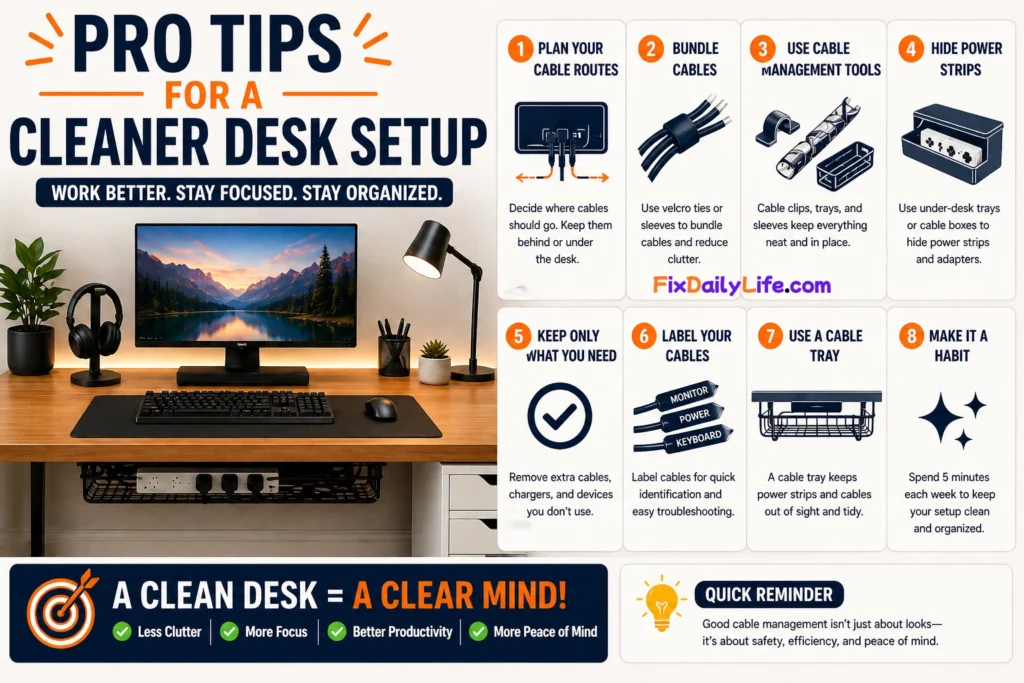
You spend time setting up your desk. You pick the right monitor, a comfortable keyboard, maybe even a lamp that gives off just the right light. But when it comes to how to hide cables on desk, things often get messy fast. Cables hang down, tangle together, and become hard to ignore. It quickly breaks the whole look.

If that sounds familiar, you’re not alone. A desk full of wires can feel messy and distracting. It pulls your attention away and makes your setup feel unfinished.

The good news? You don’t need anything complicated to fix it.

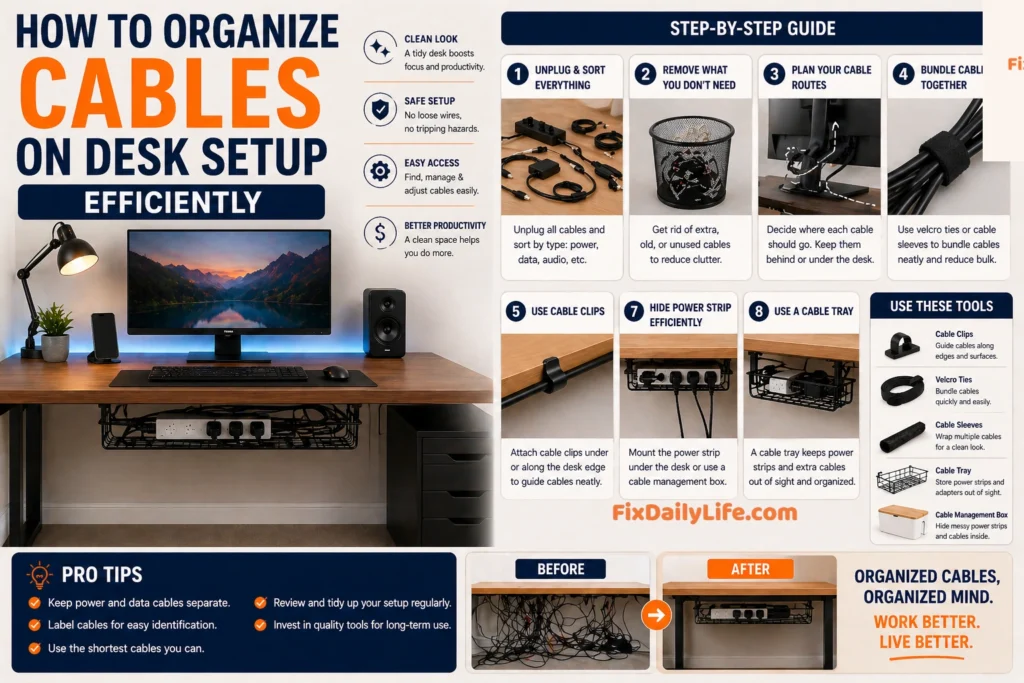
In this guide, you’ll learn how to hide cables on desk using simple, practical ideas that actually work. We’ll go step by step, covering easy ways to hide desk cables and showing you how to organize cables on desk setup without stress. Whether you want a quick fix or a clean, long-term setup, you’ll find methods that fit your space.

Let’s clean things up and make your desk look the way it should.


Why You Should Hide Cables on Your Desk Setup

how to hide cables on desk before after

Before we jump into the solutions, let’s understand why this actually matters. Learning how to hide cables on desk setups isn’t just about making your workspace look clean—it also affects how you feel and work every day. When you truly understand how to hide cables on desk, your setup becomes easier to use, manage, and enjoy.

Improves Focus and Productivity

First, a messy desk often leads to a distracted mind. When wires are scattered around, they create visual clutter. Even if you don’t notice it at first, it slowly pulls your attention away.

Once you start applying how to hide cables on desk methods, your space feels calmer. And when your space feels calm, your mind follows.

You’ll notice it becomes easier to:

  • Stay focused for longer
  • Feel less overwhelmed during work
  • Finish tasks more smoothly

That’s why learning how to organize cables on desk setup is more than just a visual fix. When you combine it with how to hide cables on desk, your workflow becomes smoother and more efficient.

Creates a Clean and Premium Look

Next, let’s talk about how your desk looks. You don’t need expensive gear to make your setup feel premium. One of the simplest upgrades is learning how to hide cables on desk the right way.

When cables are out of sight, everything looks more intentional and neat. Your desk instantly feels more put together.

Think about setups you often see online:

  • Minimal desks with clean lines
  • Calm and aesthetic YouTube setups
  • Organized home office spaces

Most of these follow simple tricks like how to hide cables behind desk or under the surface. These small changes make a big difference. Once you understand how to hide cables on desk, your setup starts to look cleaner and more professional.

Prevents Damage and Accidents

Finally, loose cables can cause real problems over time. Wires left hanging or lying around are easy to pull, bend, or step on.

This can lead to:

  • Sudden unplugging while working
  • Faster damage to cables
  • Tripping risks in tight spaces

By learning how to hide cables on desk, especially how to hide cables under desk, you protect both your setup and your space. It keeps everything secure, stable, and easier to manage.

Even simple fixes like how to hide power strip on desk or using easy ways to hide desk cables can make your setup much safer.

In the end, it’s not just about looks. When you apply how to hide cables on desk properly, you create a workspace that feels good and works better every day.

You can read : 15 Powerful Desk Setup Ideas for Minimal Setup


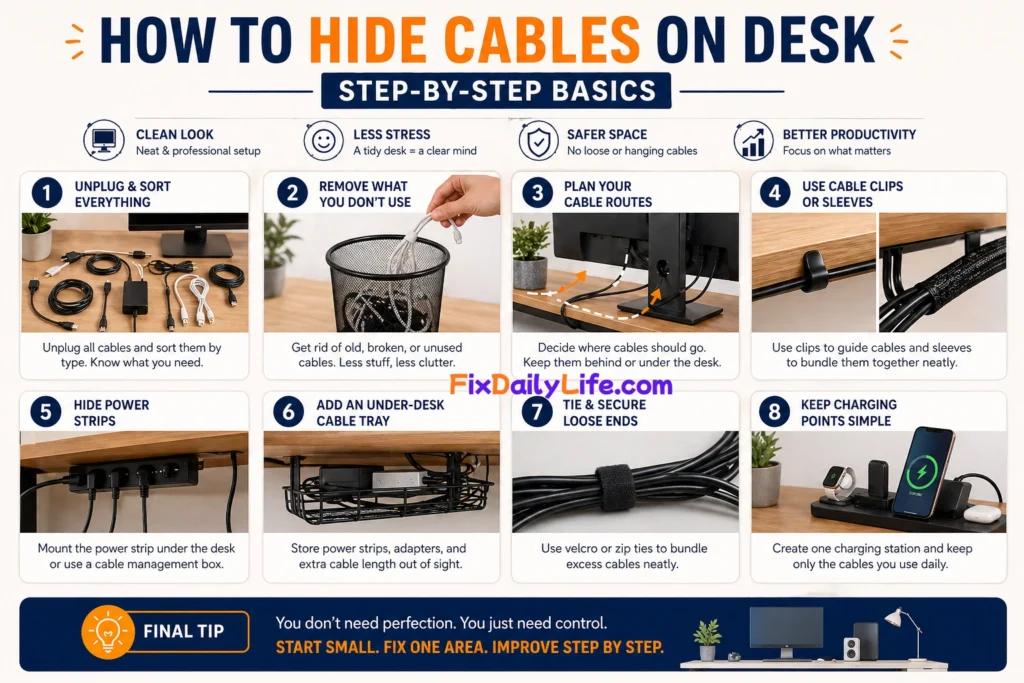
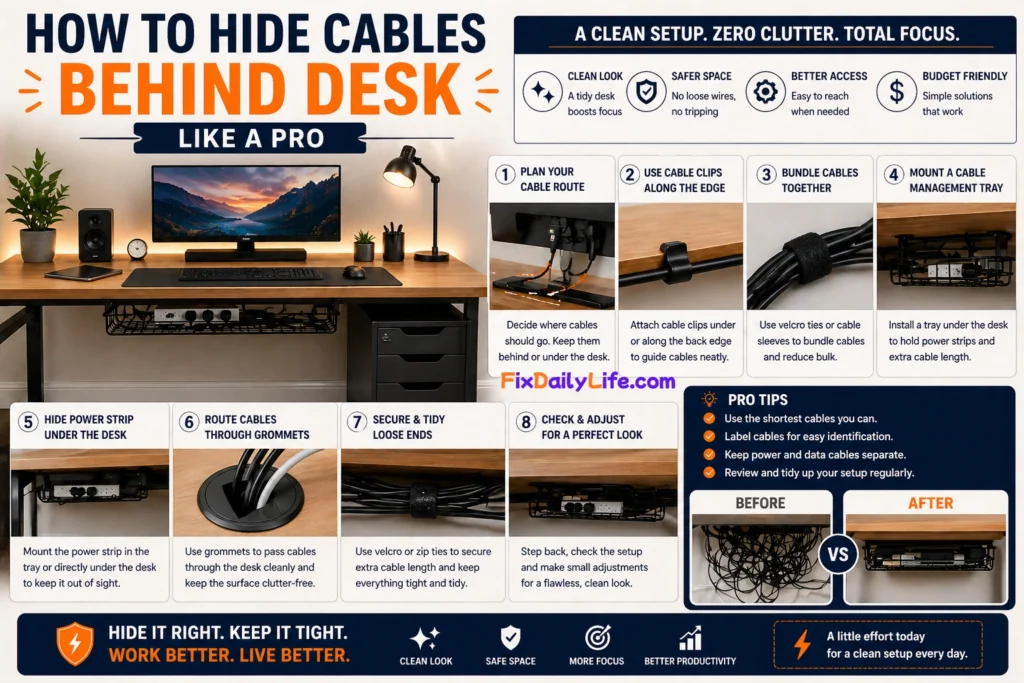
How to Hide Cables on Desk (Step-by-Step Basics)

How to Hide Cables on Desk Step-by-Step Basics

Now let’s get into the practical part. The good thing? You don’t need fancy tools or a Now let’s get into the practical part. The good thing? You don’t need fancy tools or a complicated setup. Just a little planning and a clear approach. Once you understand how to hide cables on desk, everything starts to feel simple and under control. In fact, the more you apply how to hide cables on desk step by step, the easier it becomes to keep your workspace clean.

Step 1: Identify and Group Your Cables

First, take a proper look at your desk. Don’t rush. Most people have more cables than they actually need, and this is where the cleanup begins.

You’ll usually find:

  • Power cables
  • Charging wires
  • Monitor and HDMI cables

Now group similar cables together. For example, keep all power cables in one bundle and data cables in another. This makes it much easier to figure out how to organize cables on desk setup without confusion and supports your overall goal of how to hide cables on desk.

Next, unplug everything and sort it out:

  • Keep only the cables you actually use
  • Set aside anything unused or rarely used

You’ll probably find a few cables you forgot existed. Removing them right away reduces clutter and gives you a clean starting point for how to hide cables on desk effectively.

Step 2: Remove Unnecessary Wires

Next, simplify your setup. Extra cables that aren’t even in use only make things worse.

Ask yourself:

  • Do I really use this device daily?
  • Can I switch to a wireless option?

For example:

  • Use a wireless mouse
  • Switch to a Bluetooth keyboard
  • Go for Wi-Fi instead of Ethernet if it works for you

Every cable you remove makes a big difference. It becomes much easier to manage and apply easy ways to hide desk cables when you have fewer wires. This step alone makes how to hide cables on desk much easier to handle.

Step 3: Plan Your Cable Route

Now comes the step most people skip—and regret later. Planning.

Instead of randomly placing cables, decide the path for each one first. This is key if you really want to master how to hide cables on desk properly.

Common routes include:

  • Along the edges of your desk
  • Under the desk surface
  • Behind the desk, near the wall

Think of it like creating a path for every wire. When each cable has a direction, your setup starts to look clean and intentional.

Good planning helps you:

  • Use how to hide cables behind desk techniques neatly
  • Avoid messy tangles
  • Keep cables easy to reach when needed

Spending a few extra minutes here makes how to hide cables on desk much more effective.

Step 4: Secure Cables Properly

Once your routes are clear, it’s time to lock everything in place. This step keeps your setup looking clean over time.

You can use:

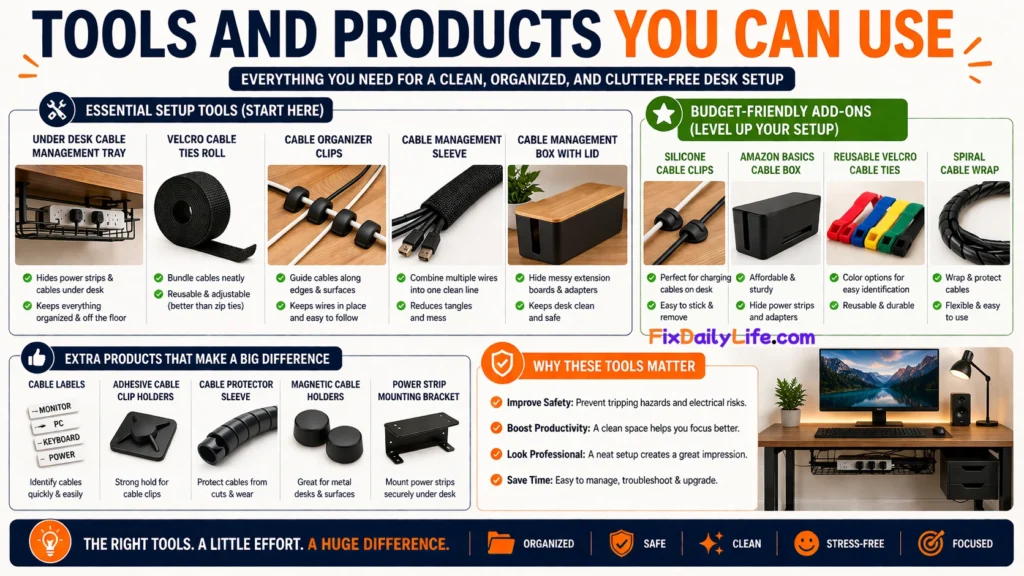
  • Cable clips to guide wires along edges
  • Velcro straps to bundle cables neatly
  • Cable sleeves to combine multiple wires

These tools are simple but very effective. They stop cables from hanging or shifting around.

Properly securing wires is one of the best ways to make how to hide cables on desk solutions last longer. It also supports easy ways to hide desk cables by keeping everything in place.

Step 5: Hide Power Sources

Finally, deal with the biggest mess—the power strip. This is where most cables connect, and it often looks the worst.

Here’s what you can do:

  • Use a cable management box to hide it
  • Mount it under your desk
  • Place it behind desk legs or against the wall

This step alone can transform your setup. Once you reduce visible wires, your desk instantly looks cleaner.

Learning how to hide power strip on desk is one of the fastest ways to improve your setup. You can also combine this with how to hide cables under desk to fully complete your how to hide cables on desk setup.

In the end, everything comes together. Your desk feels organized, looks better, and works better too.

You can read also : 10 Best Work From Home Monitor Setup Ideas for Comfort & Productivity


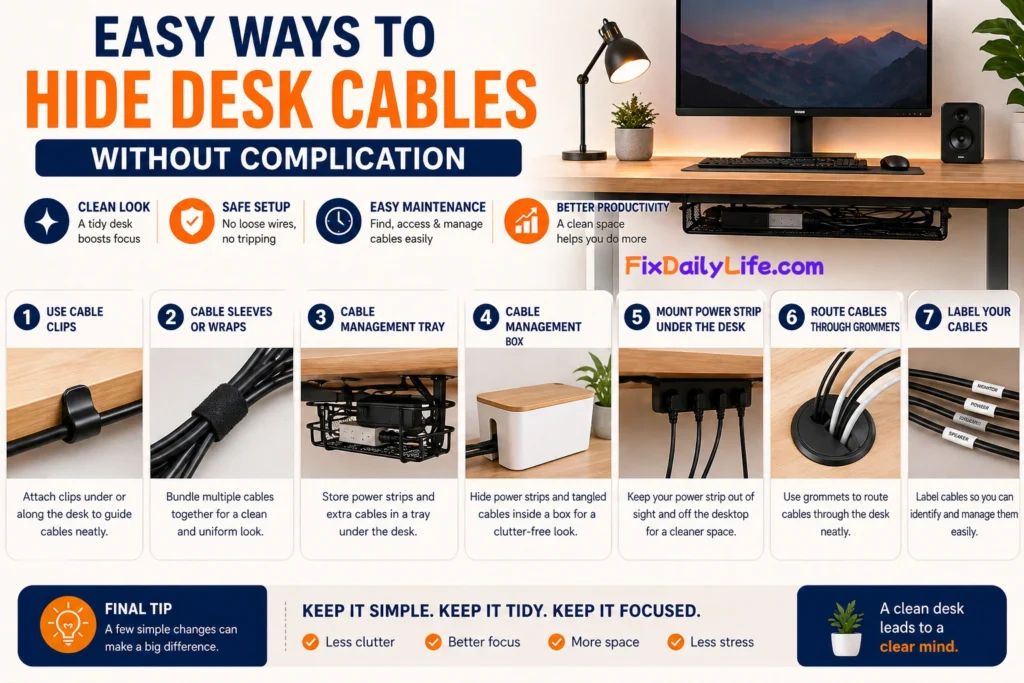
Easy Ways to Hide Desk Cables Without Complication

Easy Ways to Hide Desk Cables Without Complication

You don’t need expensive tools or a full desk makeover to fix cable mess. In most cases, a few simple changes can go a long way. If you’re just getting started, these are some of the easiest and most practical ways to improve your setup while learning how to hide cables on desk without stress. The more you apply these easy ways to hide desk cables, the easier it becomes to maintain a clean setup.

Use Cable Clips Along Desk Edges

First, try cable clips. They’re small, affordable, and very effective. You can stick them along the edges or under your desk and guide each wire through them neatly.

This helps you:

  • Keep cables fixed in one place
  • Stop wires from slipping or hanging down
  • Create a clean path for each cable

It’s one of the fastest ways to apply how to hide cables on desk techniques. Even better, it works perfectly if you’re looking for how to hide wires on desk without drilling, since most clips come with adhesive backing.

Use Cable Sleeves

Next, if you have multiple cables running in the same direction, things can get messy quickly. That’s where cable sleeves come in.

They:

  • Combine several wires into one neat bundle
  • Reduce visible clutter instantly
  • Make cable management much easier

This is one of those easy ways to hide desk cables that gives instant results. It also supports how to hide cables on desk by turning messy wires into one clean line.

Use Cable Boxes

Now let’s deal with the biggest mess—power strips and adapters. They often sit on the desk or floor, surrounded by tangled wires.

A cable box fixes this neatly.

It:

  • Hides your power strip out of sight
  • Protects cables from dust and damage
  • Makes your desk look clean right away

If you’re learning how to hide power strip on desk, this is one of the simplest solutions. You can also combine it with how to hide cables behind desk to keep everything even more out of view while improving your overall how to hide cables on desk setup.

Use Velcro Straps

Finally, don’t overlook Velcro straps. They’re simple, reusable, and very handy.

They help you:

  • Bundle cables neatly together
  • Adjust things anytime without cutting or replacing
  • Keep your setup flexible as you add or remove devices

Compared to zip ties, Velcro is much easier to manage. It’s a small tool, but it plays a big role when learning how to organize cables on desk setup and improving how to hide cables on desk effectively.

All together, these are some of the most practical and easy ways to hide desk cables without making things complicated. Start with one method, then add more if needed. Step by step, you’ll see your desk turn into a clean, organized, and stress-free space.

You can read also : 11 Powerful Small Desk Setup Ideas to Boost Productivity Fast

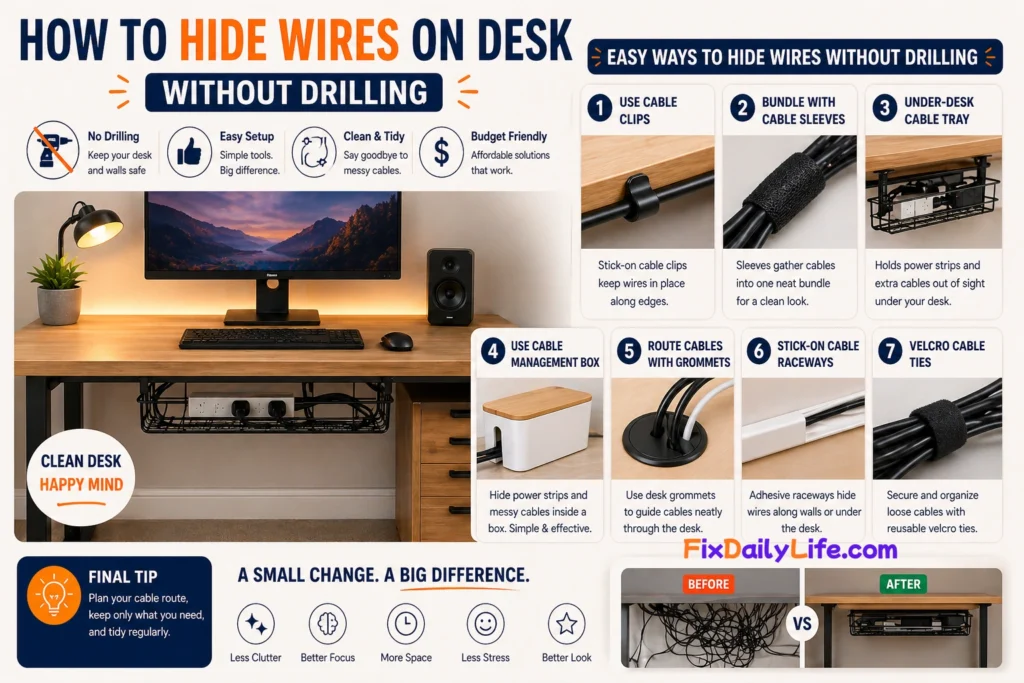
How to Hide Wires on Desk Without Drilling

How to Hide Wires on Desk Without Drilling

If you’re renting, sharing a space, or just don’t want to damage your desk, don’t worry—you still have plenty of good options. You can keep your setup clean without using screws or tools. These simple methods make it easy to hide wires on desk without drilling while keeping everything neat and flexible.

Adhesive Cable Clips

Adhesive cable clips are one of the easiest solutions. You just peel and stick them under your desk or along the back edge.

They help you:

  • Guide cables neatly along a fixed path
  • Keep wires from hanging or falling
  • Avoid any damage to your furniture

They’re perfect for beginners and work well for almost any setup.

Stick-On Cable Trays

If you have multiple cables, stick-on trays are a great upgrade. These trays attach under your desk and hold several wires at once.

They:

  • Keep cables off the floor
  • Hide messy bundles in one place
  • Make your setup look more organized

Installation takes just a few minutes, and you don’t need any tools.

Double-Sided Tape

For lighter cables like phone chargers or USB wires, double-sided tape works surprisingly well.
It’s:

  • Quick to apply
  • Budget-friendly
  • Easy to remove later

Just stick the cable along the desk edge or behind the surface to keep it out of sight.

These methods are perfect if you want a clean setup without making permanent changes. If your goal is to hide wires on desk without drilling, start with these simple fixes and build from there.


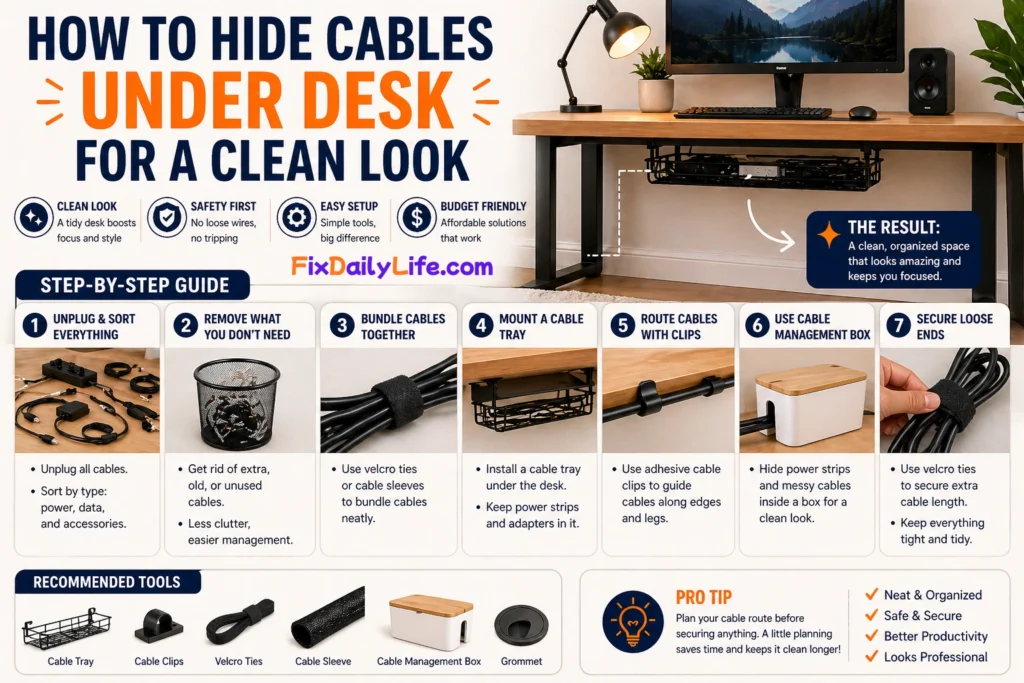
How to Hide Cables Under Desk for a Clean Look

How to Hide Cables Under Desk for a Clean Look

If you’re renting, sharing a space, or just don’t want to damage your desk, you still have plenty of options. You don’t need screws or tools to get a clean setup. With a few smart choices, you can easily manage how to hide cables on desk without making any permanent changes.

These methods are simple, flexible, and perfect for beginners.

Adhesive Cable Clips

First, adhesive cable clips are one of the easiest fixes. Just peel and stick them under your desk or along the back edge.

They help you:

  • Guide cables along a clean path
  • Keep wires from hanging or falling
  • Avoid any marks or damage on your desk

This is one of the most practical ways to learn how to hide wires on desk without drilling. It’s quick, simple, and works for almost any setup.

Stick-On Cable Trays

Next, if you’re dealing with multiple cables, stick-on trays are a great step up. These attach under your desk and hold several wires together.

They:

  • Keep cables lifted off the floor
  • Hide messy bundles in one place
  • Make your setup look much more organized

It only takes a few minutes to install. No tools needed. This method works really well if you’re trying to figure out how to hide cables under desk while keeping everything neat and out of sight.

Double-Sided Tape

Now, for lighter cables like phone chargers or USB wires, double-sided tape can do the job surprisingly well.
It’s:

  • Quick to apply
  • Budget-friendly
  • Easy to remove later

You can stick cables along the desk edge or behind the surface so they stay hidden. It’s a simple trick, but it fits perfectly into easy ways to hide desk cables without adding extra hardware.

All of these methods are great if you want a clean setup without drilling anything. They also make it easier to adjust your setup anytime.

If your goal is to master how to hide cables on desk while keeping things flexible, start here. Small changes like these can make your workspace look neat, organized, and stress-free.


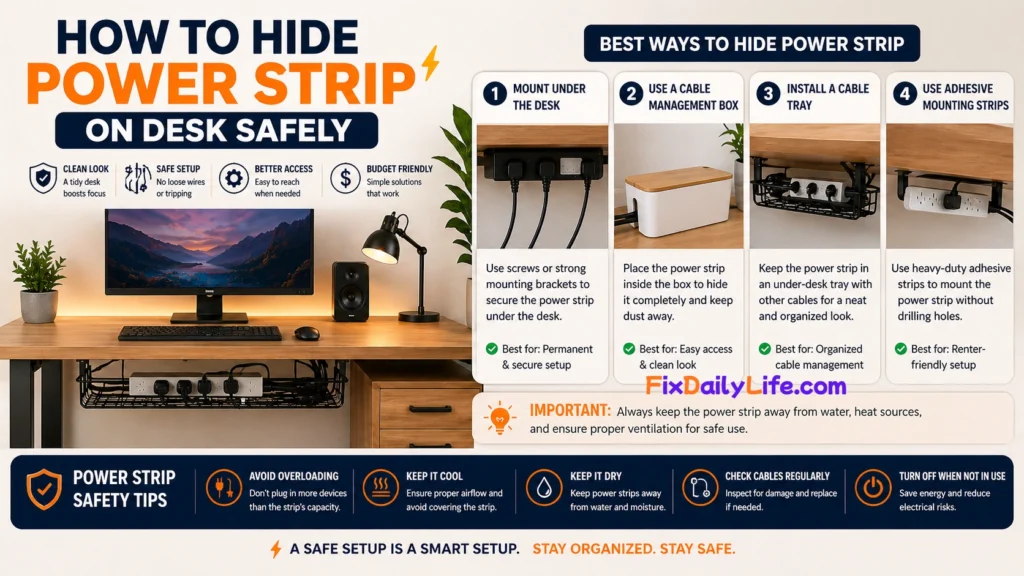
How to Hide Power Strip on Desk Safely

How to Hide Power Strip on Desk Safely

If you’re renting, sharing a space, or just don’t want to damage your desk, you still have plenty of options. You don’t need screws or tools to get a clean setup. With a few smart choices, you can easily manage how to hide cables on desk while also improving how to hide cables under desk without making any permanent changes. The more you apply how to hide cables on desk techniques here, the cleaner your setup will look.

These methods are simple, flexible, and perfect for beginners.

Adhesive Cable Clips

First, adhesive cable clips are one of the easiest fixes. Just peel and stick them under your desk or along the back edge.

They help you:

  • Guide cables along a clean path
  • Keep wires from hanging or falling
  • Avoid any marks or damage on your desk

This is one of the most practical ways to learn how to hide wires on desk without drilling. It’s quick, simple, and works for almost any setup while supporting your overall goal of how to hide cables on desk.

Stick-On Cable Trays

Next, if you’re dealing with multiple cables, stick-on trays are a great step up. These attach under your desk and hold several wires together.

They:

  • Keep cables lifted off the floor
  • Hide messy bundles in one place
  • Make your setup look much more organized

It only takes a few minutes to install. No tools needed. This method works really well if you’re trying to figure out how to hide cables under desk while improving how to hide cables on desk at the same time.
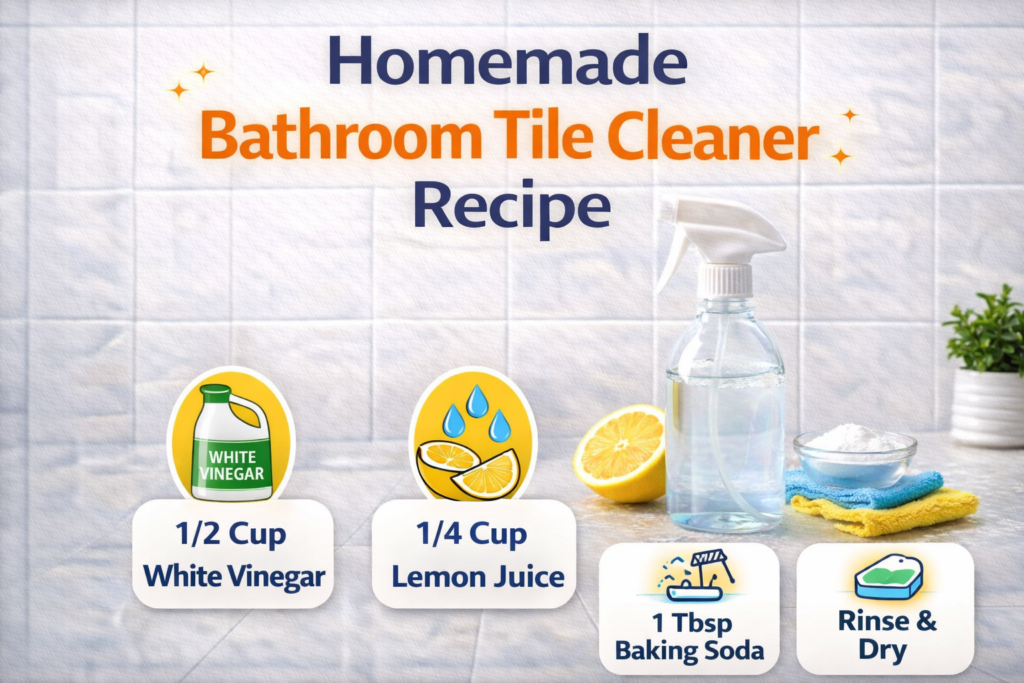
Double-Sided Tape

Now, for lighter cables like phone chargers or USB wires, double-sided tape can do the job surprisingly well.
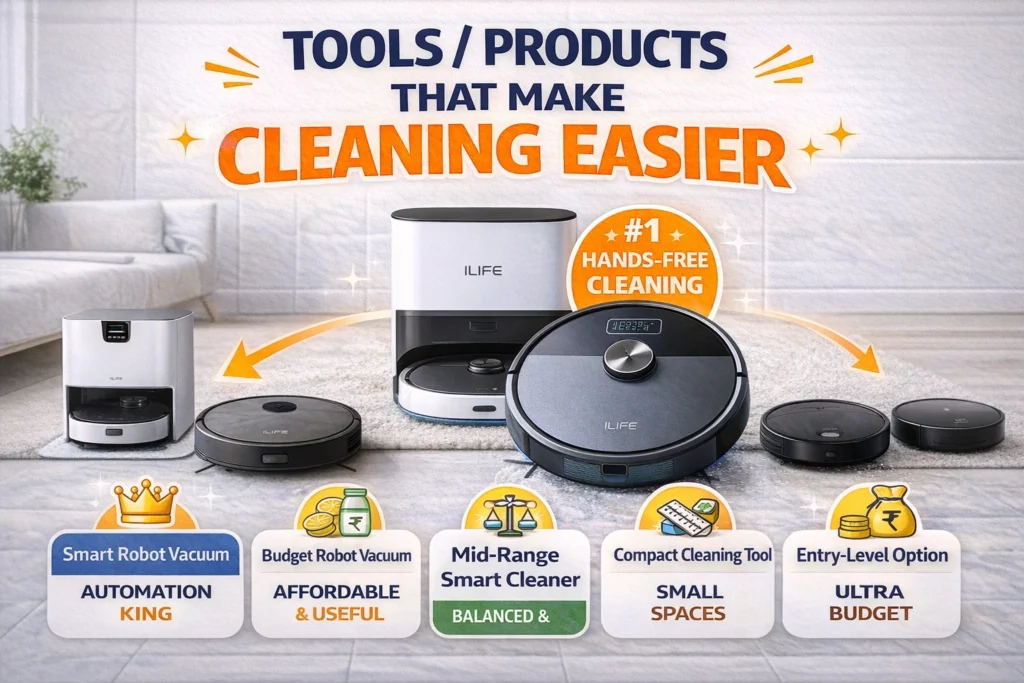
It’s:

  • Quick to apply
  • Budget-friendly
  • Easy to remove later

You can stick cables along the desk edge or behind the surface so they stay hidden. It’s a simple trick, but it fits perfectly into easy ways to hide desk cables and makes how to hide cables on desk even easier.

All of these methods are great if you want a clean setup without drilling anything. They also make it easier to adjust your setup anytime.

If your goal is to master how to hide cables on desk while keeping things flexible, start here. Combine these ideas with how to hide cables behind desk, and you’ll notice your workspace becoming neat, organized, and stress-free.

How to Hide Cables Behind Desk Like a Pro

How to Hide Cables Behind Desk Like a Pro

Want that clean, Pinterest-style setup where everything feels calm and minimal? This is where the magic happens. When wires disappear behind your desk, your whole workspace looks more organized and premium.

If you’re serious about how to hide cables on desk, this step makes the biggest visual difference.

Use Wall Raceways

First, try wall raceways. They’re one of the best tools if you want a neat, professional finish. Instead of letting cables hang loose, you guide them along the wall in a clean line.

You can:

  • Run cables vertically or horizontally
  • Keep wires aligned and hidden
  • Paint the raceway to match your wall

This creates a seamless look. It’s one of the smartest ways to improve how to hide cables behind desk without much effort.

Move Desk Closer to Wall

Next, don’t underestimate simple fixes. Just moving your desk a little closer to the wall can reduce visible cables a lot.

It helps you:

  • Shorten the length of visible wires
  • Keep cables naturally tucked behind
  • Improve the setup instantly

Even a few inches can change how your desk looks. It also supports how to hide cables on desk by reducing clutter right away.

Use Decor to Hide Wires

Finally, you can use everyday items to hide cables in a natural way. This works especially well if you want your setup to feel more styled, not just organized.

For example:

  • Place small plants near cable areas
  • Use panels or boards behind the desk
  • Add shelves to block visible wires

These tricks don’t just hide cables—they improve the whole vibe of your workspace. It’s a creative way to apply easy ways to hide desk cables while making your setup look more aesthetic.

With these simple ideas, you can master how to hide cables behind desk without doing anything complicated. A little planning goes a long way, and your setup will start to look clean, intentional, and professionally styled.


How to Organize Cables on Desk Setup Efficiently

How to Organize Cables on Desk Setup Efficiently

Hiding cables is only half the job. If you want your desk to stay clean, you need a simple system to keep everything organized over time. A little effort here saves you from going back to a messy setup later. When you combine this with how to hide cables on desk, your workspace becomes much easier to manage every day.

If you’re learning how to hide cables on desk, this step helps you keep that clean look for the long run. The better you organize, the easier it becomes to maintain how to hide cables on desk without starting over again.

Label Your Cables

First, label your cables. It sounds small, but it makes a big difference—especially when you have multiple devices connected.

By labeling them, you:

  • Save time when unplugging or rearranging
  • Avoid pulling out the wrong cable
  • Make fixing issues much easier

You don’t need anything fancy. Use simple tags, stickers, or even tape with a marker. This habit supports how to organize cables on desk setup and also improves your overall how to hide cables on desk setup.

Separate Cable Types

Next, don’t mix all cables together. When everything is bundled in one place, it can quickly turn messy again.

Instead, separate them:

  • Power cables in one group
  • Data cables (HDMI, USB, Ethernet) in another

This keeps your routing clean and easy to manage. It also works well with how to hide cables under desk, since grouped cables make how to hide cables on desk much more effective and easier to maintain.

Do Weekly Maintenance

Finally, take a few minutes each week to check your setup. Even a well-managed desk can get messy over time.

A quick weekly reset helps you:

  • Fix loose or hanging wires
  • Keep cables in their place
  • Stop clutter from building up again

Think of it as a small habit that keeps your setup looking fresh. It also makes easy ways to hide desk cables last longer and supports how to hide cables on desk without needing to redo everything.

With these simple habits, your desk won’t just look clean for a day—it will stay organized. And once you combine this with how to hide cables on desk methods, your setup becomes clean, simple, and easy to maintain every day.


Tips and Hacks for Better Cable Management

Tips and Hacks for Better Cable Management

You don’t need a full setup overhaul to see results. A few smart tweaks can clean things up quickly and keep your desk looking neat every day. These ideas are simple, practical, and perfect if you’re working on how to hide cables on desk without overcomplicating things. In fact, small changes like these make how to hide cables on desk much easier to manage in the long run.

Use Shorter Cables to Reduce Clutter

First, check your cable lengths. Long cables often create loops and tangles that are hard to manage.

Switching to shorter cables:

  • Reduces extra slack
  • Makes routing cleaner
  • Helps cables stay in place

It’s a small change, but it makes easy ways to hide desk cables much more effective and supports how to hide cables on desk properly.

Keep Cables Off the Floor

Next, avoid letting cables sit on the floor. They collect dust, look messy, and can even become a tripping risk.

Instead:

  • Route them under the desk
  • Guide them along desk edges

This works well with how to hide cables under desk and instantly improves your overall how to hide cables on desk setup.

Match Cable Color with Your Desk

Here’s a simple trick that many people overlook. Try to match your cable color with your desk.

For example:

  • Black cables for dark desks
  • White cables for light setups

This helps cables blend in naturally. Even if they’re slightly visible, they won’t stand out. It’s a smart visual trick that improves how to hide cables on desk without extra tools.

Use a Cable Box for Instant Cleanup

If your power strip area looks messy, a cable box can fix it in seconds.

Just place:

  • The power strip
  • Extra cable lengths
  • Adapters

inside the box. This is one of the fastest solutions for how to hide power strip on desk, and it works perfectly with how to hide cables behind desk to keep everything out of sight while improving your overall how to hide cables on desk setup.

Route Cables Along Hidden Edges

Finally, don’t let cables run across open space. Instead, guide them along the back or underside of your desk.

This helps you:

  • Keep wires out of sight
  • Create a cleaner finish
  • Maintain a more organized look

It’s one of the most effective habits when learning how to hide cables on desk properly and keeping your setup neat over time.

These small changes might seem simple, but together they make a big difference. Once you apply them, how to hide cables on desk becomes easier, faster, and much more effective—giving you a clean and stress-free workspace every day.

Common Mistakes to Avoid

Even with the best intentions, a few small mistakes can mess up your setup. If you want clean, long-lasting results, it’s just as important to know what to avoid. When working on how to hide cables on desk, avoiding these issues will save you time and effort.

These mistakes can slow you down or undo your progress with how to hide cables on desk, so it’s worth getting them right from the start.

1. Over-Tightening Cables

First, don’t pull cables too tight. It might feel like tighter means cleaner, but that’s not true.

Over-tight cables can:

  • Damage internal wires
  • Cause connection problems
  • Lead to sudden failures

Always leave a little slack. This keeps cables safe and helps maintain a proper how to hide cables on desk setup over time.

2. Ignoring Cable Length

Next, cable length matters more than people think. Extra-long cables create loops, tangles, and unnecessary clutter.

A better approach:

  • Use shorter cables when possible
  • Bundle extra length neatly

Managing this well makes easy ways to hide desk cables much more effective and improves your overall how to hide cables on desk results.

3. Mixing All Wires Together

Now, avoid throwing every cable into one bundle. It might look fine at first, but it quickly turns confusing.

This can:

  • Make troubleshooting harder
  • Create tangles
  • Lead to messy rework later

Instead, group cables by type. This supports how to organize cables on desk setup and makes how to hide cables on desk much easier to manage.

4. Skipping Planning

Another big mistake—starting without a plan. If you begin sticking cables randomly, things can get messy fast.

Take a few minutes to:

  • Decide cable routes
  • Choose where to hide them
  • Plan your layout

This step is key if you want to properly apply how to hide cables behind desk or how to hide cables under desk without redoing everything later. Good planning always improves how to hide cables on desk results.

5. Using Permanent Fixes Too Early

Finally, don’t rush into permanent solutions. You might want to change your setup later, and fixed mounts can make that difficult.

Start with flexible options like:

  • Velcro straps
  • Adhesive clips

Once everything feels right, then you can move to permanent solutions if needed. This is especially helpful if you’re still figuring out how to hide cables on desk in the best way for your space.

Avoiding these mistakes will save you time and effort. More importantly, it helps you keep your desk clean, organized, and stress-free while maintaining your how to hide cables on desk setup for the long run.

Pro Tips for a Cleaner Desk Setup

Pro Tips for a Cleaner Desk Setup

Want to take your setup to the next level? These small but smart upgrades can make a big difference. If you’re already learning how to hide cables on desk, these tips will help you go from “clean” to “super clean” without much extra effort.

Use a Monitor Arm to Reduce Cables

A monitor arm is one of the easiest ways to improve both space and cable management. Most monitor arms come with built-in channels that let you route cables neatly behind the screen.

This helps you:

  • Reduce visible wires instantly
  • Free up desk space
  • Make it easier to apply how to hide cables on desk properly

Go Wireless Where Possible

The fewer cables you have, the easier everything becomes. Switching to wireless devices removes clutter before it even starts.

You can:

  • Use a wireless mouse and keyboard
  • Switch to Bluetooth headphones
  • Add a wireless charging pad

This makes how to hide cables on desk much simpler because there are fewer wires to manage.

Use Matching Accessories

A clean setup isn’t just about hiding cables—it’s also about consistency. When your accessories and cables match your desk color, everything looks more organized.

For example:

  • Black cables with dark desks
  • White cables for minimal setups

This creates a more polished and intentional look.

Keep One Charging Station

Instead of spreading cables across your desk, create one dedicated charging area. This could be a small corner or a cable box.

It:

  • Reduces clutter
  • Keeps cables organized in one place
  • Makes your setup easier to maintain

Hide Everything Below Eye Level

A simple rule that works every time—if you can’t see the cables, they don’t distract you. Try to keep all wires below your eye level.

You can:

  • Route cables under the desk
  • Hide power strips
  • Avoid visible hanging wires

These small changes can elevate your setup instantly. Once you combine them with how to hide cables on desk techniques, your workspace will feel cleaner, calmer, and much more professional.

Tools and Products You Can Use

Tools and Products You Can Use

You don’t need anything complicated to manage cables properly. The right tools can make everything faster, cleaner, and much easier to maintain. If you’re working on how to hide cables on desk, these simple products can make a big difference.

1. Cable Clips

First, cable clips are small but very useful. You can stick them along the edge or underneath your desk to guide cables neatly.

They:

  • Keep cables in place
  • Stop wires from falling or hanging
  • Create clean routing paths

They’re perfect if you want a quick solution or you’re just starting with how to hide cables on desk.

2. Cable Sleeves

Next, cable sleeves are great when multiple wires run in the same direction. Instead of seeing several loose cables, you get one clean bundle.

They:

  • Reduce visual clutter
  • Keep cables organized
  • Make your setup look more polished

This is one of the most effective easy ways to hide desk cables without much effort.

3. Velcro Straps

Velcro straps are simple, flexible, and reusable. That makes them a must-have for any setup.

They:

  • Bundle cables neatly
  • Let you adjust anytime
  • Work better than permanent zip ties

They’re especially helpful when learning how to organize cables on desk setup step by step.

4. Cable Management Box

If your desk looks messy because of the power strip, this tool helps instantly. A cable management box hides everything in one place.

It:

  • Keeps your setup tidy
  • Protects cables from dust
  • Improves the overall look

It’s one of the easiest solutions for how to hide power strip on desk.

5. Under-Desk Tray

For a more complete setup, an under-desk tray works really well. It holds multiple cables and keeps them hidden.

It:

  • Keeps wires off the floor
  • Organizes cables in one place
  • Supports how to hide cables under desk effectively

This option gives you a cleaner and more permanent result.

6. Cable Raceways

Cable raceways are perfect if you want a neat, professional look. They guide wires along walls or desk frames.

They:

  • Keep cables aligned
  • Hide wires neatly
  • Improve the overall setup

They’re a great choice when working on how to hide cables behind desk.

7. Adhesive Hooks

Finally, adhesive hooks are a simple no-drill option. You can use them to guide cables exactly where you want.

They:

  • Stick easily to surfaces
  • Help route cables cleanly
  • Can be removed without damage

They work especially well if you’re trying how to hide wires on desk without drilling.

With just a few of these tools, you can completely change how your desk looks and feels. Start small, add what you need, and build a setup that stays clean and easy to manage over time.


Conclusion

A clean desk isn’t about buying expensive gear. It’s about making small, smart changes that actually work.

Now you know how to hide cables on desk using simple and practical steps. From how to hide cables under desk to how to hide wires on desk without drilling, you’ve got all the basics covered to create a setup that looks clean and feels easy to use.

The key is to start small. Don’t try to fix everything at once—just pick one area and improve it. Then move to the next.

Over time, these small changes add up. You’ll notice your space feels calmer, more organized, and much easier to work in.

Your setup doesn’t need to be perfect. It just needs to be a little better than yesterday.


FAQs

1. How to hide cables on desk easily?

Use cable clips, sleeves, and a cable box. Start by grouping cables and routing them along edges.

2. How to hide wires on desk without drilling?

Use adhesive clips, stick-on trays, and Velcro straps. These methods are renter-friendly.

3. How to hide cables under desk effectively?

Install an under-desk tray and mount the power strip. This keeps cables off the floor.

4. How to hide power strip on desk safely?

Use a cable box or mount it under the desk. Avoid placing it on the floor.

5. What are easy ways to hide desk cables?

Use shorter cables, bundle wires, and route them behind or under the desk.

6. How to organize cables on desk setup properly?

Group cables, label them, and separate power from data cables.

7. How to hide cables behind desk for a clean look?

Use wall raceways, move desk closer to wall, and use decor to hide wires.

Working from home sounds great—until your desk starts feeling cramped, messy, and uncomfortable. What once felt convenient can quickly turn into daily frustration when your setup isn’t right. That’s exactly where smart small desk setup ideas come in—they help you make the most of limited space without sacrificing comfort.

Maybe your monitor is too low. Your neck starts hurting by noon. Cables are scattered everywhere, and your desk always looks cluttered. Over time, this kind of work from home setup small space can affect your focus, energy, and even your posture.

The truth is, you don’t need a bigger room or expensive furniture. You just need a smarter setup that actually works for your space.

In this guide, you’ll discover practical and easy-to-follow small desk setup ideas to improve your workspace. From better monitor placement to simple organization tips, everything is designed to help you build a clean, comfortable, and productive work from home setup small space.

Let’s fix your setup—step by step, in a way that actually works.

Why Your Monitor Setup Matters More Than You Think

Your monitor setup isn’t just about how your desk looks—it directly affects how you feel, think, and work every single day. A poorly planned setup might seem like a small issue at first, but over time, it can seriously impact your comfort and productivity. That’s why following the right small desk setup ideas is more important than most people realize.

When your monitor is too low, too close, or poorly positioned, your body starts to compensate. You lean forward. You slouch. You strain your eyes without noticing. And in a tight work from home setup small space, these problems show up even faster.

A poor setup often leads to:

  • Neck and back pain
  • Eye strain and frequent headaches
  • Low focus and reduced productivity
  • Feeling tired even after short work sessions

On the other hand, a smart approach using small desk setup ideas can completely change your daily work experience.

A well-designed setup helps you:

  • Improve posture almost instantly
  • Reduce physical fatigue throughout the day
  • Stay focused for longer periods
  • Create a calm and distraction-free environment

When your work from home setup small space is clean, organized, and properly arranged, your mind feels clearer too. Less clutter on your desk often means less clutter in your head.

Simple truth? Better setup leads to better work—and a much better workday overall.

You can read : 10 Best Work From Home Monitor Setup Ideas for Comfort & Productivity

Small Desk Setup Ideas for a Clean and Productive Workspace

This is where everything starts. If your desk is small, every inch matters—and how you use that space makes a huge difference. The right small desk setup ideas can turn even a tight corner into a clean, focused, and comfortable workspace. When your work from home setup small space is planned well, you don’t feel limited—you feel in control.

Choose the Right Desk Size

For a simple desk setup for small room, the biggest mistake people make is choosing a desk that’s too large. It eats up space and makes everything feel cramped.

Instead, go for compact and practical options that support your daily work without overwhelming the room.

Look for:

  • 40–48 inch width desks (enough for a monitor + essentials)
  • Slim depth (20–24 inches) to save space
  • Wall-mounted or foldable desks for flexibility
  • Lightweight desks that are easy to move if needed

These choices fit perfectly into a minimal desk setup for small space, where the goal is to keep things clean, functional, and clutter-free.

A smaller desk doesn’t limit you—it actually forces you to stay organized and intentional. And that’s exactly what makes a workspace feel productive.

Pick the Right Monitor Size

Bigger is not always better—especially when you’re working with limited space. Choosing the right screen size is a key part of smart small desk setup ideas, because your monitor takes up most of your desk.

For practical and comfortable small desk setup ideas 2026, it’s best to keep things balanced:

  • 24-inch monitor (ideal for most small desks)
  • 27-inch monitor only if your desk has enough depth
  • Avoid ultra-wide screens unless you have extra space

When your monitor is too large, it doesn’t just take up space—it makes your entire work from home setup small space feel crowded and harder to manage. You may also end up sitting too close, which can strain your eyes and reduce comfort over time.

A properly sized monitor keeps your desk looking clean, gives you enough working area, and helps maintain the right viewing distance. In a small setup, the goal isn’t to go big—it’s to go smart and balanced.

Use Vertical Space Smartly

If your desk is small, don’t spread out—build upward. This is one of the most effective small desk setup ideas for keeping your workspace clean without sacrificing function. When you use vertical space properly, your work from home setup small space instantly feels bigger and more organized.

Instead of crowding your desk surface, shift things off the desk and onto the wall or above it.

Try:

  • Monitor arms (free up desk space and improve positioning)
  • Wall shelves (store books, decor, or essentials)
  • Pegboards (great for organizing tools and accessories)

These simple changes help you create an aesthetic desk setup small space that looks clean, open, and intentional. You also get more room to work comfortably without constantly moving things around.

The idea is simple: keep your desk surface as clear as possible, and let your walls do the heavy lifting.

Keep It Minimal

When space is limited, less really is more. One of the smartest small desk setup ideas is to avoid adding too many items that don’t serve a purpose. A cluttered desk not only looks messy but also makes your work from home setup small space feel tighter and harder to use.

Instead, focus on keeping only what you truly need for your daily work.

Stick to:

  • Monitor
  • Keyboard & mouse
  • One notebook or planner
  • One simple decor item (like a plant or frame)

That’s all you need for a clean and functional budget small desk setup ideas layout. This approach helps you stay organized, reduces distractions, and makes your workspace feel calm and easy to manage.

A minimal setup doesn’t mean boring—it means everything on your desk has a clear purpose.

You can read : 15 Powerful Desk Setup Ideas for Minimal Setup

Ideal Monitor Placement for Comfort and Productivity

Ideal Monitor Placement for Comfort and Productivity

Even the best desk won’t help if your monitor is placed wrong. In fact, poor placement can undo all your effort, no matter how good your small desk setup ideas are. In a tight work from home setup small space, even small positioning mistakes can quickly lead to discomfort.

Eye-Level Position

Your monitor height matters more than most people think. The top of your screen should be at or slightly below eye level. This keeps your neck in a natural, relaxed position and helps you avoid strain during long work hours.

If your monitor is too low, you’ll keep looking down. If it’s too high, you’ll tilt your head up. Both can cause pain over time.

For better small desk setup ideas, you can:

  • Use a monitor stand
  • Stack a few books
  • Adjust a monitor arm

Getting this right is essential for any comfortable work from home setup small space. It’s a small fix that makes a big difference.

Correct Viewing Distance

Getting the distance right is just as important as height. Even the best small desk setup ideas won’t feel comfortable if your screen is too close or too far. In a tight work from home setup small space, this small detail can make a big difference in how your eyes and body feel.

Keep your monitor:

  • About an arm’s length away

If your screen is too close, your eyes have to work harder, leading to strain and headaches. If it’s too far, you’ll naturally lean forward without realizing it, which can hurt your neck and back over time.

A simple check? Sit back in your chair and stretch your arm—your fingertips should just reach the screen. This keeps your posture relaxed and your viewing comfortable.

Good distance = less strain, better focus, and a smoother workday.

Adjust Angle and Tilt

Tilt your monitor slightly upward so the screen faces your eyes naturally. This small adjustment is a simple but powerful part of smart small desk setup ideas, especially when you’re working in a compact space.

A proper tilt helps reduce glare from lights or windows and makes the screen easier to see without straining. In a tight work from home setup small space, even a slight angle change can improve comfort during long hours.

Try to keep the screen directly in front of you and avoid sharp angles. When your monitor is aligned well, your eyes feel relaxed and your posture stays more natural throughout the day.

You can also Read : How to Clean House Fast: 7 Simple Steps in Minutes

Simple Desk Setup for Small Room (Step-by-Step Guide)

Simple Desk Setup for Small Room Step-by-Step Guide

Let’s build your setup from scratch.

Step 1: Clear Everything Off Your Desk

Start fresh. Remove everything from your desk—even the items you think you need. This reset is one of the simplest yet most powerful small desk setup ideas, especially when your space already feels crowded.

Why does this matter? Because clutter hides problems. You can’t fix your layout if you can’t clearly see what’s taking up space. In a tight work from home setup small space, even a few extra items can make your desk feel overwhelming.

For better results, only bring back what truly supports your work.

Focus on:

  • Essentials only
  • Clean, open surface
  • No unnecessary distractions

This step helps you rethink your setup with intention. It also sets a strong foundation for a clean and efficient minimal desk setup for small space, where every item has a purpose and place.

Step 3: Set Up Your Monitor Properly

Now it’s time to position your monitor the right way. This step is the core of all effective small desk setup ideas, because your screen is where you spend most of your time.

A well-placed monitor improves comfort, posture, and focus—especially in a tight work from home setup small space.

Follow this:

  • Eye-level alignment
  • Arm’s length distance
  • Slight upward tilt

If your monitor doesn’t reach the right height, don’t worry. You can use simple fixes like stacking books or adding a monitor stand. Even small adjustments can make a big difference.

This step is truly the heart of your small desk setup ideas 2026, helping you create a setup that feels natural and easy to work in every day.

Step 4: Organize Cables Cleanly

Messy cables ruin everything—even the best small desk setup ideas can look cluttered if wires are all over the place. In a tight work from home setup small space, visible cables make your desk feel smaller and more chaotic.

The fix is simple: keep cables hidden and organized.

Use:

  • Cable clips
  • Cable sleeves
  • Under-desk trays

These small tools help you route wires neatly and keep your desk surface clean. You’ll also find it easier to clean and manage your setup daily.

Clean cables = clean mind. And honestly, this step is essential if you want your budget small desk setup ideas to look neat, minimal, and well put together.

Step 5: Add Only Useful Accessories

Now add items slowly—don’t rush this part. One of the smartest small desk setup ideas is to be intentional about what you bring back onto your desk. In a work from home setup small space, every item should earn its place.

Start with a few practical additions that improve comfort and usability.

Good additions:

  • Desk mat (keeps the surface clean and organized)
  • Lamp (for better lighting and reduced eye strain)
  • Small plant (adds a calm, fresh feel)

Avoid over-decorating or adding things just for looks. Too many items will quickly make your desk feel crowded again.

Keep your simple desk setup for small room functional, clean, and easy to manage. The goal is to create a space that feels calm, not cluttered, so you can focus better every day.

Budget Small Desk Setup Ideas That Still Look Premium

Budget Small Desk Setup Ideas That Still Look Premium

You don’t need to spend a lot.

Affordable Setup Tips

You don’t need a big budget to build a clean and functional workspace. Some of the best small desk setup ideas are simple, low-cost, and easy to set up at home. With a few smart choices, you can upgrade your work from home setup small space without spending much.

Try these budget-friendly ideas:

  • Use books as monitor stands (quick and effective height fix)
  • Buy second-hand desks (often cheaper and still solid)
  • Use LED strips for lighting (adds a modern, aesthetic touch)

These small upgrades can make your setup look better and feel more comfortable, without putting pressure on your budget.

Where to Spend vs Save

Not everything in your setup needs a big budget. The key is knowing where to invest and where to cut back. Smart decisions like this are part of effective small desk setup ideas, especially when you’re working with limited space and money.

Spend on:

  • Monitor (you use it all day, so quality matters)
  • Chair (supports posture and long-term comfort)

Save on:

  • Decor (keep it minimal and simple)
  • Accessories (buy only what you truly need)

This balance helps you build a clean, functional work from home setup small space without overspending. In the end, a thoughtful approach creates a neat and comfortable budget small desk setup ideas that looks good and works even better.

Aesthetic Desk Setup Small Space (Minimal + Modern Look)

Aesthetic Desk Setup Small Space

Want that Pinterest-Style Setup? Keep It Simple

If you’re aiming for that clean, Pinterest-style look, don’t overcomplicate it. The best small desk setup ideas focus on simplicity and consistency, especially in a work from home setup small space where too many elements can feel overwhelming.

Stick to a Color Theme

A simple color palette makes your setup look calm and well put together. It also helps your space feel bigger and less cluttered.

Use:

  • White
  • Black
  • Wood tones

These colors work well together and create a modern, minimal look. Try to avoid mixing too many colors, as it can make your desk feel busy and distracting.

Keeping your colors consistent is a small change, but it makes a big difference in creating an aesthetic desk setup small space that feels clean and intentional.

Add Soft Lighting

Lighting can completely change how your setup feels. In smart small desk setup ideas, lighting isn’t just functional—it sets the mood. Warm lights create a cozy and relaxed atmosphere, which is perfect for a work from home setup small space where comfort matters.

Try:

  • LED strips behind your monitor (soft backlight reduces eye strain)
  • A small desk lamp with warm light

Avoid harsh, bright lights directly on your screen. Soft lighting makes your setup feel calm, improves focus, and gives your space a clean, aesthetic look without adding clutter.

Use Minimal Decor

Less is more—especially when you’re working with limited space. One of the easiest small desk setup ideas is to keep decor simple and intentional. Too many items can quickly make your work from home setup small space feel crowded and distracting.

Pick:

  • One small plant (adds freshness and life)
  • One frame or artwork (keeps it personal)

That’s enough to create an aesthetic desk setup small space without clutter. A clean look helps your mind stay calm and focused while you work.

Minimal Desk Setup for Small Space (Focus-First Design)

Minimal doesn’t mean empty or dull. It means every item has a purpose. That’s the core of smart small desk setup ideas, especially in a work from home setup small space where extra items quickly become distractions.

Remove Distractions

Cut out anything you don’t actually use. Unnecessary gadgets, random papers, or extra decor can break your focus without you realizing it.

Keep:

  • Only tools you use daily
  • A clean and open surface

When your small desk setup ideas stay simple and focused, your mind does too. Less distraction means better clarity, better work, and a calmer workspace overall.

Use Multi-Functional Items

When space is limited, every item should do more than one job. That’s the idea behind smart small desk setup ideas—get more function without taking up more space. In a tight work from home setup small space, multi-functional items help you stay organized without crowding your desk.

Try:

  • Monitor riser with storage (raises screen + stores essentials)
  • Foldable accessories (easy to use, easy to store)

These simple upgrades reduce clutter and keep your setup clean. You save space while still having everything you need within reach.

Work From Home Setup Small Space: Smart Layout Ideas

Corner Setup

A corner setup is one of the smartest small desk setup ideas when space is tight. It uses an area that often goes unused and turns it into a functional workspace. In a work from home setup small space, corners help you stay organized without blocking movement in the room. It also creates a natural boundary, making your setup feel more defined and less cluttered.

Wall-Mounted Setup

If you really want to save space, go for a wall-mounted setup. A floating desk paired with a monitor arm frees up floor space and keeps everything looking clean. This approach works great for modern small desk setup ideas and is perfect for a minimal work from home setup small space where every inch counts.

Bedroom Setup

Working from your bedroom? Then separation is key. Even in a small area, you should visually separate your work zone from your rest zone. Use a rug, lighting, or even a small divider to create that boundary. This simple trick improves focus and makes your work from home setup small space feel more structured and balanced.

Common Monitor Setup Mistakes to Avoid

Even good setups can fail because of small mistakes. That’s why understanding what not to do is just as important as following the right small desk setup ideas. In a work from home setup small space, these errors show up faster and affect your comfort more.

Avoid these common errors:

  1. Monitor too low → causes neck pain over time
  2. Sitting too close → leads to eye strain and fatigue
  3. Poor lighting → creates glare and headaches
  4. Too much clutter → reduces focus and productivity
  5. Ignoring cables → makes your setup look messy

The good news? These are easy to fix. Small adjustments can quickly improve your posture, comfort, and overall setup.

Fixing these mistakes can instantly upgrade your small desk setup ideas and make your work from home setup small space feel cleaner, more comfortable, and easier to use every day.

Pro Tips for the Perfect Setup

Want to take your setup to the next level? These simple upgrades can make a big difference. The best small desk setup ideas are not just about looks—they improve comfort and productivity in your work from home setup small space.

  • Use a monitor arm to save space and improve positioning
  • Keep desk depth at least 20 inches for comfortable viewing distance
  • Use a wireless keyboard and mouse to reduce cable clutter
  • Add a footrest for better posture and support
  • Take breaks every 30–60 minutes to avoid fatigue
  • Keep screen brightness balanced to reduce eye strain

These small changes are easy to apply, but they make your setup feel more comfortable, clean, and efficient every day.

Tools / Products That Make Easier small desk setup ideas

Tools / Products That Make Easier small desk setup ideas

The right tools can completely transform your workspace. Good small desk setup ideas are not just about arranging things—they’re about choosing tools that save space and improve comfort. In a work from home setup small space, these small upgrades can make your setup feel bigger, cleaner, and easier to use every day.

1. Monitor Arm – Saves Desk Space

SYGA Monitor Stand Arm 

Affordable adjustable monitor arm that frees up desk space and improves ergonomics.

A monitor arm lifts your screen off the desk, giving you more working space. It also lets you adjust height, angle, and position easily. This is one of the most effective small desk setup ideas for creating a clean and flexible work from home setup small space. Many modern arms also include built-in cable routing for a cleaner look.

2. Cable Management Kit – Keeps Wires Hidden

Messy cables can ruin even the best setup. Cable clips, sleeves, and trays help keep wires organized and out of sight. According to workspace setup guides, cable trays can even hold power strips and reduce clutter under your desk . This is essential for maintaining clean small desk setup ideas in a tight work from home setup small space.

3. Desk Mat – Protects Surface and Looks Clean

A desk mat is simple but powerful. It protects your desk from scratches and creates a defined workspace. It also makes your setup look more organized and premium. For clean small desk setup ideas, a good mat can visually tie everything together while improving comfort for typing and mouse movement.

4. LED Light Strip – Adds Mood Lighting

LED light strips are an easy way to upgrade your setup. Place them behind your monitor for soft backlighting. This reduces eye strain and adds a modern feel. In a work from home setup small space, lighting plays a big role in creating a calm and focused environment without adding clutter.

5. Ergonomic Chair – Supports Posture

Your chair matters just as much as your desk. A good ergonomic chair supports your back, reduces strain, and helps you sit properly for long hours. Even with perfect small desk setup ideas, a bad chair can ruin your comfort. Investing here improves both health and productivity.

6. Laptop Stand – Raises Screen to Eye Level

Acer Ergo Multifunction Monitor Laptop Stand 

Compact stand that raises your laptop to eye level for better posture and comfort.

A laptop stand lifts your screen to the correct height, helping you maintain proper posture. It’s a simple upgrade that fits perfectly into any work from home setup small space. Many stands are lightweight and portable, making them ideal for flexible small desk setup ideas.

These tools are practical, affordable, and easy to use. The goal isn’t to buy more—it’s to choose smarter.

Conclusion

Creating the perfect workspace doesn’t require a big room—it requires smart planning and the right choices. That’s the power of practical small desk setup ideas. Even in a limited area, you can build something that feels clean, comfortable, and easy to work in.

With the right approach, your work from home setup small space can support your focus, reduce discomfort, and improve your daily routine. You don’t need to do everything at once.

Start simple. Focus on essentials. Improve step by step.

Small changes—like better monitor placement or cleaner cables—can make a big difference over time. Your setup doesn’t have to be perfect. It just needs to work better for you than it did yesterday.

small desk setup ideas FAQs

1. What are the best small desk setup ideas for productivity?

Focus on minimal items, proper monitor height, and clean cable management. These improve focus and comfort.

2. How do I create a work from home setup small space?

Use compact desks, monitor arms, and vertical storage to maximize space.

3. What is the ideal monitor size for small desk setup ideas 2026?

A 24-inch monitor is best for most small desks.

4. How can I make a budget small desk setup ideas look premium?

Use clean colors, minimal decor, and proper lighting.

5. What is a simple desk setup for small room?

A desk, monitor, keyboard, and one or two accessories—nothing more.

6. How do I create an aesthetic desk setup small space?

Stick to a color theme, add soft lighting, and keep it clutter-free.

7. What is the best minimal desk setup for small space?

Only keep essentials and use multi-functional items.

Best Work From Home Monitor Setup (Complete Guide)

Working from home sounds simple. But after a few hours, your neck starts hurting, your eyes feel tired, and your focus drops.

That’s where the best work from home monitor setup makes a big difference.

A good setup is not just about looks. It helps you sit better, work faster, and feel less tired. Whether you write, design, code, or attend meetings all day, your monitor setup shapes your entire work experience.

In this guide, you’ll learn how to build the best work from home monitor setup step by step. Simple tips. Real benefits. No confusion.

Why the Right Monitor Setup Matters for Remote Work

Why the Right Monitor Setup Matters for Remote Work

Many people ignore their desk setup. They just place a laptop or monitor and start working.

But small mistakes can lead to big problems.

A poor setup can cause:

  • Neck and back pain
  • Eye strain and headaches
  • Low energy and focus
  • Poor posture over time

On the other hand, the best work from home monitor setup helps you:

  • Sit comfortably for long hours
  • Reduce eye stress
  • Stay focused longer
  • Work more efficiently

Think of your setup as your daily workspace engine. If it’s not right, everything feels harder.

You can read also : 15 Powerful Desk Setup Ideas for Minimal Setup

Best Work From Home Monitor Setup: Core Principles to Follow

Before you buy anything, you need to understand the basics.

A great setup always follows three simple rules. If you get these right, almost everything else falls into place. You don’t need the most expensive monitor or a fancy desk. You just need a setup that works with your body, not against it.

The best work from home monitor setup is built on three core principles: ergonomics, visibility, and workflow. These ideas are also key in many work from home monitor setup ideas and even a smart budget monitor setup for remote workers. Let’s break them down in a simple way.

Ergonomics Comes First

Your body should feel relaxed while working.

  • Keep your back straight
  • Shoulders relaxed
  • Wrists in a natural position

An best work from home monitor setup for remote work helps prevent long-term pain.

Screen Visibility & Lighting

Your screen should be easy to see.

  • Avoid glare from windows
  • Use soft lighting
  • Adjust brightness properly

Too much brightness or reflection can hurt your eyes quickly.

Workflow Optimization

Your setup should help you work faster.

  • Keep important windows easy to access
  • Avoid constant switching
  • Keep desk clutter-free

A clean setup improves focus more than you think.

You can read also : 10 Best Time Saving Cleaning Tools That Actually Work

Home Office Monitor Placement Guide (Perfect Positioning Explained)

Home Office Monitor Placement Guide Perfect Positioning Explained

This is one of the most important parts of the best work from home monitor setup.

Even a good monitor can feel bad if placed wrong. You could spend hundreds on a high-quality screen, but if it sits too low, too close, or at the wrong angle, your body will feel the strain within a few hours.

A smart home office monitor placement guide is not about guesswork. It’s about small adjustments that make a big difference in comfort, focus, and long-term health.

Let’s break it down in a simple, practical way.

Ideal Monitor Height (Keep It at Eye Level)

Your monitor height matters more than you think.

The top of your screen should be at, or slightly below, your eye level. This keeps your neck in a natural position and supports a proper home office monitor placement guide.

If your monitor is too low, you’ll keep looking down all day. That leads to:

  • Neck pain
  • Rounded shoulders
  • Poor posture

If it’s too high, you’ll tilt your head up, which can feel just as uncomfortable.

Simple fix:

  • Sit straight in your chair
  • Look forward naturally
  • The top edge of your screen should align with your eyes

If needed, use:

  • A monitor stand
  • Books (yes, even this works)
  • Adjustable monitor arms

This one change alone can upgrade your entire best work from home monitor setup and improve your overall comfort instantly.

Best Viewing Distance (Not Too Close, Not Too Far)

Now let’s talk about distance.

Your monitor should sit about an arm’s length away from your eyes. This is the sweet spot for most people.

Too close, and your eyes work harder. Too far, and you start leaning forward without even realizing it.

Here’s a quick guide:

  • 21–24 inch monitor → about 20–24 inches away
  • 27 inch monitor → about 24–30 inches away
  • Ultrawide monitors → slightly farther

A good rule?
If you can touch your screen by fully extending your arm, you’re in the right zone.

This small adjustment reduces eye strain and helps you stay relaxed during long work sessions.


Monitor Angle & Tilt (Small Detail, Big Impact)

Most people ignore this—but they shouldn’t.

Your monitor should be slightly tilted back, around 10 to 20 degrees. This helps reduce glare and keeps your viewing angle natural.

If your screen is perfectly straight or tilted forward, it can cause:

  • Light reflections
  • Eye discomfort
  • Poor visibility

Also, position your monitor directly in front of you. Avoid placing it to the side unless you’re using a dual setup.

Avoid Glare and Bad Lighting

Lighting can make or break your setup.

Even the best work from home monitor setup won’t feel right if your screen has constant glare.

Here’s what to avoid:

  • Placing your monitor directly in front of a window
  • Sitting with bright light behind the screen
  • Using harsh overhead lighting

Instead, aim for:

  • Soft, indirect lighting
  • Natural light from the side
  • A desk lamp for balance

This makes your screen easier to look at and reduces eye fatigue over time.

Dual Monitor Placement (If You Use Two Screens)

If you’re using a dual monitor setup for home office productivity, placement becomes even more important.

You have two main options:

1. Side-by-side (Most Common)

  • Keep your primary screen directly in front
  • Place the second screen slightly angled

2. Centered Dual Setup

  • Both monitors angled inward
  • Good for equal usage of both screens

Avoid turning your neck too much. Your goal is to move your eyes more than your head.

Quick Placement Checklist

Before you start working, run through this quick checklist:

No glare or harsh light ✔

Monitor at eye level ✔

About an arm’s length away ✔

Slight backward tilt ✔

Centered in front of you ✔

Ergonomic Monitor Setup for Remote Work (Step-by-Step)

Ergonomic Monitor Setup for Remote Work Step by Step

Let’s make this simple and practical.

You don’t need a complicated system or expensive gear to feel comfortable while working from home. A few small adjustments can completely change how your body feels after a long day.

Follow these steps to create an ergonomic monitor setup for remote work that actually works in real life—not just on paper.

Step 1: Adjust Your Chair (Start with Your Body, Not the Screen)

Most people jump straight to adjusting the monitor. That’s a mistake.

Your body position comes first. Your monitor should adapt to you—not the other way around.

Here’s how to set your chair correctly:

  • Feet flat on the floor (not hanging)
  • Knees at a 90-degree angle
  • Hips slightly higher than knees (if possible)
  • Back fully supported by the chair

If your chair is too high, use a footrest. Too low? Raise it until your posture feels natural.

A stable sitting position makes everything else easier to fix.

Step 2: Position Your Monitor (The Heart of the Setup)

Now that your body is set, adjust your screen.

Your monitor should feel like it’s “meeting your eyes,” not forcing you to move.

Follow these simple rules:

  • Place the screen at eye level
  • Keep it about an arm’s length away
  • Position it directly in front of you

If you find yourself leaning forward or looking down, something is off.

This is where most people go wrong. Fixing this step alone can instantly upgrade your best work from home monitor setup.

Step 3: Align Keyboard and Mouse (Small Detail, Big Relief)

This part often gets ignored—but it matters a lot.

If your keyboard and mouse are placed poorly, your wrists and shoulders take the hit.

Here’s what to do:

  • Keep them close to your body
  • Maintain straight, neutral wrists
  • Keep elbows relaxed and near your sides

Avoid reaching forward or stretching your arms too much. That tension builds up quickly over time.

A relaxed arm position helps you work longer without discomfort.

Step 4: Fix Your Lighting (Easy on the Eyes)

Lighting is one of those things you don’t notice—until it starts bothering you.

Bad lighting can cause:

  • Eye strain
  • Headaches
  • Constant fatigue

Keep it simple:

  • Avoid harsh overhead lights
  • Use a soft desk lamp for balance
  • Match your screen brightness with your room lighting

Natural light is great, but don’t let it hit your screen directly. Side lighting works best.

A well-lit space supports the home office monitor placement guide and makes your setup feel comfortable all day.

Quick Ergonomic Checklist

Before you start your workday, take 10 seconds to check this:

✔ Feet flat on the floor
✔ Back straight and supported
✔ Screen at eye level
✔ Wrists in a neutral position
✔ No glare on the screen

You don’t need to fix everything at once. Small changes here create the best work from home monitor setup over time.

Start small. Adjust one thing today. Maybe your chair. Tomorrow, fix your monitor height.

Over time, these small changes build the best work from home monitor setup—one that feels natural, comfortable, and easy to maintain every single day.


Single vs Dual Monitor Setup: What’s Better for You?

Single vs Dual Monitor Setup

This is a common question—and honestly, there’s no one-size-fits-all answer.

The right choice depends on how you work, how much space you have, and how often you multitask. Some people thrive with a clean, single-screen setup. Others can’t imagine working without two screens open at once.

When choosing the best work from home monitor setup, it helps to explore different work from home monitor setup ideas and understand what actually fits your daily routine.

Let’s break it down in a simple, practical way so you can decide what fits your workflow best.

Single Monitor Setup (Simple and Focused)

A single monitor setup is all about simplicity.

If you like a clean desk and fewer distractions, this setup can feel just right. It’s also the easiest way to build a budget monitor setup for remote workers without sacrificing comfort.

Best for:

  • Minimalists
  • Small desks or tight spaces
  • Budget setups
  • People who focus on one task at a time

Pros:

  • Less distraction, more focus
  • Clean and aesthetic workspace
  • Affordable and easy to set up
  • Requires less desk space

Cons:

  • Limited multitasking
  • Frequent tab switching
  • Can slow down workflow for complex tasks

That said, a single monitor can still be powerful if used smartly. Features like split-screen (side-by-side apps) can help you get more done without needing extra hardware.

Dual Monitor Setup for Home Office Productivity (The Multitasking Boost)

If your work involves juggling multiple tasks, this is where things get interesting.

A dual monitor setup for home office productivity gives you more room to think, work, and move between tasks without breaking your flow.

Instead of constantly switching tabs, you can keep everything visible.

Best for:

  • Writers and content creators
  • Programmers and developers
  • Designers and editors
  • Remote professionals handling multiple tools

Benefits:

  • Work on two (or more) apps at the same time
  • Faster workflow with fewer interruptions
  • Better organization of tasks
  • Reduced mental fatigue from constant switching

For example, you can:

  • Write on one screen and research on the other
  • Keep meetings open on one monitor and notes on the second
  • Edit content while previewing it live

Just make sure your placement follows a proper home office monitor placement guide so you’re not turning your neck too much.

Ultrawide Monitor Alternative (Clean but Powerful)

Not a fan of two separate screens? There’s a middle ground.

An ultrawide monitor gives you a large, seamless workspace without the bezels (the borders between screens). It’s like having two monitors merged into one.

Pros:

  • Smooth, uninterrupted screen experience
  • No gap between displays
  • Less cable clutter
  • Great for creative work and timelines

Cons:

  • More expensive than standard monitors
  • Needs a wider desk
  • Can take time to get used to

Ultrawide monitors work really well for people who want both aesthetics and performance in their best work from home monitor setup.

So, Which One Should You Choose?

Here’s a quick way to decide:

  • Go for single monitor if you prefer simplicity and focus
  • Choose dual monitors if you multitask heavily
  • Pick an ultrawide if you want a clean, all-in-one solution

At the end of the day, the best work from home monitor setup is the one that fits your daily work style—not just what looks good on Instagram.

Start with what you need. You can always upgrade later.

Work From Home Monitor Setup Ideas (Aesthetic + Functional)

Let’s be honest—if your desk looks good, you feel better working at it.

The best work from home monitor setup isn’t just about comfort and productivity. It should also feel inviting. A space you actually want to sit in every day.

Here are some simple, practical work from home monitor setup ideas that balance both style and function.


Minimal Clean Desk Setup (Calm, Distraction-Free)

This setup is all about clarity.

No clutter. No noise. Just a clean space where your mind can focus.

Key elements:

  • White, black, or neutral color tones
  • Hidden or well-managed cables
  • Single monitor setup
  • Minimal desk accessories

This style works great if you get distracted easily or prefer a calm, focused environment.

Why it works:

  • Reduces visual stress
  • Helps you stay focused longer
  • Makes your desk feel open and organized

It’s simple—but powerful. Sometimes less really is more.


Productivity-Focused Setup (Built for Getting Things Done)

If your work involves juggling multiple tasks, this setup is designed for speed and efficiency.

Think function first, then style. This approach is a key part of the best work from home monitor setup, especially when productivity is your top priority.

Key elements:

  • Dual monitors for multitasking
  • Organized screen layout (main + secondary tasks)
  • Easy access to tools and accessories
  • Clean but functional desk arrangement

This setup pairs perfectly with a dual monitor setup for home office productivity, and it also aligns well with smart work from home monitor setup ideas, especially if you switch between apps often.

Why it works:

  • Saves time by reducing tab switching
  • Keeps your workflow smooth
  • Helps you stay in “deep work” mode

It may not look minimal—but it gets serious work done.

Cozy & Creative Setup (Warm, Personal, Inspiring)

Now this is where things get a bit more personal.

A cozy setup adds warmth and personality to your workspace. It’s perfect if you spend long hours at your desk and want it to feel less “office-like.”

Key elements:

  • Warm lighting (desk lamps or LED lights)
  • Indoor plants for a natural touch
  • Personal décor (frames, art, small objects)
  • Soft textures and colors

This setup fits beautifully with an ergonomic monitor setup for remote work, especially when combined with comfortable seating and proper lighting.

Why it works:

  • Makes long work hours feel less tiring
  • Boosts mood and creativity
  • Creates a space you enjoy being in

Pro Tip: Mix Style with Function

You don’t have to pick just one style.

A lot of the best work from home monitor setup designs are actually a mix:

  • Clean base + cozy lighting
  • Minimal desk + dual monitors
  • Functional layout + personal touch

Start with what you need for work. Then slowly add elements that make the space feel like yours.

Because at the end of the day, the best setup isn’t just efficient—it feels right the moment you sit down.

Budget Monitor Setup for Remote Workers (Smart & Affordable)

Budget Monitor Setup for Remote Workers Smart & Affordable

You don’t need a big budget to build the best work from home monitor setup.

In fact, some of the most comfortable and productive setups are built with simple, affordable choices. It’s not about spending more—it’s about spending smart.

Here’s how to keep things practical without cutting corners.


Budget Monitor Options (What to Actually Buy)

You don’t need a high-end display to get a great experience.

For most remote workers, a good 24-inch monitor is more than enough. It gives you enough screen space without taking over your desk.

What to look for:

  • 24-inch monitors → affordable, practical, and widely available
  • IPS panels → better colors and wider viewing angles
  • Full HD (1080p) → sharp enough for daily work
  • Adjustable stand (if possible) → helps with ergonomics

If your budget allows a bit more, a 27-inch monitor can give you extra space. But for most people, 24-inch hits the sweet spot.


Affordable Accessories That Actually Matter

This is where small investments make a big impact.

You don’t need a fancy setup, but a few basic tools can instantly improve comfort and usability.

Start with these:

  • Monitor stand or riser (for proper height)
  • Basic desk lamp (for better lighting)
  • Cable organizers (to reduce clutter)
  • External keyboard and mouse (optional but helpful)

These upgrades support both comfort and productivity, and they align perfectly with an ergonomic monitor setup for remote work.

Even simple changes—like raising your screen or improving lighting—can transform your daily experience.


Smart Ways to Save Money (Without Compromising Quality)

You don’t have to buy everything at once.

A smart budget monitor setup for remote workers is built step by step.

Try this:

  • Use books or boxes as a monitor riser
  • Reuse your existing desk and chair
  • Start with one monitor, upgrade later if needed
  • Buy essential items first, extras later

This approach helps you avoid unnecessary spending while still building a setup that works.


Real Talk: Budget Doesn’t Mean Basic

A lot of people think “budget” means low quality. That’s not true.

If your monitor is at the right height, your lighting feels comfortable, and your desk is organized—you already have a strong setup.

The best work from home monitor setup is not about how much you spend. It’s about how well everything fits together.

Start simple. Improve slowly. And before you know it, your setup will feel just as good as the expensive ones—maybe even better.

Must-Have Accessories for the Best Setup

If you want to upgrade your setup, start here.

You don’t need dozens of gadgets. Just a few smart accessories can make your workspace feel more comfortable, organized, and efficient. These small upgrades can quickly turn a basic desk into the best work from home monitor setup.


Monitor Arm or Stand

This is one of the easiest upgrades you can make.

A monitor arm or stand helps you position your screen at the perfect height and angle. It also frees up desk space, making your setup look cleaner.

Why it matters:

  • Improves posture instantly
  • Reduces neck and shoulder strain
  • Creates more usable desk space

External Keyboard and Mouse

If you’re using a laptop, this is a must.

An external keyboard and mouse allow you to place your monitor at the correct height without compromising hand position.

Benefits:

  • Keeps wrists in a neutral position
  • Makes typing more comfortable
  • Improves overall workflow

Blue Light Filter

Staring at screens all day can be tough on your eyes.

A blue light filter (or built-in night mode) reduces eye strain, especially in the evening.

Why you should use it:

  • Helps reduce eye fatigue
  • May improve sleep quality
  • Makes long work sessions easier

Anti-Glare Screen

Glare can ruin even the best setup.

An anti-glare screen helps reduce reflections from windows or lights, making your screen easier to see.

Best for:

  • Bright rooms
  • Workspaces near windows
  • Long hours of screen time

Desk Lighting

Good lighting changes everything.

A simple desk lamp can balance your lighting and reduce strain on your eyes. It also adds a nice aesthetic touch to your setup.

What to look for:

  • Soft, adjustable brightness
  • Warm or neutral light tones
  • Positioning that avoids direct glare on your screen

These tools help you create the best work from home monitor setup faster.

You don’t need to buy everything at once.

Start with one or two essentials, then upgrade slowly. Even small changes can make a big difference over time.

Common Monitor Setup Mistakes to Avoid

Common Monitor Setup Mistakes to Avoid

Even small mistakes can ruin your setup.

You might have a good monitor, a decent desk, and still feel uncomfortable after a few hours. That usually comes down to simple mistakes people don’t notice at first.

If you want the best work from home monitor setup, avoiding these common issues is just as important as setting things up correctly.


Monitor Too Low or Too High

This is the most common mistake.

If your monitor is too low, you’ll keep looking down all day. Too high, and your neck tilts upward. Both lead to discomfort over time.

Fix it:

  • Keep the top of your screen at eye level
  • Use a stand or books to adjust height

This small change can instantly improve your ergonomic monitor setup for remote work.


Sitting Too Close to the Screen

Many people sit much closer than they should.

This puts extra strain on your eyes and can cause headaches or fatigue.

Fix it:

  • Keep your monitor about an arm’s length away
  • Adjust based on screen size

Following a proper home office monitor placement guide helps you find the right distance easily.


Poor Lighting Conditions

Bad lighting can make even a perfect setup feel uncomfortable.

Glare, reflections, or very dim light all affect your eyes.

Fix it:

  • Avoid placing your screen directly in front of a window
  • Use soft, balanced lighting
  • Adjust brightness based on your room

Good lighting is a key part of the best work from home monitor setup, especially if you work long hours.


Ignoring Ergonomics

A lot of people focus only on the screen and forget their posture.

But your chair, desk, and body position all matter just as much.

Fix it:

  • Keep your back supported
  • Feet flat on the floor
  • Wrists in a neutral position

A proper ergonomic monitor setup for remote work reduces long-term strain and keeps you comfortable.


Cluttered Desk

A messy desk doesn’t just look bad—it affects how you work.

Too many items can distract you and make your setup feel stressful.

Fix it:

  • Keep only essential items on your desk
  • Use cable organizers
  • Maintain a clean, simple layout

This also improves your overall workflow and supports the best work from home monitor setup.

Pro Tips to Improve Your Setup Instantly

Pro Tips to Improve Your Setup Instantly

Want quick results? Try these.

You don’t always need a big upgrade to feel the difference. A few small habits can quickly improve your comfort, focus, and overall experience. In fact, these simple changes can take your setup much closer to the best work from home monitor setup without spending anything.


Follow the 20-20-20 Rule

This is one of the easiest ways to reduce eye strain.

Every 20 minutes, look at something 20 feet away for at least 20 seconds.

Why it works:

  • Relaxes your eye muscles
  • Reduces fatigue from screen time
  • Helps you stay focused longer

This habit supports both your eye health and your ergonomic monitor setup for remote work.


Adjust Brightness Based on Room Light

Your screen should never feel too bright or too dim.

If your monitor brightness doesn’t match your room lighting, your eyes have to work harder.

Quick tip:

  • Bright room → increase screen brightness
  • Dim room → lower brightness

This simple adjustment is often overlooked in a proper home office monitor placement guide, but it makes a big difference.


Use Dark Mode at Night

If you work in the evening, dark mode can be a game changer.

It reduces glare and makes your screen easier on the eyes in low-light conditions.

Benefits:

  • Less eye strain at night
  • More comfortable viewing
  • Better for long sessions

It’s a small tweak that fits perfectly into the best work from home monitor setup.


Take Short Posture Breaks

Even with a perfect setup, sitting too long isn’t ideal.

Your body needs movement.

Try this:

  • Stand up every 30–60 minutes
  • Stretch your shoulders and neck
  • Walk around for a minute or two

These breaks support your posture and improve circulation, making your best work from home monitor setup more effective over time.est work from home monitor setup.


FAQs About Work From Home Monitor Setup

What is the ideal monitor height?

At or slightly below eye level.

Is a dual monitor setup worth it?

Yes, if you multitask or work with multiple apps.

How far should a monitor be?

About an arm’s length away.

What monitor size is best?

24–27 inches is ideal for most users.

Conclusion: Build Your Best Work From Home Monitor Setup

The truth is simple.

You don’t need a fancy desk or expensive gear. You just need the right setup. The best work from home monitor setup is not about trends or aesthetics—it’s about how well your space supports your body and your daily work.

At the end of the day, the best work from home monitor setup is one that:

  • Keeps you comfortable
  • Helps you stay focused
  • Fits your natural workflow

Whether you follow a proper home office monitor placement guide or improve your ergonomic monitor setup for remote work, small adjustments can make a huge difference.

Start small. Fix your monitor height. Adjust your chair. Improve your lighting.

You don’t have to do everything at once.

Over time, these small changes will completely transform how you work—making your setup more efficient, more comfortable, and much easier to maintain every single day.


✅ Call to Action (CTA)

If you found this guide helpful, start upgrading your setup today.

Even one small change can make your workday easier.

And if you want more ideas, check out our guide on Desk Setup Ideas to build a clean and productive workspace

Let’s be honest—bathroom tiles get dirty fast. One week they look shiny, and the next, they’re covered in soap scum, water stains, and dull patches. If you don’t Clean the Bathroom Tiles regularly, this buildup happens quickly. That’s why you need a simple way to Clean the Bathroom Tiles and keep them fresh.

It can feel frustrating. You scrub hard, but the stains don’t fully go away. Sometimes, they come back in just a few days. This usually happens when you don’t Clean the Bathroom Tiles the right way. When you Clean Tiles properly, the results last much longer.

Here’s the good news—you don’t need expensive cleaners or hours of effort. With the right method, you can Clean the Bathroom Tiles quickly and keep them looking like new. Once you learn how to Clean Bathroom Tiles the right way, everything becomes easier.

In this guide, you’ll learn simple, step-by-step methods that actually work—even if your tiles are heavily stained. By following these steps, you can Clean the Bathroom Tiles easily and keep your bathroom looking clean all the time.

Why You Should Clean Bathroom Tiles Regularly

Why You Should Clean Bathroom Tiles Regularly

Bathroom tiles deal with moisture every single day. Steam from hot showers, soap residue, and water splashes create the perfect space for grime and bacteria to grow. If you don’t Clean the Bathroom Tiles regularly, this buildup spreads quickly and becomes harder to remove. That’s why it’s important to Clean the Bathroom Tiles before small issues turn into bigger problems.

If you ignore them, problems build up fast:

  • Mold and mildew start growing in damp areas
  • Tiles lose their shine and start looking dull
  • Grout turns dark and harder to clean
  • Stains become deeper and more stubborn

Regular cleaning helps you:

  • Keep your bathroom hygienic and safe
  • Save time by avoiding heavy scrubbing later
  • Reduce the stress of deep cleaning
  • Maintain a fresh and clean look

When you Clean the Bathroom Tiles every week, the process becomes quick and easy. In the long run, it’s much easier to Clean the Bathroom Tiles regularly than deal with tough stains later.ence—and honestly, it saves you from dealing with tough stains later.

You can also read : 10 Best Time Saving Cleaning Tools That Actually Work

Essential Tools and Supplies You’ll Need

Before you start, gather everything in one place. It may seem small, but this step saves time and keeps the whole process smooth. When you don’t have to stop and search for tools, you can Clean the Bathroom Tiles faster and more efficiently. A well-prepared setup also helps you stay focused and makes it easier to Clean the Bathroom Tiles without wasting time.

Having the right tools makes a big difference. It turns a tiring job into something simple and manageable—especially when you clean regularly. With the right setup, it becomes much easier to Clean the Bathroom Tiles and get better results with less effort.

Basic Tools

These are your everyday essentials. You don’t need anything fancy to get started.

  • Microfiber cloth (great for wiping and drying without streaks)
  • Soft sponge (gentle on tiles but effective on dirt)
  • Scrub brush or old toothbrush (perfect for grout and corners)
  • Spray bottle (helps apply cleaning solution evenly)

Cleaning Ingredients

Simple ingredients can do a powerful job. Most of these are already in your home.

  • White vinegar (cuts through grease and soap scum)
  • Baking soda (removes stains and buildup)
  • Dish soap (breaks down oils and dirt)
  • Warm water (helps loosen grime faster)

These are especially useful if you prefer how to clean bathroom tiles naturally without harsh chemicals.

Optional Time-Saving Tools

If you want to make things even easier, these tools can speed things up.

  • Electric scrubber (reduces manual effort)
  • Steam cleaner (deep cleans without chemicals)
  • Grout brush (targets tough grout stains quickly)

While optional, these tools can help you clean the bathroom tiles more effectively, especially when dealing with heavy buildup.

You can also Read : How to Clean House Fast: 7 Simple Steps in Minutes

How to Clean the Bathroom Tiles Step-by-Step

How to Clean the Bathroom Tiles Step-by-Step

This is the core method that actually works. If you follow these steps in order, you’ll notice a clear difference right away. The goal isn’t just to clean—it’s to clean the bathroom tiles properly so they stay fresh longer. Take your time with each step, and you won’t need to scrub endlessly.

Step 1: Remove Dust and Loose Dirt

Start simple, but don’t skip this.

Before using any cleaner, remove loose dirt, dust, and debris. If you ignore this step, you’ll just push dirt around and make the surface messier. When you clean the bathroom tiles the right way, preparation matters just as much as cleaning.

Use a dry cloth or a slightly damp sponge. Wipe the tiles gently from top to bottom so dirt doesn’t spread downward.

Pay close attention to:

  • Corners
  • Edges
  • Tile joints

These areas often collect hidden grime. This step only takes a few minutes, but it makes the rest of the process much easier.

It prepares the surface so your cleaner can actually do its job instead of mixing with dust and forming streaks.

Step 2: Apply the Right Cleaning Solution

Now it’s time to break down the dirt and buildup.

Choosing the right solution is key if you want to clean the bathroom tiles effectively without damaging them. You don’t need anything complicated—simple solutions work best.

You have two great options:

Natural solution:

  • 1 cup vinegar
  • 1 cup warm water

Stronger mix (for tough stains):

  • Baking soda paste

Spray or apply the solution directly onto the tiles. Make sure you cover the surface evenly so no spots are missed.

Focus on areas with:

  • Soap scum
  • Hard water stains
  • Visible dirt

A well-applied cleaner does half the work for you.

Step 3: Let It Sit for Better Results

This is where the magic happens—and most people rush it.

After applying the solution, let it sit for at least 5–10 minutes. This gives the cleaner time to break down grime, soap scum, and stains. When you clean the bathroom tiles this way, you’ll notice you don’t need to scrub as hard later.

If your tiles are heavily dirty, let it sit for up to 15 minutes.

Why does this matter?

Because it softens stubborn buildup and loosens dirt from the surface. That means less effort and better results.

In fact, this is the secret behind the best way to clean shower tiles without scrubbing too much.

Step 4: Scrub Tiles and Grout Gently

Now comes the hands-on part.

Use a soft brush or sponge and start scrubbing gently in circular motions. You don’t need to apply too much pressure—let the cleaner do most of the work.

Focus on:

  • Grout lines
  • Corners
  • Stained spots

For grout, an old toothbrush works surprisingly well. It gets into tight spaces where larger brushes can’t reach.

Avoid aggressive scrubbing. If you scrub too hard, you can damage the tile surface or grout. Gentle, steady movement is the best way to clean the bathroom tiles without causing wear.

Step 5: Rinse Thoroughly with Water

Once you’re done scrubbing, rinse everything properly.

Use warm water and a clean cloth or sponge to wipe down the tiles. This step removes all leftover cleaner and loosened dirt.

Make sure no residue is left behind. If you skip this, tiles can look dull or sticky even after cleaning.

Take your time here—it’s more important than it seems. A proper rinse helps you clean the bathroom tiles completely and gives a cleaner finish.

Step 6: Dry and Buff for a Streak-Free Finish

This is the final step—and the one that makes your tiles look amazing.

Use a microfiber cloth or a squeegee to dry the tiles. Don’t let water sit, or you’ll get water spots again.

After drying, lightly buff the surface in circular motions. This small step helps restore shine and gives your tiles that fresh, polished look.

It’s also one of the easiest ways to make bathroom tiles shine again without using any extra products.

Do this regularly, and your bathroom will always look clean, bright, and well-maintained.

How to Clean Bathroom Tiles Naturally

How to Clean Bathroom Tiles Naturally

If you prefer safer options, natural cleaning works really well—and in many cases, just as effectively as store-bought products. You don’t need harsh chemicals to clean the bathroom tiles properly. Simple ingredients from your kitchen can handle most dirt, stains, and buildup with ease.

In fact, many people switch to natural methods because they’re gentle on surfaces and better for daily use. If you clean the bathroom tiles regularly using natural solutions, you’ll notice less buildup over time and easier maintenance overall.

Best natural methods:

  • Vinegar + water for daily cleaning
    This is one of the easiest and most effective solutions. It cuts through soap scum and light stains without much effort. Just spray, wait a few minutes, and wipe clean.
  • Baking soda for stains
    Baking soda works great for stubborn spots. Make a simple paste with water, apply it to the stain, and scrub lightly. It helps lift dirt without damaging tiles.
  • Lemon for shine and freshness
    Lemon adds a natural shine and leaves a fresh smell behind. It’s especially useful if your tiles look dull after cleaning.

Why natural cleaning works so well:

  • Safe for you and your family
  • Affordable and easy to find
  • Simple to use with no complicated steps
  • Gentle on tiles and grout

Plus, these methods are perfect for regular maintenance. When you clean the bathroom tiles naturally on a weekly basis, you prevent heavy buildup and keep your bathroom looking fresh without extra effort.

Remove Stains from Bathroom Tiles Fast

Remove Stains from Bathroom Tiles Fast

Some stains need extra attention. Regular cleaning helps, but certain marks can stick around and make your tiles look dull and dirty. If you want to clean the bathroom tiles effectively, you need to treat these stains the right way instead of just wiping them. When you clean the bathroom tiles using the right method, even stubborn stains become easier to handle.

Common stains:

  • Hard water marks
  • Soap scum buildup
  • Mold and mildew spots

These stains don’t just affect appearance—they can also make your bathroom feel less clean overall. The good news is, you don’t need strong chemicals to deal with them.

Quick solution:

  • Apply baking soda paste directly on the stain
  • Spray vinegar over it
  • Let it fizz for a few minutes
  • Scrub lightly with a brush or sponge

This simple reaction helps break down tough buildup. The fizzing action loosens dirt, making it easier to remove without heavy scrubbing.

This combo is one of the easiest ways to clean the bathroom tiles and remove stains quickly while keeping your surfaces safe and damage-free.

Homemade Bathroom Tile Cleaner Recipe

Homemade Bathroom Tile Cleaner Recipe

Want a simple DIY solution that actually works? You don’t need fancy products to clean the bathroom tiles effectively. A few basic ingredients can do the job just as well—sometimes even better.

This easy mix is perfect for daily or weekly cleaning. It helps break down soap scum, light stains, and grime without damaging your tiles or grout. If you clean the bathroom tiles regularly with this solution, you’ll notice they stay fresh for longer with less effort.

Easy Recipe:

  • 1 cup vinegar
  • 1 tbsp dish soap
  • 1 cup warm water

Mix everything in a spray bottle and shake it gently before use. Spray it directly onto the tiles and let it sit for a few minutes before wiping or scrubbing lightly.

This simple formula is one of the most effective homemade bathroom tile cleaner recipes for everyday use. It’s quick, affordable, and makes it much easier to clean the bathroom tiles without relying on harsh chemicals.

How to Make Bathroom Tiles Shine Again

Over time, tiles naturally lose their shine. Soap residue, water spots, and everyday use slowly make them look dull. Even after cleaning, they may not have that fresh, glossy finish you want. That’s why it’s important to clean the bathroom tiles properly and follow a few extra steps to restore their shine. When you clean the bathroom tiles the right way, the results look noticeably better.

The good part? You don’t need expensive products. A simple routine can bring your tiles back to life.

To bring the shine back:

  • Clean thoroughly first
    Always start by removing dirt and buildup. If the surface isn’t clean, shine won’t last. This step is essential when you clean the bathroom tiles for long-lasting results.
  • Use a vinegar solution
    A light vinegar and water mix helps remove leftover residue and adds a natural shine.
  • Dry immediately
    Don’t let water sit on the tiles. It can leave marks and reduce the shine.
  • Buff with a microfiber cloth
    Gently buff the surface in circular motions. This gives tiles a smooth, polished look.

It’s simple, but very effective. When you consistently clean the bathroom tiles, and finish with proper drying and buffing, they can look almost brand new again.

Tips / Hacks to Clean Faster

Want to save time and avoid long cleaning sessions? The trick is not to work harder—but smarter. When you build a few simple habits, it becomes much easier to clean the bathroom tiles quickly and consistently without feeling overwhelmed. In fact, if you clean the bathroom tiles regularly, you’ll notice there’s less dirt to deal with each time.

Try these simple hacks:

  • Clean once a week
    A quick weekly clean prevents heavy buildup. It keeps your tiles fresh and reduces the need for deep scrubbing later.
  • Use a spray cleaner after showers
    A light spray after each shower helps control soap scum and water spots before they settle.
  • Keep tools in one place
    Store your cleaning supplies together. This saves time and makes it easier to clean the bathroom tiles whenever needed.
  • Work section by section
    Don’t try to clean everything at once. Focus on one area at a time—it’s faster and more effective.

Small habits make a big difference. When you consistently clean the bathroom tiles, cleaning feels quicker, easier, and far less stressful.

Common Mistakes to Avoid

Even with the right method, small mistakes can ruin your results. Many people try to clean the bathroom tiles, but end up making the job harder without realizing it. If you want better results with less effort, it’s important to avoid these common issues when you clean the bathroom tiles.

Avoid these mistakes:

1. Using too much cleaner
More cleaner doesn’t mean better cleaning. It can leave residue behind, making tiles look dull and sticky.

2. Skipping drying
If you don’t dry the tiles, water spots and streaks will appear. This reduces shine and makes your bathroom look less clean.

3. Ignoring grout
Grout collects the most dirt, but many people skip it. Dirty grout can make even clean tiles look bad.

4. Scrubbing too hard
Aggressive scrubbing can damage tile surfaces and wear down grout. Gentle, consistent cleaning works better.

5. Cleaning too rarely
Waiting too long allows dirt and stains to build up. This makes it harder to clean the bathroom tiles later.

These mistakes may seem small, but they can affect your results in a big way. Avoid them, and cleaning becomes much easier and more effective.

Pro Tips for Best Results

Want better results without extra effort? A few smart tweaks can completely change how you clean the bathroom tiles. These small adjustments help you clean faster, protect your tiles, and keep them looking fresh for longer. If you clean the bathroom tiles using these tips, you’ll notice the difference almost immediately.

Here are some expert-level tips:

  • Use warm water for better cleaning
    Warm water helps loosen dirt and grime faster than cold water, making cleaning more effective.
  • Always let cleaner sit before scrubbing
    Give your cleaner time to break down buildup. This reduces the need for heavy scrubbing.
  • Use microfiber for best shine
    Microfiber cloths are great for drying and polishing. They leave no streaks behind.
  • Clean high-use areas more often
    Focus on spots like shower walls and near faucets. These areas collect dirt faster.
  • Use a squeegee daily
    A quick swipe after each shower helps prevent water stains and soap buildup.
  • Test new cleaners on a small area
    Before using any new product, test it on a small spot to avoid damage.

These simple changes may seem small, but they make it much easier to clean the bathroom tiles efficiently and keep them looking clean and shiny all the time.

Tools / Products That Make Cleaning Easier

Tools Products That Make Cleaning Easier

Using the right tools can make a huge difference in how quickly and effectively you clean the bathroom tiles. Instead of spending extra time and energy, good tools help you get better results with less effort. If you clean the bathroom tiles regularly, having these tools ready can turn a tiring job into a simple routine.

Here are some helpful tools:

1. Electric scrubber – Saves time and effort
An electric scrubber does most of the hard work for you. It’s especially useful for stubborn dirt and large tile areas.

2. Microfiber cloths – Great for drying and polishing
These cloths are perfect for wiping and buffing. They help you clean the bathroom tiles without leaving streaks or lint behind.

3. Grout brush – Perfect for tight spaces
Grout lines collect the most dirt. A grout brush helps you reach deep into those narrow areas easily.

4. Spray bottle – Easy application
A spray bottle lets you apply cleaning solutions evenly, which helps you clean the bathroom tiles more efficiently.

5. Steam cleaner – Deep cleaning without chemicals
Steam cleaners use heat to remove dirt and bacteria, making them a great option for deep cleaning.

6. Squeegee – Prevents water stains
Using a squeegee after showers helps keep tiles dry and reduces buildup over time.

With the right tools, you can clean faster, easier, and get better results every time.

Conclusion

Cleaning doesn’t have to be hard or time-consuming. Once you understand the right method, it becomes much easier to clean the bathroom tiles without stress or heavy effort. The key is to stay consistent and use simple techniques that actually work.

When you clean the bathroom tiles regularly, you prevent dirt, stains, and buildup before they become serious problems. This means less scrubbing, less time, and better results every time you clean.

Stick to a simple routine, use smart cleaning solutions, and focus on small habits that make a big difference. Your bathroom will always feel fresh, bright, and welcoming.

Start today—and once you see the results, you’ll never want to go back to old cleaning habits.

Let’s be honest—bathrooms get dirty fast.

Soap scum builds up. Water stains won’t go away. And somehow, even after cleaning, it still doesn’t feel truly fresh. That’s frustrating, especially when you’ve already put in the effort.

The truth is, regular cleaning isn’t enough. You need a proper system—one that shows you how to deep clean bathroom the right way.

In this guide, you’ll learn how to deep clean bathroom step by step, without stress or confusion. No fancy tricks. Just practical, easy methods that actually work.

By the end, your bathroom won’t just look clean—it’ll feel fresh, smell better, and stay that way longer.


Why Deep Cleaning Your Bathroom Matters

Why Deep Cleaning Your Bathroom Matters

A quick wipe-down might make your bathroom look clean. But it doesn’t remove hidden grime, bacteria, or mold.

That’s the problem.

Over time, dirt builds up in places you don’t notice—like grout lines, corners, and damp areas. This can lead to bad smells, stains, and even health issues.

That’s why learning how to deep clean bathroom properly is so important. Once you understand how to deep clean bathroom the right way, you stop cleaning the same mess again and again.

Deep cleaning goes beyond the surface. It targets the dirt and germs that regular cleaning misses and gives your space a true reset. When you follow a proper method for how to deep clean bathroom, your results last much longer.

Here’s why it matters:

  • Removes bacteria and germs from high-touch areas
  • Prevents mold and mildew growth
  • Eliminates odors at the source
  • Extends the life of tiles and fixtures

If you follow a simple deep cleaning bathroom checklist, your bathroom will not only look clean—it will feel clean too. And the more consistently you apply how to deep clean bathroom, the easier the process becomes each time.set..

Also Read: 10 Best Time Saving Cleaning Tools That Actually Work


How Often Should You Deep Clean Your Bathroom?

It really depends on how often your bathroom is used. But if you want a simple rule to follow, here it is:

  • Once a month → Ideal for most homes
  • Every 2–3 weeks → For shared or busy bathrooms
  • Every 2 months → For low-use guest bathrooms

Sticking to this schedule makes it easier to manage dirt before it builds up. It also helps you follow a consistent deep cleaning bathroom checklist without feeling overwhelmed.

But timing isn’t everything. Sometimes your bathroom gives clear signs that it needs attention.

Watch for these:

  • Yellow stains or visible buildup
  • Musty or damp smells
  • Dirty or dark grout lines
  • Water spots that don’t wipe away

If you notice any of these, don’t wait. That’s your signal to start how to deep clean bathroom properly before things get worse.

Also, once you understand how often should you deep clean your bathroom, it becomes much easier to stay on track. The more consistent you are with how to deep clean bathroom, the less effort it takes each time.

In simple terms: regular timing + the right method for how to deep clean bathroom faster, easier cleaning every time. Cleaning becomes quicker and easier each time.


Essential Supplies for Deep Cleaning a Bathroom

Essential Supplies for Deep Cleaning a Bathroom

Before you start, take a minute to gather everything you need. It might feel small, but it makes a big difference.

When all your tools are in one place, you don’t waste time running back and forth. You stay focused, and the whole process becomes faster and smoother—exactly what you want when learning how to deep clean bathroom the right way. In fact, having the right setup is one of the easiest ways to improve how to deep clean bathroom efficiently.

Here’s a simple breakdown of what you’ll need:

Must-Have Tools

These are your basics—don’t skip them if you want the best results from how to deep clean bathroom.

  • Microfiber cloths – Great for wiping, dusting, and polishing surfaces
  • Scrub brush (soft + hard) – For gentle cleaning and tough stains
  • Toilet brush – Essential for deep cleaning the bowl
  • Grout brush or old toothbrush – Perfect for tight corners and grout lines
  • Mop or floor cleaner – For finishing the job properly

Cleaning Products

These help remove dirt, stains, and germs effectively while following how to deep clean bathroom properly.

  • Multi-surface cleaner – Works on most areas like sink and counters
  • Disinfectant spray – Important to disinfect bathroom surfaces and kill germs
  • Glass cleaner – For streak-free mirrors and glass
  • Baking soda + vinegar – A simple natural option for stains and buildup

Optional (But Helpful)

These tools can save time and effort, especially when you’re serious about how to deep clean bathroom faster.

  • Electric scrubber – Cuts down scrubbing time
  • Steam cleaner – Deep cleans without harsh chemicals
  • Rubber gloves – Keeps your hands safe and clean

Having the right supplies is half the job done. It makes following your deep cleaning bathroom checklist much easier and helps you get better results every time you apply how to deep clean bathroom in your routine.

Deep Cleaning Bathroom Checklist (Before You Start)

Don’t skip this step—it might look simple, but it makes the whole process much easier.

Before you jump into scrubbing, take a few minutes to prepare your space. This is a key part of any deep cleaning bathroom checklist, and it helps you clean faster with better results. In fact, proper prep is the first step in learning how to deep clean bathroom the right way.

Here’s what to do:

  • Remove towels, rugs, and trash so nothing gets in your way
  • Clear countertops and shelves to reach every surface easily
  • Open windows or turn on the fan for proper ventilation
  • Spray tough areas and let them soak (like shower walls, tiles, and toilet)

Letting cleaners sit for a few minutes helps break down grime. That means less scrubbing later and better results when following how to deep clean bathroom.

This small prep step sets the tone for the entire process. It makes it easier to follow the best way to clean a bathroom thoroughly without feeling overwhelmed.

Think of it as setting yourself up for success before you begin how to deep clean bathroom properly. The better your preparation, the easier and faster how to deep clean bathroom becomes every time.


How to Deep Clean Bathroom Step-by-Step

How to Deep Clean Bathroom Step-by-Step

Step 1: Declutter and Prepare the Space

Start by clearing everything out.

Take off towels, remove products, and empty trash bins. You want a blank space so you can clean every corner—this is the first step in how to deep clean bathroom properly.

Next, dust surfaces. Yes—dust first.

Hair, dirt, and loose debris can spread if you start with wet cleaning right away.

Then spray cleaning solution on:

  • Shower walls
  • Sink area
  • Toilet exterior

Let it sit for a few minutes. This helps break down grime and makes how to deep clean bathroom much easier.

This step sets the foundation. Skip it, and cleaning becomes twice as hard.


Step 2: Clean and Disinfect the Toilet

The toilet is one of the most important areas to clean properly.

Start with the bowl:

  • Apply toilet cleaner inside
  • Let it sit for 5–10 minutes
  • Scrub thoroughly with a brush

Next, move to the outside.

Focus on:

  • Seat and lid
  • Flush handle
  • Base and surrounding floor

Use disinfectant here. This is where germs build up the most.

This step also covers how to disinfect bathroom surfaces effectively.

Always let disinfectant sit for at least 30 seconds before wiping. That’s how it actually kills germs.

Also Read : How to Clean House Fast: 7 Simple Steps in Minutes

Step 3: Scrub the Shower and Bathtub

This is where deep cleaning really shows.

Soap scum and hard water stains can build up fast.

Here’s the best way to clean a bathroom thoroughly in this area:

  • Use a strong cleaner or baking soda paste
  • Scrub tiles, corners, and edges
  • Focus on joints and grout

For glass doors:

  • Spray vinegar solution
  • Wipe with microfiber cloth
  • Use a squeegee for a streak-free finish

For shower curtains:

  • Wash in a machine or replace if needed

Take your time here. This area often needs extra attention.


Step 4: Clean Sink, Countertops, and Mirrors

Now move to the vanity area.

Start with the sink:

  • Scrub the basin
  • Clean around the drain
  • Remove toothpaste stains

Next, wipe countertops.

Don’t forget:

  • Faucet handles
  • Edges and corners
  • Behind items

Then clean mirrors.

Use a glass cleaner and wipe in a circular motion. Finish with a dry cloth to avoid streaks.

This step instantly improves how your bathroom looks.


Step 5: Tackle Tiles, Grout, and Floors

Grout is often the dirtiest part of a bathroom.

Use a grout brush or toothbrush with a baking soda paste.

Scrub gently but thoroughly.

For floors:

  • Sweep first
  • Then mop with disinfectant

Pay attention to:

  • Corners
  • Behind the toilet
  • Under cabinets

This final step pulls everything together.

Once done, your bathroom will feel completely refreshed.


Best Way to Clean a Bathroom Thoroughly (Quick Strategy)

Want to make things easier?

Want to make things easier and faster? There’s a simple trick most people miss.

👉 Always clean from top to bottom

Why does this work?

Because dirt, dust, and water all fall downward. If you clean the floor first, you’ll end up making it dirty again while cleaning higher areas. That just wastes time.

So, if you’re figuring out the best way to clean a bathroom thoroughly, follow this order:

  1. Mirrors and shelves
  2. Sink and countertops
  3. Toilet
  4. Shower or bathtub
  5. Floor (always last)

This method keeps your cleaning efficient and prevents rework.

Also, keep these simple bathroom deep cleaning tips in mind:

  • Let cleaners sit for a few minutes before scrubbing
  • Use the right tool for each surface (don’t use one cloth for everything)
  • Work in sections to stay organized and avoid feeling overwhelmed

Once you follow this system, how to deep clean bathroom becomes much easier—and a lot quicker too.

Bathroom Deep Cleaning Tips for Faster Results

Bathroom Deep Cleaning Tips for Faster Results

Want to save time without cutting corners? A few smart habits can make a big difference.

When you follow the right bathroom deep cleaning tips, the whole process feels quicker and less tiring. You don’t need to rush—you just need a better system to improve how to deep clean bathroom efficiently.

Here are some simple shortcuts that actually work:

  • Use multi-purpose cleaners to reduce switching between products
  • Clean one section at a time so you stay focused and organized
  • Keep tools in a cleaning caddy to avoid wasting time searching
  • Play music or set a timer to stay motivated and move faster
  • Clean regularly to avoid buildup, so deep cleaning becomes easier

These small changes help you follow the best way to clean a bathroom thoroughly without feeling overwhelmed.

Over time, as you get used to how to deep clean bathroom properly, you’ll notice it takes less effort and gives better results every time.

Pro Tips (Make It Look Professionally Clean)

Want your bathroom to look like it was cleaned by a pro? It’s not about expensive products—it’s about small habits done right.

These simple tricks can take your results to the next level and make how to deep clean bathroom feel much easier over time.

  • Use a squeegee after every shower
    This prevents water spots and soap scum from building up on glass and tiles.
  • Dry surfaces to prevent water stains
    A quick wipe on faucets and sinks keeps them shiny and spotless.
  • Use separate cloths for toilet and sink
    This keeps things hygienic and helps you properly disinfect bathroom surfaces.
  • Apply baking soda for tough stains
    Great for grout, tubs, and stubborn buildup without harsh chemicals.
  • Keep a daily wipe routine (2–3 minutes)
    A quick clean every day reduces the need for heavy scrubbing later.
  • Use essential oils for a fresh smell
    Add a few drops to cleaning water or tissues for a clean, pleasant scent.
  • Replace old sponges regularly
    Old tools spread germs instead of cleaning them.

These small habits follow a professional bathroom cleaning guide approach. Once you get used to them, your bathroom stays cleaner longer—and deep cleaning becomes much faster and easier.


Common Mistakes to Avoid

Even when you’re putting in effort, a few small mistakes can ruin your results.

If you’re trying to learn how to deep clean bathroom the right way, avoiding these will make a big difference.

Here are the most common ones:

  • Cleaning without removing clutter
    When surfaces are full, you miss spots and don’t clean properly. Always clear the area first.
  • Not letting cleaners sit long enough
    This is a big one. Cleaners need time to break down dirt and help disinfect bathroom surfaces effectively.
  • Using one cloth for everything
    This spreads germs instead of removing them. Use separate cloths for toilet, sink, and other areas.
  • Skipping grout and corners
    These spots collect the most dirt and mold. Ignoring them means your bathroom isn’t truly clean.
  • Ignoring ventilation
    Without airflow, moisture stays trapped, leading to mold and bad smells.

Fix these simple mistakes, and you’ll instantly see better results. It also helps you follow the best way to clean a bathroom thoroughly without extra effort.prove instantly.


Tools / Products That Make Deep Cleaning Easier

Tools Products That Make Deep Cleaning Easier

Using the right tools can save you a lot of time and effort. In fact, one of the easiest ways to improve how to deep clean bathroom is simply upgrading your cleaning setup.

You don’t need anything fancy—just tools that actually work.

Here are some of the most useful ones:

  • Microfiber Cloths – These trap dust, dirt, and bacteria better than regular cloths. Great for wiping and polishing surfaces.
  • Electric Scrubber – Perfect for tubs, tiles, and grout. It reduces hard scrubbing and speeds up your deep cleaning bathroom checklist.
  • Steam Cleaner – Uses heat to break down grime and sanitize surfaces without harsh chemicals.
  • Grout Brush – Designed for tight spaces where dirt builds up the most, especially between tiles.
  • Spray Mop – Makes floor cleaning quick and controlled, especially in small bathroom spaces.
  • Disinfectant Spray – Essential to disinfect bathroom surfaces like toilet handles, faucets, and switches.
  • Glass Cleaner – Helps you get that streak-free shine on mirrors and shower glass.

The right tools don’t just make cleaning easier—they help you follow the best way to clean a bathroom thoroughly with less effort and better results.


Maintaining a Clean Bathroom After Deep Cleaning

Once your bathroom is spotless, the goal is simple—keep it that way.

The good news? You don’t need to deep clean again and again. A few small habits can help you maintain results and reduce effort over time. This is a key part of any professional bathroom cleaning guide and makes how to deep clean bathroom much easier in the long run.

Daily Habits (2–5 minutes)

  • Wipe the sink after use to prevent stains and buildup
  • Rinse shower walls to reduce soap scum
  • Keep surfaces dry to avoid water spots and mold

Weekly Habits

  • Clean the toilet to maintain hygiene
  • Mop floors to remove dirt and bacteria
  • Replace towels to keep things fresh and odor-free

These simple routines stop dirt from building up in the first place.

When you follow them consistently, how to deep clean bathroom becomes quicker, easier, and far less stressful. Over time, you’ll notice you need less effort to maintain a clean, fresh space.


Conclusion

Now you know exactly how to deep clean bathroom step by step—and more importantly, how to do it the right way.

The truth is, a spotless bathroom doesn’t come from random cleaning. It comes from a simple, repeatable system. When you follow a clear deep cleaning bathroom checklist, everything becomes easier, faster, and way less overwhelming.

Remember this:

  • Prepare your space first
  • Clean from top to bottom
  • Focus on high-touch areas and disinfect bathroom surfaces properly
  • Use the right tools for each task

This is the best way to clean a bathroom thoroughly without wasting time or energy.

Also, don’t wait until things get out of control. Once you understand how often should you deep clean your bathroom, you can stay ahead of dirt, grime, and buildup. A little consistency goes a long way.

And here’s the good part—every time you follow these bathroom deep cleaning tips, the job gets easier. Less scrubbing. Less stress. Better results.

So don’t overthink it.

Start today. Even a small step—like cleaning your sink or disinfecting your toilet—puts you on the right track.

Because a clean bathroom isn’t just about looks. It’s about comfort, hygiene, and peace of mind.


FAQs (Important for SEO)

1. How to deep clean bathroom properly at home?

Start by decluttering, then clean top to bottom—shower, sink, toilet, and floors. Use disinfectants and let them sit before wiping.

2. What is the best way to clean a bathroom thoroughly?

Work in sections, use proper tools, and follow a step-by-step approach. Always clean from top to bottom.

3. How often should you deep clean your bathroom?

Once a month is ideal. High-use bathrooms may need cleaning every 2–3 weeks.

4. What is included in a deep cleaning bathroom checklist?

Toilet, sink, shower, tiles, grout, mirrors, floors, and disinfecting all surfaces.

5. How to disinfect bathroom surfaces effectively?

Use a disinfectant spray and let it sit for at least 30 seconds before wiping.

6. What are the best bathroom deep cleaning tips?

Let cleaners sit, use the right tools, and clean regularly to avoid buildup.

7. Can I deep clean my bathroom naturally?

Yes. Use baking soda, vinegar, and lemon for effective natural cleaning.

The sink is full. Clothes are everywhere. Dust is sitting quietly on every surface like it owns the place. You want a clean space—but you don’t have the time or energy.

Here’s the shift. When you learn to clean house fast, everything feels more manageable.

You don’t need hours or a perfect plan. You just need a simple system that helps you clean house fast without stress—even on your busiest days.

In this guide, you’ll learn how to clean your house fast and efficiently, even if your home feels out of control right now. Whether you have 30 minutes or just a little energy, this will help you reset your space quickly.


Why Learning to Clean House Fast Matters

Why Learning to Clean House Fast Matters

Cleaning isn’t just about how your home looks. It has a direct effect on how you feel, think, and move through your day.

When your space is messy, it slowly drains your energy without you even noticing. You walk into a room and feel stuck. Your brain keeps reminding you of all the things that need to be done. It’s distracting and tiring.

When your home is messy:

  • Your mind feels cluttered and unfocused
  • You waste time searching for everyday things
  • Small tasks start to feel overwhelming
  • Stress builds up quietly in the background

Now compare that to a clean space.

When your home is in order, everything feels lighter. You know where things are. You can sit down and relax without that constant pressure in your head.

When your space is clean:

  • You feel calm and more in control
  • You think clearly and make better decisions
  • You move faster because everything is in place
  • You actually enjoy spending time at home

This is why learning how to clean house fast is so important. It’s not about making your home perfect. It’s about creating a system that keeps things manageable.

A simple time saving cleaning routine helps you stay on top of things without spending hours every day. You do a little, but you do it smartly.

And once you understand how to clean your house fast and efficiently, cleaning stops feeling like a big task. It becomes something you can handle quickly—without stress, without overthinking.


Fastest Way to Clean a House (Simple System That Works)

Fastest Way to Clean a House Simple System That Works

Let’s keep it real—you don’t need complicated methods or long cleaning schedules to get results if your goal is to clean house fast.

The fastest way to clean your home comes down to following a simple, repeatable system. No overthinking. No trying to do everything at once.

Here’s what actually works:

  • Don’t clean everything
  • Clean what matters most
  • Move with purpose
  • Avoid distractions

That’s it. Simple, but powerful.

Most people slow themselves down by chasing perfection. They try to deep clean every corner, organize every drawer, and fix everything in one go. That’s where the frustration starts.

Instead, shift your focus.

👉 Focus on visible impact, not perfection.

Start with the areas that make the biggest difference—like surfaces, floors, and clutter. When these look clean, your whole home feels clean, even if everything isn’t perfect.

This approach is key if you want to clean house fast without burning out. You’re not ignoring the mess—you’re just being smart about what to clean first.

Also, stay in motion. Don’t stop to check your phone or switch tasks every few minutes. The moment you lose focus, cleaning takes twice as long.

If you follow this system consistently, you’ll notice something surprising. Cleaning becomes quicker, easier, and far less stressful.

And more importantly, you’ll finally understand how to clean your house fast and efficiently—without feeling exhausted at the end.


Step-by-Step Guide to Clean House Fast

Step-by-Step Guide to Clean House Fast

If you want to clean house fast, the order matters more than the effort. Don’t jump around or try random tasks—that’s what slows you down. Follow these steps in sequence so each one makes the next easier. It builds momentum, keeps you focused, and helps you finish faster without feeling overwhelmed.

Step 1: Declutter First (The Instant Reset Trick)

Before you grab any cleaning spray or cloth, pause for a second. Most of what looks like “mess” isn’t dirt—it’s clutter.

That’s why the first step to clean house fast is simple: remove everything that doesn’t belong where it is.

Grab a basket, box, or even a laundry bag. Move quickly from room to room and pick up:

  • Clothes lying around
  • Trash or empty wrappers
  • Dishes or cups
  • Random items out of place

Don’t stop to organize. Don’t overthink. Just collect.

This is one of the easiest ways to clean a messy house fast because it instantly changes how your home looks. Within minutes, your space feels lighter and more manageable.

Clutter slows you down. It blocks surfaces, distracts your mind, and makes every cleaning task harder. Once it’s gone, actual cleaning becomes much faster.

Spend 10–15 minutes on this step. Move with speed, not perfection.

By the end, your home will already look noticeably cleaner—and now you’re ready for the next step.


Step 2: Start with High-Impact Areas

Now that clutter is gone, don’t try to clean everything. Once the clutter is out of the way, don’t try to clean everything at once. That’s a common mistake. Instead, start with the areas that make the biggest visual difference—like the living room, kitchen, and bathroom. Focusing on these high-impact spots helps you clean house fast because you see quick results, which keeps you motivated and moving.

Focus on areas people notice first:

  • Living room
  • Kitchen
  • Bathroom

This is a core principle in quick house cleaning tips for busy people.

Start with surfaces:

  • Coffee table
  • Kitchen counter
  • Bathroom sink

Wipe them down quickly.

Then fix obvious things:

  • Arrange cushions
  • Fold blankets
  • Straighten chairs

You’re not deep cleaning. You’re improving how things look.

This gives you quick wins. And honestly, it keeps you motivated.


15 Powerful Desk Setup Ideas for Minimal Setup

Step 3: Clean Top to Bottom (Work Smarter)

Here’s a mistake most people make—they clean randomly.

Now that you’ve handled the main areas, it’s time to clean in the right order. Always work from top to bottom. Start with higher surfaces like shelves, counters, and tables, then move down to lower areas and finally the floors.

This simple method helps you clean house fast because dust and dirt naturally fall downward. If you clean the floor first, you’ll only end up doing it again. By following this order, you avoid repeat work and save time while keeping your cleaning smooth and efficient.

Instead, follow one simple rule:

👉 Always clean from top to bottom.

Start with:

  • Shelves
  • Tables
  • Counters

Then move to:

  • Lower surfaces
  • Floors

Why?

Because dust falls down. If you clean the floor first, you’ll have to do it again.

Use this method if you want to clean your house fast and efficiently.

It saves time. It prevents repeat work.

Keep a cloth in one hand. Move quickly. No perfection needed.


Step 4: Use Multi-Task Cleaning Tools

If you want to clean house fast, stop switching between too many tools. It slows you down more than you think. Instead, use simple, multi-purpose cleaning tools that can handle different surfaces in one go.

For example, a microfiber cloth can dust and wipe, and an all-purpose spray works on most surfaces. Keep everything in a small cleaning caddy so you’re not walking back and forth.

This small change makes a big difference. You stay focused, move faster, and follow a true time saving cleaning routine without breaking your flow.

Some of the best options:

  • Microfiber cloth (dust + wipe)
  • Spray cleaner (multi-surface)
  • Vacuum with attachments
  • Spray mop

These are essential for any time saving cleaning routine.

Keep everything in one caddy.

That way:

  • You don’t walk back and forth
  • You stay focused
  • You clean faster

This small change makes a big difference.


Step 5: Set a Timer (The Speed Cleaning Hack)

Here’s a simple trick that works almost instantly—set a timer.

Give yourself 10–15 minutes for each area and clean like you’re on a countdown. No distractions. No stopping to check your phone. Just focus and move.

This method is powerful because it creates urgency. You stop overthinking and start acting. Instead of dragging one task for too long, you keep pushing forward.

It’s one of the most effective ways to clean house fast and stay consistent. Plus, it turns cleaning into a small challenge, which makes it feel less boring and more doable.

This trick works because:

  • It keeps you focused
  • It removes overthinking
  • It makes cleaning feel like a challenge

It’s one of the best quick house cleaning tips for busy people.

You’ll be surprised how much you can do in a short burst.

And suddenly, cleaning doesn’t feel endless anymore.


Clean Your House in 30 Minutes (Realistic Routine)

Clean Your House in 30 Minutes Realistic Routine

Don’t have time? Don’t have hours to clean? No problem. That’s completely fine. You can still clean your house in 30 minutes if you follow a simple, focused routine.

The key is to move quickly and focus only on visible areas—not deep cleaning.

Here’s how to clean your house in 30 minutes:

0–10 Minutes:

  • Pick up clutter
  • Throw trash
  • Put items back quickly

10–20 Minutes:

  • Wipe kitchen counters
  • Clean visible surfaces
  • Fix living room

20–30 Minutes:

  • Clean bathroom sink + mirror
  • Quick vacuum or sweep

That’s it.

Is it perfect? No.

But This method works because you’re not trying to do everything. You’re doing what matters most. It’s one of the easiest ways to clean house fast when you’re short on time, and it fits perfectly into a time saving cleaning routine.


Emergency House Cleaning Checklist (Before Guests Arrive)

Emergency House Cleaning Checklist Before Guests Arrive

We’ve all had that moment—someone texts, “I’ll be there in 20 minutes.” Instant pressure.

This is where last minute house cleaning tips really save you. Don’t try to deep clean. Focus only on what people will actually see.

Here’s a quick checklist to clean house fast before guests arrive:

  • Pick up and hide clutter (use a basket or box)
  • Wipe main surfaces like tables and counters
  • Quickly clean the bathroom sink and mirror
  • Take out the trash
  • Fix cushions, blankets, and chairs
  • Open windows or use a room freshener

If you have extra time, do a quick sweep or vacuum in visible areas.

The goal is simple—make your home look clean, not perfect. Focus on high-impact spots, move quickly, and don’t overthink. This approach helps you stay calm and get everything done just in time.


Best Tools to Clean House Fast

best-tools-to-clean-house-fast

If you want speed, tools matter.

If you really want to clean house fast, the tools you use matter more than you think. The right tools don’t just make cleaning easier—they cut your time in half.

Instead of using random items, focus on tools that are fast, simple, and multi-purpose. These are the ones that actually support a time saving cleaning routine.

Here are must-haves:

1. Handheld Vacuum (Quick Pickups)

A small vacuum helps you clean crumbs, dust, and dirt in seconds. No setup, no hassle. Perfect for sofas, corners, and small messes.

👉 Great for how to clean a messy house fast

2. Spin Mop System (Fast Floor Cleaning)

Spin mops clean large areas quickly and require less effort. You don’t need to scrub hard, which saves time and energy.

3. Microfiber Duster (Dust in Seconds)

Microfiber dusters trap dust instead of spreading it. Use them on shelves, fans, and electronics for quick cleaning.

4. Electric Spin Scrubber (Deep Clean Faster)

For bathrooms and tiles, this tool does the hard work for you. No more manual scrubbing.

👉 Ideal for how to clean your house fast and efficiently

5. Spray Mop (All-in-One Floor Tool)

Spray mops combine water spray and mopping in one tool. You clean and mop at the same time—no bucket needed.

Why These Tools Help You Clean Faster

Using the right tools means:

  • Less effort
  • Less time
  • Better results

Many modern cleaning tools are designed to handle multiple tasks, which reduces the need to switch between products and speeds up your routine.

That’s the secret behind most quick house cleaning tips for busy people—they don’t work harder, they use smarter tools.

If you keep these tools ready and organized, you’ll find it much easier to stay consistent and clean house fast whenever needed.


Daily Cleaning Routine to Stay Ahead

Daily Cleaning Routine to Stay Ahead

The secret? Don’t let mess build up.

Most people wait until things get out of control. Then cleaning feels heavy and time-consuming. But when you do a little every day, it never reaches that point.

Here’s a simple time saving cleaning routine that keeps your home under control without taking much time:

Morning (5–10 minutes)

Start your day with a quick reset. It sets the tone.

  • Make your bed
  • Put away clothes or items from the night before
  • Wipe down bathroom sink if needed

These small actions make your home feel clean right from the start.

Afternoon (Optional 5 minutes)

If you’re home, do a tiny check.

  • Put things back in place
  • Clear kitchen counter after meals

This keeps clutter from piling up.

Evening (10–15 minutes)

This is the most important part of your routine.

  • Wash dishes or load the dishwasher
  • Wipe kitchen surfaces
  • Do a quick sweep or vacuum in main areas
  • Reset the living room (cushions, table, etc.)

Think of it as preparing your home for the next day.

Why This Routine Works

  • You avoid big cleaning sessions
  • Your home stays consistently clean
  • You save time and energy

This is how busy people manage to clean house fast without stress. It’s not about doing more—it’s about doing a little, every day, in the right way.

Small actions daily = less stress later.


Common Mistakes That Slow You Down

Common Mistakes That Slow You Down

Even if you’re motivated, a few small mistakes can make cleaning feel slow and exhausting. If you want to clean house fast, it’s just as important to know what not to do and follow a smart time saving cleaning routine.

Avoid these common time-wasters:

Cleaning without a plan

Jumping from one task to another might feel productive, but it actually slows you down. You lose focus and repeat work. Always follow a simple order so you can clean house fast without confusion.

Trying to deep clean everything

Not every cleaning session needs to be perfect. Deep cleaning takes time. If your goal is to clean house fast, focus on visible areas and leave detailed cleaning for another day.

Using too many products

Switching between different sprays and tools wastes time. Stick to a few multi-purpose cleaners that work across surfaces. This makes your time saving cleaning routine quicker and easier.

Ignoring clutter

Cleaning around clutter is frustrating and slow. If you skip decluttering, every step after that becomes harder. Clear the space first to clean house fast and stay efficient.

At the end of the day, the goal is simple—keep your approach clean and focused. When you avoid these mistakes, it becomes much easier to clean house fast and follow a proper time saving cleaning routine.

Keep it simple. Focus on speed and impact.


FAQs

1. How can I clean house fast every day?

Stick to a daily routine. Spend 10–15 minutes resetting your space. This prevents big messes from building up.

2. What is the fastest way to clean a house?

Focus on decluttering first, then clean high-traffic areas. Use a timer to stay on track.

3. How to clean your house fast and efficiently?

Use multi-purpose tools, clean top to bottom, and avoid distractions while cleaning.

4. Can I clean your house in 30 minutes?

Yes. Focus on visible areas, skip deep cleaning, and follow a quick routine.

5. How to clean a messy house fast?

Start by removing clutter. Then clean surfaces and key areas like kitchen and bathroom.

6. What are the best quick house cleaning tips for busy people?

Use a timer, clean daily in small bursts, and keep tools ready.

7. What are the best last minute house cleaning tips?

Focus only on visible areas, clean bathroom quickly, and hide clutter if needed.


Final Thoughts: Clean Smarter, Not Harder

Here’s the truth—you don’t need more time.

You need a better system.

Once you learn how to clean house fast, everything changes. Your home feels lighter. Your mind feels clearer.

Start small. Stay consistent.

And remember—”done is better than perfect“.

Got a cleaning trick that saves you time or a routine that works for you? Share it in the comments below—I’d love to hear what helps you clean house fast.

Your ideas might just help someone else make their daily cleaning easier.

Let’s be honest. A messy desk can drain your energy fast. You sit down to work, and suddenly you’re distracted by tangled cables, random papers, and clutter everywhere.

It feels heavy. Hard to focus. Hard to think.

That’s where the right desk setup ideas come in.

A clean and minimal workspace doesn’t just look good—it helps you work better, think clearer, and feel calmer. Whether you’re working from home or setting up a small office, the right setup can completely change your day.

In this guide, you’ll discover simple, practical, and easy-to-follow desk setup ideas that actually work.


Why a Clean Desk Setup Matters

Why a Clean Desk Setup Matters

A clean desk setup is not just about looks. It directly affects how you think, feel, and work. A messy workspace creates visual noise, which leads to distractions and stress.

On the other hand, a clean and minimal desk creates calm and clarity. That’s why the best desk setup ideas focus on simplicity.

A clean desk setup helps you:

  • Reduce distractions
  • Improve focus
  • Save time
  • Feel less stressed
  • Stay productive

These benefits are the foundation of strong desk organization ideas and a well-built minimalist desk setup.

“A well-designed desk isn’t just a workspace—it’s where focus begins and distractions end.”

1. Start With a Minimalist Desk Setup Mindset

Start With a Minimalist Desk Setup Mindset

A good setup doesn’t begin with buying new items. It starts in your head.

A minimalist desk setup is all about intention. You’re not just arranging things—you’re deciding what truly deserves a place on your desk. That means letting go of anything that doesn’t serve a clear purpose, which is the foundation of smart desk setup ideas.

It’s easy to keep things “just in case.” A random notebook. Extra cables. Old papers. Small decor pieces you don’t even notice anymore. Over time, these pile up and quietly create clutter, making it harder to maintain a clean desk setup.

Instead, shift your thinking.

Focus on what you actually use every day. Your workspace should support your work, not distract you from it. This is where strong desk organization ideas begin.

Ask yourself:

  • Do I use this daily?
  • Does it add real value to my work or comfort?

If the answer is no, it doesn’t belong on your desk.

This mindset helps you avoid unnecessary items before they even enter your setup. It also makes future organization much easier, especially if you’re exploring Desk Setup Ideas for Small Spaces where every inch matters.

And here’s the truth—minimal doesn’t mean empty or boring. It means clean, intentional, and functional. Every item has a purpose. Every item earns its place.

When you remove the excess, something interesting happens. Your desk feels lighter. Your mind feels clearer. You can focus better without even trying.

Less stuff really does mean more clarity.

2. Declutter Everything First

Declutter Everything First

Before you organize anything, you need a clean starting point. This is one of the most important desk setup ideas, yet many people skip it.

Take everything off your desk. Yes—everything. Clear the surface completely so you can see what you’re working with. It might feel messy at first, but this step gives you full control.

Now start sorting your items with intention.

  • Keep – Items you use daily and truly need
  • Store – Things you don’t use often but still matter
  • Remove – Anything broken, outdated, or unnecessary

Be honest with yourself here. If you haven’t used something in weeks, it probably doesn’t belong on your desk.

This process is the core of smart desk organization ideas. You’re not just cleaning—you’re deciding what deserves space in your workspace.

Next, throw away or recycle anything that adds no value. Old papers, empty boxes, unused accessories—they all create visual clutter. The less you keep, the easier it becomes to maintain a clean desk setup.

Once you’re done, you’ll notice something instantly. Your desk feels bigger. Lighter. Easier to manage.

This is also where a minimalist desk setup truly begins. You’re building your workspace from scratch, with only the essentials. No distractions. No unnecessary items.

If you’re working with limited space, this step becomes even more important. For anyone looking for Desk Setup Ideas for Small Spaces, decluttering is the fastest way to create more room without buying anything new.

In short, don’t rush this step. A clean slate is the foundation of every great desk. Get this right, and everything else becomes simple.

10 Best Time Saving Cleaning Tools That Actually Work

3. Use Smart Cable Management Ideas

Cables are one of the biggest reasons a desk looks messy. Even if everything else is perfect, tangled wires can ruin a clean look in seconds.

That’s why smart cable management ideas are essential for any clean desk setup.

Start simple. You don’t need anything fancy.

  • Use cable clips to keep wires in place
  • Hide cables under the desk or behind furniture
  • Use a cable box to cover power strips
  • Bundle wires neatly with Velcro ties

These small changes make a big difference. Your desk instantly looks more organized and distraction-free.

If you’re aiming for a minimalist desk setup, reducing visible cables is a must. It creates a cleaner, calmer workspace and helps you stay focused.

Less visible mess, more mental clarity.

“Your desk setup shapes your mindset. Keep it clean, and your thoughts will follow.”

4. Keep Only Essential Items on Desk

Your desk is for working, not for storing everything you own.

One of the simplest yet most powerful desk setup ideas is to keep only the essentials within reach. The more items you add, the more distractions you create.

Stick to the basics:

  • Laptop or monitor
  • Keyboard and mouse
  • Notebook or planner
  • One or two minimal decor items

That’s it. No extra clutter. No unnecessary items.

This approach helps you build a true minimalist desk setup where every item has a purpose. It also makes your workspace feel open, calm, and easy to use.

If you’re looking for practical desk organization ideas, this is where it starts—by limiting what stays on your desk in the first place.

5. Add a Desk Organizer

Even a minimalist desk setup needs a bit of structure. Without it, small items can quickly turn into clutter.

A simple organizer helps you keep things in place without ruining your clean look. It’s one of those small desk setup ideas that makes a big difference over time.

Use it for:

  • Pens
  • Sticky notes
  • Small tools or accessories

The key is to keep it simple. Choose a clean, neutral design that blends with your setup. Avoid bulky organizers that take up too much space or draw too much attention.

Good desk organization ideas are not about adding more—they’re about organizing smarter. A compact organizer keeps your essentials tidy while maintaining a clean desk setup.

Less mess, more control.

6. Choose Neutral Colors

Colors do more than just make your desk look nice—they shape how you feel while working.

One of the simplest desk setup ideas is to stick with a neutral color palette. It instantly makes your space look clean, balanced, and easy on the eyes.

A minimalist desk setup works best with:

  • White
  • Black
  • Grey
  • Beige

These colors create a calm and focused environment. They reduce visual noise and help your brain stay on track.

On the other hand, too many bright or mixed colors can feel overwhelming. They may look fun at first, but over time, they can become distracting.

If you want a truly clean desk setup, keep your colors simple and consistent. It’s a small change that makes your entire workspace feel more organized and professional.

7. Use Vertical Space

If your desk feels cramped, don’t go wider—go higher.

One of the smartest desk setup ideas is to use vertical space, especially when you’re working with limited room. It helps you keep your surface clear while still having everything you need nearby.

Great Desk Setup Ideas for Small Spaces include:

  • Wall shelves for books or decor
  • Pegboards for tools and accessories
  • Monitor risers to create space underneath

By moving items upward, you free up valuable desk space and make your setup feel more open.

This approach also supports a minimalist desk setup by keeping your main work area clean and distraction-free. Less clutter on the desk means better focus and a smoother workflow.

Simple shift, big difference.

8. Add a Monitor Stand

A monitor stand might seem like a small upgrade, but it can completely change your workspace.

It’s one of those simple desk setup ideas that improves both comfort and organization at the same time.

Here’s why it works:

  • Raises your screen to eye level, reducing neck strain
  • Improves posture during long work hours
  • Creates extra storage space underneath for small items

This makes your desk feel more open and structured. You can store your keyboard, notebook, or accessories below, keeping the surface clean.

If you’re aiming for a clean desk setup or a minimalist desk setup, a monitor stand helps you achieve both without adding clutter.

Small upgrade, big comfort.

9. Keep a Clean Surface Daily

A great setup won’t stay great without the right habits.

One of the most overlooked desk setup ideas is simple daily maintenance. Even a perfect setup can turn messy in just a few days if you don’t reset it.

At the end of each day, take 2–3 minutes to:

  • Remove unnecessary items
  • Wipe the surface
  • Reset everything to its place

It’s quick, but it makes a huge difference.

This habit helps you maintain a consistent clean desk setup without needing big cleanups later. It also keeps your desk organization ideas working smoothly over time.

Start fresh every day. Your future self will thank you.

10. Use Drawer Storage Smartly

Not everything needs to be on display. In fact, one of the smartest desk setup ideas is knowing what to hide.

Drawers help you keep your workspace clean without losing access to important items. Instead of crowding your desk, you store things neatly out of sight.

Use drawers for:

  • Extra cables
  • Documents and papers
  • Office supplies

This keeps your surface clear while still staying organized.

Good desk organization ideas are all about balance—what stays visible and what doesn’t. By using drawers wisely, you create a clean desk setup that feels open, simple, and easy to manage.

Out of sight, but always within reach.

“Small changes in your desk setup can create big shifts in your productivity.”

11. Add One Personal Touch

Minimal doesn’t mean cold or boring. A clean space should still feel like yours.

One of the easiest desk setup ideas is to add just one or two personal items. Not more. Just enough to bring life to your workspace without creating clutter.

You can add:

  • A small plant
  • A photo
  • A simple desk lamp

These small touches make your setup feel warm and comfortable while still maintaining a clean desk setup.

The key is balance. In a minimalist desk setup, every item should have meaning—not just fill space. This is also part of smart desk organization ideas, where you keep things intentional and clutter-free.

A little personality goes a long way.

12. Go Wireless Where Possible

Wires = clutter. It’s that simple.

One of the most effective desk setup ideas is to reduce cables wherever you can. Fewer wires instantly make your workspace look cleaner and more organized.

Switch to:

  • Wireless mouse
  • Wireless keyboard
  • Bluetooth devices

This small upgrade makes a big visual difference. It also works perfectly with smart cable management ideas, since you have fewer cords to deal with in the first place.

Going wireless supports both a minimalist desk setup and a clean desk setup, giving your workspace a sleek and distraction-free look.

Less wires, less mess, more focus.

13. Improve Lighting

Lighting can quietly make or break your workspace.

Good lighting boosts your mood, reduces eye strain, and helps you stay focused for longer. That’s why it’s an important part of smart desk setup ideas.

Use:

  • Natural light whenever possible
  • A simple desk lamp for consistent lighting

Try to keep the light soft and balanced. Harsh lighting can feel uncomfortable and distracting, especially during long work sessions.

A well-lit space also enhances your clean desk setup, making everything look clearer and more organized. It pairs perfectly with a minimalist desk setup, where simplicity and comfort go hand in hand.

Good light, better focus.

14. Use a Desk Mat

A desk mat might seem like a small detail, but it can completely transform your setup.

One of the simplest desk setup ideas is to use a desk mat to create structure and visual balance on your workspace.

  • Defines your workspace
  • Protects your desk surface
  • Adds a clean, subtle style

A desk mat helps separate your work area from the rest of the desk, making everything feel more organized. It also supports better desk organization ideas by keeping your essentials in one defined space.

For a clean desk setup or minimalist desk setup, choose a neutral color like black, grey, or beige. This keeps the look simple and distraction-free.

Small addition, big visual impact.

15. Maintain a Weekly Reset Routine

Even the best setups won’t stay perfect on their own. Every workspace needs a reset.

One of the most underrated desk setup ideas is a simple weekly routine. It keeps your setup fresh without letting clutter build up over time.

Once a week:

  • Clean your desk surface
  • Reorganize items properly
  • Remove anything unnecessary

This habit supports long-term desk organization ideas and helps you maintain a consistent clean desk setup.

If you’re following a minimalist desk setup, this step is even more important. It keeps your space intentional, not cluttered again after a few days.

Consistency is what turns a good setup into a great one.

Step-by-Step Guide to Create the Perfect Desk Setup

Step 1: Clear and Clean Your Desk

Start with a fresh slate. Remove everything from your desk and clean the surface completely. This simple reset helps you see what you actually need and what you don’t. A clear base makes your desk setup ideas more effective and sets the foundation for a clean desk setup.

Step 2: Plan Your Layout

Before placing anything, take a moment to plan your setup:

  • Decide where your monitor or laptop will go
  • Plan smart cable routes using cable management ideas
  • Keep frequently used items within easy reach
  • Avoid overcrowding your workspace

This step strengthens your desk setup ideas and builds a solid base for effective desk organization ideas and a clean desk setup.

Step 3: Set Up Cable Management

Time to fix the mess you usually ignore—cables.

  • Use clips to keep wires in place
  • Add cable sleeves for a tidy look
  • Route cables behind or under the desk

Smart cable management ideas make a huge difference. Clean cables support a clean desk setup and help your desk setup ideas look neat and distraction-free.

Step 4: Add Essential Items Only

Keep it simple and intentional:

  • Place only the tools you use daily
  • Avoid adding extra or “just in case” items
  • Stick to core work items and minimal decor

This step brings your desk setup ideas to life and defines a true minimalist desk setup with a clean, distraction-free feel.

Step 5: Fine-Tune and Adjust

Take a step back and review your setup:

  • Does your desk feel clean and clutter-free?
  • Is everything easy to reach and use?
  • Is there anything unnecessary left?

Make small adjustments until it feels right. This final step refines your desk setup ideas and ensures a smooth, clean desk setup.

“A refined desk setup removes the noise so your best ideas can speak.”

Tools & Products for a Clean Desk Setup

The right tools can make your desk setup ideas easier to maintain without adding clutter. Here’s how each one helps:

Cable Management Box

A cable management box is a simple way to hide messy power strips and tangled wires. It keeps everything tucked away neatly, making your workspace look clean and organized. This tool supports smart cable management ideas and is essential for maintaining a distraction-free, clean desk setup.

Monitor Stand

A monitor stand lifts your screen to eye level, improving posture and reducing neck strain. It also creates extra space underneath for storing small items like a keyboard or notebook. This makes it a key part of both desk setup ideas and a functional minimalist desk setup.

Desk Organizer Tray

A desk organizer tray helps you manage small items like pens, sticky notes, and accessories. Instead of letting them scatter across your desk, it keeps everything in one place. It’s a simple yet powerful tool for improving desk organization ideas and maintaining a neat, clean desk setup.

Wireless Keyboard & Mouse

Switching to a wireless keyboard and mouse reduces visible cables and creates a cleaner look. It also gives you more flexibility in how you arrange your workspace. This small upgrade supports both cable management ideas and a smooth, clutter-free minimalist desk setup.

Desk Mat

A desk mat defines your working area and adds a clean, structured look to your setup. It protects your desk surface while keeping your essentials organized in one space. This makes it a great addition to any desk setup ideas focused on simplicity and a tidy workspace.

LED Desk Lamp

An LED desk lamp provides focused lighting that reduces eye strain and improves productivity. Soft, adjustable light helps create a calm and comfortable work environment. It enhances your clean desk setup and works perfectly with a minimalist desk setup for better focus.

Wall Shelf

A wall shelf helps you use vertical space, especially if your desk area is small. It keeps items off your desk while still within reach. This is one of the smartest Desk Setup Ideas for Small Spaces, helping you stay organized without overcrowding your workspace.

Pro Tips for a Perfect Desk Setup

Pro Tips for a Perfect Desk Setup

Take your desk setup ideas to the next level:

  • Keep your desk around 80% empty to maintain a clean desk setup
  • Use neutral colors for a calm minimalist desk setup
  • Hide cables using smart cable management ideas
  • Clean your desk daily for 2 minutes
  • Avoid stacking items to reduce clutter
  • Use labels to improve desk organization ideas
  • Stick to a simple layout for better focus

Desk Setup Ideas for Small Spaces

Desk Setup Ideas for Small Spaces

If you have limited space, don’t worry—you can still create a clean, functional, and stylish workspace. Small desks don’t mean limited productivity. With the right desk setup ideas, you can make even a tiny space feel open and organized.

The key is to use your space wisely and avoid unnecessary clutter. Focus on smart placement and only keep what truly matters.

Try these simple ideas:

  • Use wall shelves to free up desk space and store items vertically
  • Choose compact or multi-purpose furniture to save room
  • Go wireless to reduce cable clutter and improve your layout
  • Use vertical storage like pegboards or racks
  • Keep only essential items for a true minimalist desk setup

These Desk Setup Ideas for Small Spaces help you stay organized, improve focus, and create a clean desk setup without making your workspace feel cramped or overwhelming.

Common Mistakes to Avoid

Common Mistakes to Avoid

1. Keeping Too Many Items

Keeping too many items on your desk creates distractions and reduces focus. Smart desk setup ideas follow a minimalist approach, where less clutter leads to better productivity and clarity.

2. Ignoring Cable Management

Ignoring cables can ruin even the best desk setup ideas. Messy wires create clutter and distraction. Use simple cable management ideas early to maintain a clean, organized workspace.

3. Using Bulky Organizers

Using bulky organizers takes up valuable space and makes your desk feel crowded. Smart desk organization ideas focus on small, simple solutions that support a clean, minimal workspace.

4. Adding Too Much Decor

Adding too much decor can quickly clutter your workspace and distract your focus. Effective desk setup ideas follow a minimalist approach, keeping decor simple, intentional, and limited.

5. Not Maintaining the Setup

Not maintaining your setup leads to clutter over time, even with great desk setup ideas. Stay consistent with daily and weekly cleaning to keep a clean, organized workspace.

“The best setups don’t just look good—they feel effortless to work in.”


FAQs

1. What are the best desk setup ideas for productivity?

The best desk setup ideas focus on minimalism, clean layout, and proper organization. Keep only essentials and remove distractions.

2. How do I create a minimalist desk setup?

Start by removing clutter. Use only essential items. Choose neutral colors and keep your layout simple.

3. What are effective cable management ideas?

Use cable clips, sleeves, and boxes to hide wires. Keep cables organized and out of sight.

4. How can I keep my desk clean daily?

Spend 2–3 minutes at the end of each day resetting your desk. Remove clutter and wipe surfaces.

5. What are desk setup ideas for small spaces?

Use vertical storage, wall shelves, and compact organizers. Keep your setup minimal and efficient.

6. Why is a clean desk setup important?

A clean desk setup improves focus, reduces stress, and increases productivity.

7. What items should I keep on my desk?

Only keep essentials like your computer, notebook, and a few minimal accessories.


Conclusion

A great workspace doesn’t need to be expensive or complicated.

With the right desk setup ideas, you can turn any desk into a clean, calm, and productive space.

Start small. Declutter. Organize. Maintain.

That’s the real secret.

Now it’s your turn—try one idea today and see the difference.

Share Your Thoughts

What do you think about these desk setup ideas? Do you prefer a minimalist desk setup or something more personal?

Share your thoughts in the comments—your ideas might help someone create a better clean desk setup.